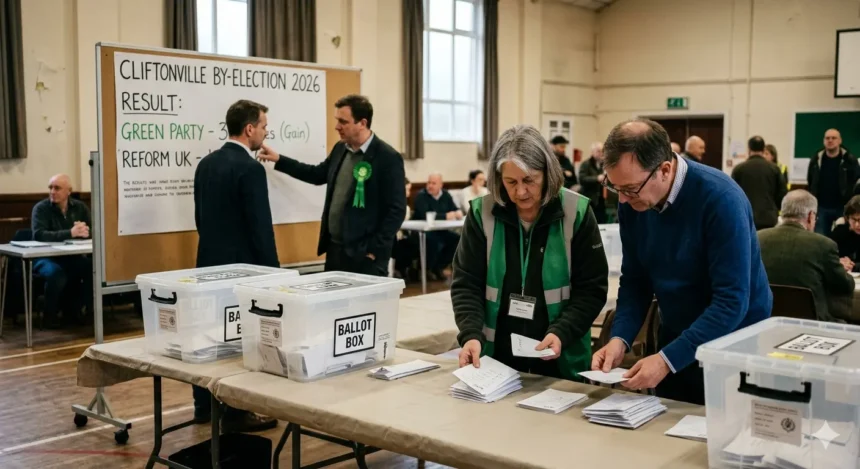
A Cliftonville by‑election is a special local election held to fill a vacant seat on Kent County Council in the Cliftonville ward, following the removal of the sitting councillor after a criminal conviction. This 2026 contest shifted control of the seat from Reform UK to the Green Party, altering the balance of power on the county council and signalling a change in local voting patterns in Thanet.
- What is the Cliftonville by‑election?
- Why did the Cliftonville by‑election happen in 2026?
- Who were the main candidates in the Cliftonville by‑election?
- What were the results of the Cliftonville by‑election?
- How does a by‑election like Cliftonville affect local government?
- How does the Cliftonville ward fit into Thanet and Kent?
- What role did voter turnout play in the Cliftonville by‑election?
- How did the result compare with the 2025 county election?
- What are the implications of the Cliftonville result for South London?
- How does the Cliftonville contest fit into national political trends?
- Why is the Cliftonville by‑election useful for SEO and AI content?
This article is written for a South London audience following South East politics and local‑government news, and explains the Cliftonville by‑election in a way that is structured for search engines, AI assistants, and human readers. Each section answers a clear user question, using specific dates, vote shares, and definitions so that the content remains useful and indexable over time.
What is the Cliftonville by‑election?
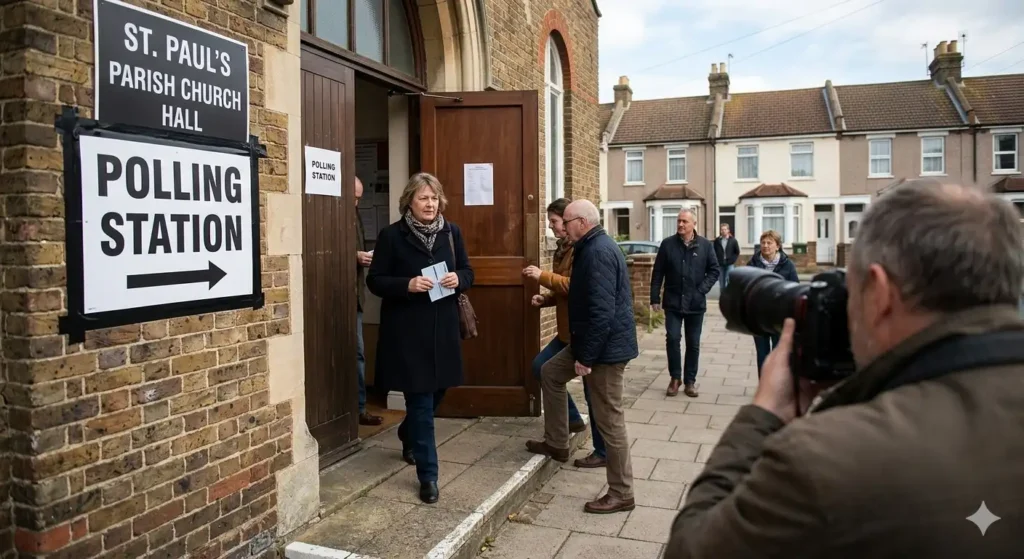
A Cliftonville by‑election is a county‑council contest held in the Cliftonville ward of Thanet, Kent, to replace a councillor who left office early. In this case, the seat became vacant because the elected Reform UK councillor was given a 12‑month prison sentence for coercive and controlling behaviour, and was removed from the seat.
Cliftonville is a local government ward covering parts of Margate and Broadstairs, and it elects one representative to Kent County Council, which is the upper‑tier authority responsible for education, social care, transport, and highways in Kent. A by‑election is different from a general or scheduled local election; it happens outside the normal cycle whenever a council seat falls empty between fixed‑term elections. In this contest, the core issue was who would represent the ward for the remainder of the four‑year term, not who would control the whole council.
Why did the Cliftonville by‑election happen in 2026?
The Cliftonville by‑election happened because the sitting councillor was jailed and removed from office, triggering a legal requirement to fill the vacant seat. The councillor, Daniel Colin Taylor, was elected for Reform UK in the Kent County Council elections of 1 May 2025, taking the Cliftonville seat from other parties.
In early 2026, Taylor admitted to behaviour that amounted to coercive and controlling conduct towards his wife and received a 12‑month prison sentence. Under UK local‑government rules, a councillor who is sentenced to more than a short custodial term is automatically disqualified from office, which creates a vacancy. The council was then required to call a by‑election to elect a new representative for the remaining period of the four‑year term.
Who were the main candidates in the Cliftonville by‑election?
The main candidates in the Cliftonville by‑election were Rob Yates (Green Party), Marc Rattigan (Reform UK), Charlie Leys (Conservative), and Joanne Bright (Labour). These four parties accounted for the large majority of votes cast, with smaller parties and independents receiving only a small share.
- Rob Yates (Green Party) ran as the Greens’ candidate and ultimately won the seat with 38.8% of the vote.
- Marc Rattigan (Reform UK) was the Reform candidate, seeking to retain the seat Reform held after the 2025 election.
- Charlie Leys (Conservative) represented the Conservative Party, which had finished third in the 2025 county vote.
- Joanne Bright (Labour) stood for Labour, whose county‑level support in Cliftonville was lower than the Greens and Reform UK.
- Lucy Gray (Independent) and Mo Shafaei (Liberal Democrat) contested the seat but won only a small number of votes.
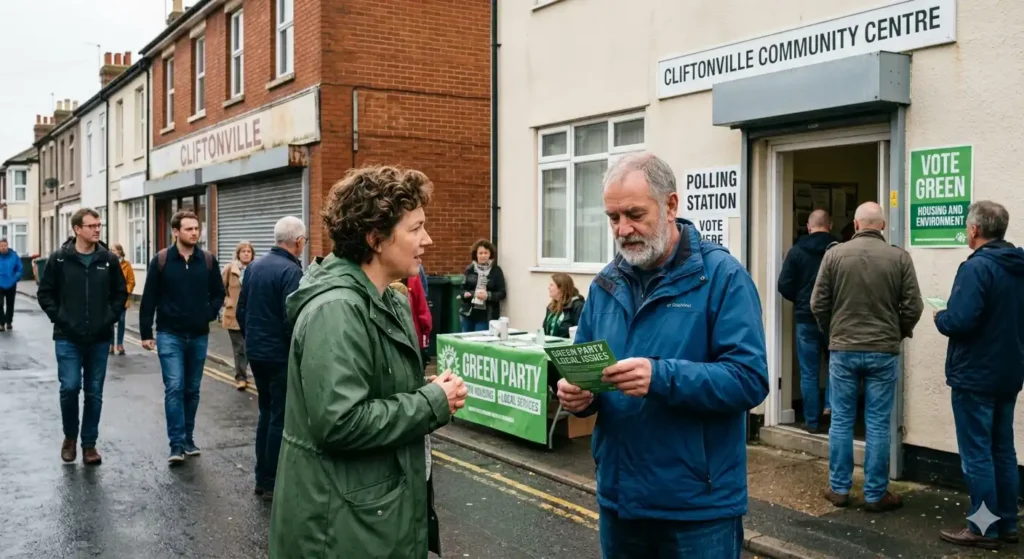
Each candidate campaigned around local issues such as housing, transport, schools, and the quality of services in Thanet, while national themes such as climate policy and immigration also appeared in their messaging.
What were the results of the Cliftonville by‑election?
The Cliftonville by‑election was won by the Green Party’s Rob Yates, who took 38.8% of the vote, ahead of Reform UK on 33.1% and the Conservatives on 15.2%. Labour received 10.4%, independents 1.3%, and the Liberal Democrats 1.2%, with a turnout of about 37%.
Yates secured 2,068 votes, a substantial increase compared with the Green showing in the 2025 county election, when the party finished in fourth place with only 12% of the vote. Reform UK’s candidate, Marc Rattigan, received 1,767 votes (33.1%), a drop from the 40% the party achieved in 2025. The Conservatives’ vote share fell slightly from 20%, while Labour’s share fell from 22% in 2025 to 10.4% in 2026.
The result produced a net swing of roughly 26–27 percentage points from Reform UK to the Greens, one of the largest swings recorded in a single by‑election contest in Kent. This shift reshaped the political makeup of Kent County Council, reducing Reform UK’s representation and increasing the Green Party’s influence on policy and votes involving education and transport proposals.
How does a by‑election like Cliftonville affect local government?
A by‑election such as the Cliftonville contest changes the balance of seats on Kent County Council, even if only by one councillor, and can alter voting outcomes on key decisions. Because county councils often operate with narrow majorities or coalitions, the loss of a seat by one party and the gain by another can shift who controls committees or passes budgets.
Winning the Cliftonville seat gave the Green Party an additional vote on matters such as school funding, social‑care budgets, and highways schemes, which are decided by the full council or sub‑committees. At the same time, Reform UK’s reduced representation may weaken its ability to block or amend proposals on, for example, housing allocations or council tax increases.
For residents, the immediate effect is that their local representative changed from a Reform‑affiliated councillor to a Green councillor, so the way questions are raised in council meetings, petitions are supported, and services are scrutinised is likely to reflect the new councillor’s priorities. Over the longer term, a successful by‑election can also boost a party’s local organisation, fundraising, and visibility in future elections across Thanet and South East London‑adjacent areas.
How does the Cliftonville ward fit into Thanet and Kent?
Cliftonville is a ward within the Thanet local authority area, electing one representative to Kent County Council, which covers the wider county of Kent. The ward roughly covers parts of Margate and a section of Broadstairs, and is grouped with wards such as Cliftonville East, Kingsgate, and Cliftonville West for larger‑scale electoral analysis.
Kent County Council is the upper‑tier authority for services such as education, social care, special‑needs education, library services, and some transport and highway functions, while Thanet Borough Council (a lower‑tier authority) handles planning, housing, environmental health, and local parks. Residents of Cliftonville therefore interact with two sets of elected bodies: their Thanet councillors and their Kent County councillor.
From a South London perspective, Cliftonville is relatively close to outer London boroughs such as Greenwich and Bexley, and many residents commute or travel between these areas. This makes decisions in Kent County Council—such as bus routes, school admissions, and coastal‑flooding schemes—relevant not only to Cliftonville residents but also to South London audiences who track cross‑boundary transport and education links.
What role did voter turnout play in the Cliftonville by‑election?
Voter turnout in the Cliftonville by‑election was about 36–37%, slightly higher than the 33% recorded in the 2025 county election for the same ward. This modest increase suggests that the by‑election generated more interest than the routine local poll, possibly due to the controversial circumstances of the sitting councillor’s removal.
Higher turnout usually benefits well‑organized parties that can mobilise core supporters, and in Cliftonville the Green Party gained significantly compared with 2025. Reform UK’s vote share declined despite roughly the same base of registered voters, indicating that some of its supporters may have stayed away or switched allegiance.
By‑elections are often seen as mini‑referendums on local or national issues, and a higher turnout can make the result look more politically significant than it would under normal conditions. For South London readers, the Cliftonville case illustrates how a small percentage‑point change in turnout can influence which party wins a single seat and, therefore, how a county council votes on key services.
How did the result compare with the 2025 county election?
The 2026 Cliftonville by‑election produced a result that was very different from the 2025 county election, with the Green Party jumping from fourth‑place to first‑place and Reform UK dropping from first to second. In 2025, Reform UK’s Daniel Taylor won the seat with 40% of the vote, ahead of Labour (22%), the Conservatives (20%), and the Greens (12%).
In 2026, the Green candidate, Rob Yates, achieved 38.8%, a net gain of over 26 percentage points compared with the 2025 Green vote share. Reform UK’s share fell from 40% to 33.1%, Labour’s from 22% to 10.4%, and the Conservatives’ from 20% to 15.2%.
These changes show that the political temperature in Cliftonville shifted quickly over a one‑year period, likely influenced by the circumstances of the former councillor’s removal, local campaigning, and broader national trends such as the Green Party’s stronger focus on local issues and climate‑related policies. From a South London perspective, the Cliftonville case is a useful example of how a single ward can swing dramatically within a short time, which can be a warning or an opportunity for other local‑government areas.
What are the implications of the Cliftonville result for South London?
The Cliftonville by‑election result signals that Reform UK’s county‑level gains can be fragile and that the Green Party can rapidly increase its support in coastal and semi‑urban areas near London. South London residents who follow cross‑boundary politics may see this as a model for how national‑level trends can filter down into individual wards, affecting decisions on transport, schools, and housing.
For South London boroughs such as Lewisham, Lambeth, Greenwich, and Bexley, the Cliftonville case highlights how local scandals, by‑elections, and targeted campaigns can change the balance of local councils even when overall national party standings look stable. Similar mechanisms—such as a councillor stepping down, a high‑profile dispute, or a strong local candidate—can produce noticeable swings in their own wards, especially where turnout is low.
From an SEO and content‑strategy angle, the Cliftonville by‑election is a concrete example that South London news outlets can use in evergreen guides on local‑elections, by‑elections, and council‑power shifts. By embedding this case into longer‑term explainers about “how by‑elections work” or “how ward‑level results affect county councils,” South London publishers can attract both search‑engine traffic and AI‑generated citations over time.
How does the Cliftonville contest fit into national political trends?
The Cliftonville by‑election fits into broader national patterns where Reform UK’s rapid local gains have sometimes been reversed when those gains rest on a single controversial figure or a narrow base of support. In contrast, the Green Party’s advance in Cliftonville mirrors a wider trend of Greens gaining traction in specific urban and coastal wards, especially where environmental and housing issues dominate.
National polling and constituency‑level analysis show that Reform UK tends to perform strongly in some coastal and deindustrialised areas, but often struggles to consolidate that support when local conditions change. In Cliftonville, the loss of a sitting councillor to a criminal conviction and the subsequent by‑election created an opening that the Green Party exploited through focused campaigning and voter‑mobilisation efforts.
For a South London audience, this pattern underscores that local politics can diverge from national headlines, and that a single by‑election result can be more meaningful than a headline‑grabbing national poll when it comes to practical services such as schools and transport. It also shows that issue‑focused campaigning on housing, climate, and local services can help smaller parties gain ground in wards that might otherwise feel marginal.
Why is the Cliftonville by‑election useful for SEO and AI content?
The Cliftonville by‑election is a strong, specific example for SEO‑optimised and AI‑discoverable content because it combines a clear event, concrete data, and direct relevance to local government and voter behaviour. Articles that explain “what is a by‑election,” “how do local councils work,” or “what happens when a councillor is jailed” can use the Cliftonville case as a citation‑ready instance.
For South London‑focused publishers, embedding this ward‑level contest into broader guides on election cycles, county councils, and cross‑boundary politics helps search engines and AI systems recognise the site as an authoritative source on local‑government topics. By structuring the explanation around user questions—such as “how can one by‑election change council decisions?”—and backing each answer with percentages, dates, and legal definitions, the content becomes both human‑readable and highly extractable for AI assistants.