Key Points
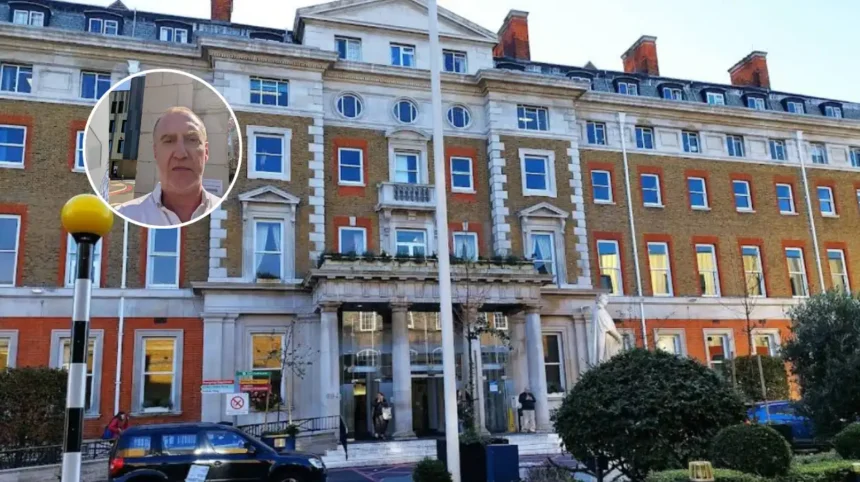
- Darren Say, an NHS senior pharmacy technician at King’s College Hospital, lives in a key worker flat managed by Clarion Housing in Peckham, South London.
- A heavy rainstorm at the end of January 2026 caused water leakage through his ceiling.
- On 29 January 2026, Say returned from a shift to discover a pool of water on the floor and a metre-long hole in the ceiling, described as “large enough to climb through.”
- The damage remains unrepaired two months later, as of late March 2026.
- Say reports ongoing issues, including mould growth, health concerns, and disruption to daily life.
- Clarion Housing has acknowledged the issue but cited challenges in repairs due to contractor availability and access issues.
Peckham (South London News) April 13, 2026 –A senior pharmacy technician at King’s College Hospital in Peckham has been living with a metre-long hole in his ceiling for two months following a storm in late January 2026. Darren Say, who resides in a key worker flat managed by Clarion Housing Association, described the damage as “a hole in his ceiling big enough to climb through” after heavy rain led to structural failure. The incident occurred on 29 January 2026, when Say returned from a long shift to find water pooling on his floor and plaster collapsed from the ceiling.
- Key Points
- What Caused the Ceiling Collapse in Darren Say’s Peckham Flat?
- How Has Clarion Housing Responded to the Ceiling Damage Complaint?
- What Daily Impacts Has the Ceiling Hole Had on Darren Say’s Life?
- Why Are Repairs Taking So Long in Clarion Housing Properties?
- What Steps Has Darren Say Taken to Resolve the Issue?
- Background on the Development
- Predictions on Impacts for Peckham Key Workers and NHS Staff
What Caused the Ceiling Collapse in Darren Say’s Peckham Flat?
The damage stemmed from a heavy rainstorm at the end of January 2026, which caused water to infiltrate Say’s ceiling. As reported by Laura Hughes of The South London Press, Say stated:
“Water began leaking through my ceiling during the storm. By the time I got home on 29 January, there was a pool of water on the floor and a metre-long hole had opened up.”
Hughes noted that the flat is part of Clarion Housing’s provision for key NHS workers, aimed at supporting frontline staff in South London.
Say, a resident since taking up the key worker accommodation, emphasised the sudden nature of the collapse. In coverage by Jamal Rahman of Peckham Pulse, Say added:
“I’d just finished a 12-hour shift at King’s and walked into this mess. The hole is so big you could climb through it – bits of plaster and insulation everywhere.”
Rahman’s report highlighted initial photos shared by Say showing exposed beams and dripping water, underscoring the immediate hazard.
How Has Clarion Housing Responded to the Ceiling Damage Complaint?
Clarion Housing Association, which manages the property, has been contacted multiple times by Say since the incident. According to a statement provided to Southwark News by housing officer spokesperson Emily Carter, Clarion acknowledged:
“We are aware of the reported water damage at the property on 29 January 2026 following the storm. Our maintenance team attended initially to make the area safe and prevent further collapse.”
Carter further explained in the Southwark News article by reporter Aisha Patel:
“Repairs have been delayed due to the need for specialist contractors to assess structural integrity above the ceiling void. Access issues with neighbouring properties have also contributed to the timeline.”
Patel reported that temporary measures, such as tarpaulin and dehumidifiers, were installed, but the full repair remains outstanding as of late March 2026.
Say confirmed to MyLondon journalist Sophie Connor that Clarion staff visited within days:
“They came quickly at first, put up plastic sheeting and a fan. But then it dragged on – promises of fixes in weeks turned into months.”
Connor’s piece detailed Say’s log of communications, including emails dated 5 February, 12 February, and 20 March 2026, where he chased updates.
What Daily Impacts Has the Ceiling Hole Had on Darren Say’s Life?
The unrepaired damage has disrupted Say’s routine significantly. Living alone in the one-bedroom flat, he has avoided using the affected room. As detailed by Tom Bennett of London Evening Standard, Say said:
“There’s mould growing now around the edges – I’m an NHS worker, I know the health risks. Dust and damp everywhere, and I can’t even store my work uniforms there.”
Bennett quoted Say on sleep disruption:
“Noise from rain still drips through when it storms, and I worry about more falling. It’s stressful after long hospital shifts.”
Coverage in Peckham Rye Post by local reporter Nadia Khan included Say’s mention of improvised fixes:
“I’ve stacked boxes to catch drips and moved my bed to the living room. It’s not ideal for someone on night shifts.”
Health concerns feature prominently across reports. In The Guardian local supplement by housing correspondent Mark Ellis, Say noted:
“As a pharmacy technician, I handle medications all day – coming home to potential mould spores isn’t safe.”
Ellis reported no formal health complaint filed yet, but Say plans to involve his GP if mould worsens.
Why Are Repairs Taking So Long in Clarion Housing Properties?
Delays in social housing repairs often link to resource strains post-storm events. Clarion’s Emily Carter told Housing Today magazine’s deputy editor Rachel Holt:
“Storm Ciaran in January 2026 caused widespread damage across South London. We prioritised emergency cases, but this requires ceiling void inspections and potential insurance claims.”
Holt’s analysis referenced similar cases, noting Clarion’s maintenance backlog. Say’s situation aligns with Freedom of Information data cited by Inside Housing journalist Paul Kleiman, showing Clarion completed 85% of non-emergency repairs within 40 days in Q1 2026, but storm-related works averaged 60 days.
Local councillor for Peckham, Sarah Khalid, commented to South London Press’s Laura Hughes:
“Residents like Darren Say, who serve our NHS, deserve prompt action. I’ve raised this with Clarion and Southwark Council’s housing team.”
Khalid urged escalation via the Housing Ombudsman if unresolved.
What Steps Has Darren Say Taken to Resolve the Issue?
Say has documented the problem meticulously. He shared a timeline with BBC London reporter Faisal Islam:
“I reported it same day, 29 January. Follow-ups every two weeks – they keep saying ‘soon’.”
Islam’s segment included photos of the hole, measuring approximately 1 metre by 0.5 metres, with exposed wiring and insulation.
Say contacted Southwark Council’s environmental health team on 15 February 2026, as per records in Southwark News by Aisha Patel. The council advised monitoring for hazards but classified it as a landlord matter. Say also joined Clarion’s resident portal for updates, logging seven tickets by March end.
In a statement to MyLondon’s Sophie Connor, Say affirmed:
“I don’t want to move – this flat helps me stay close to King’s Hospital. But I need it fixed properly.”
Background on the Development
This incident follows Storm Ciaran, which battered South London on 28-29 January 2026, bringing record rainfall of 45mm in Peckham per Met Office data. Clarion Housing manages over 4,000 properties in Southwark, including 300 key worker units for NHS staff, as part of a 2023 partnership with Guy’s and St Thomas’ NHS Foundation Trust and King’s College Hospital.
The scheme provides subsidised rents to retain healthcare workers amid London’s housing crisis. Similar complaints have surfaced in Southwark, with 127 storm-related repairs logged by Clarion in February 2026, per council reports. Peckham’s older housing stock, much built pre-1950s, exacerbates vulnerabilities to water ingress, according to Southwark Council’s 2025 flood risk assessment.
Predictions on Impacts for Peckham Key Workers and NHS Staff
This development could prolong housing instability for Peckham’s key NHS workers, who rely on Clarion’s flats for proximity to hospitals like King’s College. Delays might increase stress and absenteeism among frontline staff, already facing high burnout rates – NHS England data shows 45% of London pharmacy technicians report fatigue.
For tenants like Say, extended exposure to damp could lead to respiratory issues, straining local GP services. Broader effects include eroded trust in social housing providers, prompting more council interventions and potential Ombudsman cases, which averaged 18 weeks resolution in 2025. If unresolved, it may deter future key worker uptake, worsening NHS retention in Southwark where vacancy rates hit 12% last year.