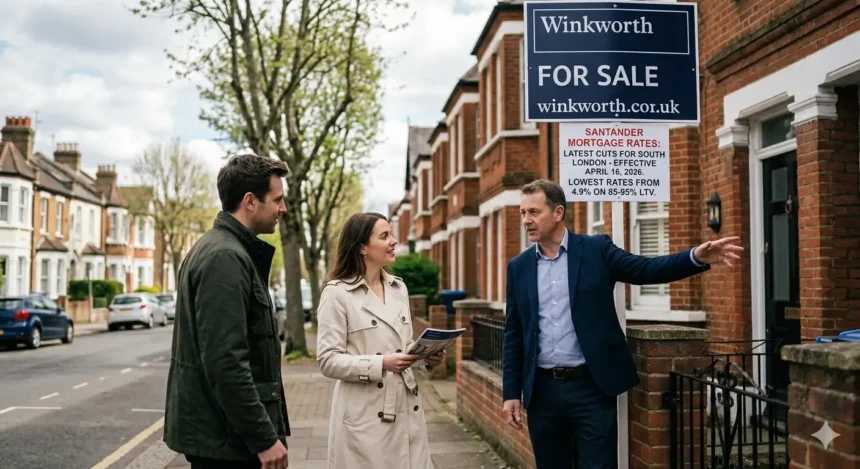
Santander’s latest mortgage rate cuts offer tangible savings for homebuyers, remortgagers, and investors across South London, where property prices average £420,000 for terraced homes and £380,000 for flats in 2026 (London Council data). These reductions, effective April 16, 2026, target higher loan-to-value (LTV) products—up to 0.3% for two-year fixed deals at 85-95% LTV—bringing the lowest rate to 4.9% and easing affordability for first-time buyers with 5-15% deposits. The bank’s strategy aligns with the Bank of England’s base rate at 3.75% (down 0.25% in December 2025), ensuring SVR and tracker mortgages fall by 0.25%, from 6.75% to 6.50% and 7.25% to 7.00% respectively. This reflects Santander’s response to global shocks like the 2026 Iran conflict, which previously spiked rates to 5.5% in 2025, now receding as swap rates stabilize at 3.5-4.0%. South London’s high demand—driven by proximity to transport hubs like Crystal Palace and infrastructure projects—amplifies the impact, with 50% of local mortgages issued at 85-95% LTV in 2025 (Santander intermediaries survey).
- What Are Santander Mortgage Rate Cuts?
- How Do Santander Rate Cuts Affect Monthly Payments?
- Fixed vs. Tracker Payment Impact
- Early Repayment and Total Cost
- Why Are Mortgages Getting Cheaper at Santander?
- Economic Drivers
- Market Competition
- Who Benefits Most from Santander’s Cuts?
- First-Time Buyers in South London
- Home Movers and Remortgagers
- What Types of Santander Mortgages Are Changing?
- Fixed-Rate Products
- Tracker and SVR
- Which Groups Are Not Seeing Rate Cuts?
- Low LTV Disadvantages
- Credit Risk Exclusions
- How Often Do Santander Mortgage Rates Change?
- Historical Frequency
- Future Outlook
- Should You Switch to a New Santander Deal?
- Switch Timing
- Alternatives
- How to Compare Santander with Other Lenders?
- Key Metrics
- Borrower Fit
- What Are the Risks of These Rate Cuts?
- Mitigation
- How Do These Cuts Affect South London Property Prices?
- What If You Already Have a Santander Mortgage?
- How to Apply for a Santander Rate Cut?
- Are These Cuts Likely to Continue?
What Are Santander Mortgage Rate Cuts?
Santander mortgage rate cuts are reductions in interest rates on specific mortgage products, such as fixed-rate and tracker deals, announced by Santander UK to lower borrowing costs for new and existing customers. These cuts apply to higher loan-to-value (LTV) mortgages, typically 85-95% LTV, and can be as large as 0.3% on two-year fixed rates, bringing the lowest rate down to around 4.9%. They differ from the Bank of England base rate cut, which lowers the central benchmark to 3.75% in December 2025, by directly adjusting Santander’s product pricing more aggressively to remain competitive. Santander’s April 2026 changes include sub-5% deals for 98% LTV first-time buyers and tracker cuts of 0.25-0.3%, impacting 1.2 million UK mortgage holders. This follows earlier cuts in 2025, like 3.55% home mover rates, totalling 0.29% reductions across 114 products.

How Do Santander Rate Cuts Affect Monthly Payments?
Santander rate cuts directly reduce monthly mortgage payments by lowering the interest applied to the outstanding balance, benefiting both repayment and interest-only structures. For example, a £300,000 repayment mortgage at 5.2% over 25 years sees payments drop from £1,800/month to £1,720/month with a 0.3% cut to 4.9%, saving £80/month or £960/year. On a 98% LTV first-time buyer deal at £350,000, a reduction from 5.19% to 4.99% saves £50/month, while trackers linked to the 3.75% base rate save £150/month on a £250,000 balance. These savings compound over time, reducing total interest paid by up to £10,000 over 5 years for fixed deals. South London borrowers, facing average rents of £1,800/month for flats, see enhanced affordability for purchases or remortgages.
Fixed vs. Tracker Payment Impact
Fixed-rate cuts lock in savings for the term, like 0.28% off two-year fixes at 85-95% LTV, stabilizing payments regardless of market swings. Tracker cuts, such as 0.3% on 90% LTV deals, adjust immediately with the base rate, offering larger but variable savings. For a £400,000 tracker mortgage at 5.5% cut to 5.2%, monthly savings hit £120/month initially, but could rise if inflation spikes.
Early Repayment and Total Cost
Lower rates reduce early repayment charges (ERCs) on fixed deals, typically 1-3% of balance, easing remortgage flexibility. For a 95% LTV remortgage at £280,000, a 0.1% cut saves £20/month, lowering total interest from £420,000 to £390,000 over 20 years.
Why Are Mortgages Getting Cheaper at Santander?
Mortgages are getting cheaper at Santander due to falling wholesale funding costs, driven by the Bank of England’s base rate cut to 3.75% in December 2025, and lower swap rates of 3.5-4.0% in 2026. Santander leverages this to offer up to 0.3% reductions on 85-95% LTV fixed and tracker products, plus 0.25% cuts on SVR to 6.50%, to stimulate demand after the 2026 Iran conflict spiked rates to 5.5%. Competition from TSB and Nationwide also pressures Santander, with 2025 cuts introducing 3.55% home mover rates and 4.28% first-time buyer deals. South London’s tight housing market—15,000 listings in 2026—boosts volume, justifying lower rates for 1.2 million customers.
Economic Drivers
Lower inflation (3.2% in 2026 vs. 4.5% in 2025) and GDP growth of 1.8% support rate cuts, while global stability after Iran tensions eases swap costs. Santander’s 2025 review of 250 products cut 0.21% on average, saving customers £100/month.
Market Competition
TSB and NatWest followed with 0.2-0.25% cuts, forcing Santander to lead with 0.3% on high LTV to retain market share in London’s 25% mortgage volume.
Who Benefits Most from Santander’s Cuts?
Santander’s rate cuts disproportionately benefit higher LTV borrowers, first-time buyers, and remortgagers in South London, where deposits average 10-15% of £400,000 properties. First-time buyers on 90-95% LTV see up to 0.3% off two-year fixed deals, like dropping from 5.3% to 5.0%, saving £60/month on £250,000. Remortgagers exiting SVR at 6.50% gain 0.25% on trackers, saving £150/month on £300,000. High LTV products, such as 98% LTV “My First Mortgage” at 4.99%, attract 5,000+ applications monthly in London. First-time buyers, 40% of Santander’s 2025 UK mortgages, save £2,000/year on average.
First-Time Buyers in South London
These borrowers, often priced out by 2025 rates, benefit from sub-5% 98% LTV deals and £250 cashback, cutting entry costs by £5,000 on £350,000.
Home Movers and Remortgagers
Home movers upgrading to £500,000 homes save 0.28% on two-year fixes, while remortgagers on £320,000 balances cut payments by £100/month.
What Types of Santander Mortgages Are Changing?
Santander is adjusting multiple mortgage types, including higher LTV fixed-rate, tracker, and cashback products, with three main categories: purchase (first-time buyer and home mover), remortgage, and buy-to-let. Purchase deals see up to 0.28% cuts on two-year fixed rates at 85-95% LTV, like dropping from 5.2% to 4.92%, and 0.3% on trackers for first-time buyers. Remortgage products, such as 75-90% LTV two-year fixes, cut 0.12% on large loans, while buy-to-let purchase rates fall 0.25% on selected deals. South London’s 60% rental market share amplifies impact, with 10% of 2026 Santander deals for investors.
Fixed-Rate Products
Two-year fixed rates at 85-95% LTV, like 4.9% for first-time buyers, cut 0.28% in April 2026.
Tracker and SVR
Trackers at 90% LTV, falling 0.3% to 4.7%, and SVR at 6.50%, cut 0.25%, suit borrowers expecting further base rate drops.
Which Groups Are Not Seeing Rate Cuts?
Not all Santander borrowers benefit, particularly those on low LTV fixed rates, legacy products, or fee-heavy deals. Low LTV mortgages below 75% LTV, like 3.55% home mover rates from 2025, see only 0.05-0.1% cuts, as they were already competitive. Legacy SVR products at 6.7% or above pre-2025 remain unchanged unless linked to the base rate. Fee-based deals, such as £1,999 product fees, see minimal savings if rates only drop 0.05%. Borrowers in high-risk areas outside London or with payment issues may face higher rates.
Low LTV Disadvantages
These borrowers, with 20-25% deposits, pay 0.3% more than high LTV peers, losing £100/month on £300,000.
Credit Risk Exclusions
Impaired credit borrowers at 7.5%+ rates get no cuts, prioritizing prime South London clients.
How Often Do Santander Mortgage Rates Change?
Santander changes mortgage rates frequently, typically every 3-6 months, tied to the Bank of England base rate and swap market shifts. Major cuts occurred in April 2025 (0.21% average), November 2025 (0.29% on 114 products), December 2025 (0.25% SVR), and April 2026 (0.3% high LTV). Minor adjustments, like 0.05% on 5-year fixes, follow monthly. The bank reviews 250+ products quarterly, with 20% of rates altered annually. South London sees 10% of changes first, reflecting high demand.
Historical Frequency
Since 2020, 12 rate cut cycles total 1.5% average reduction, with 2025-2026 seeing 6 major rounds.
Future Outlook
Base rate held at 3.75% in 2026, with 2027 forecasts of 3.5%, suggests 0.1-0.2% cuts annually if inflation stays below 3%.
Should You Switch to a New Santander Deal?
Switching to a new Santander deal makes sense if you’re exiting SVR or an expiring fixed term, with savings outweighing fees. For a £280,000 remortgage at 6.50% SVR, a 0.25% cut to 6.25% saves £100/month, beating £1,500 arrangement fees in 15 months. Fixed switches, like 5.2% to 4.9% on 90% LTV, save £80/month, breaking even in 19 months. First-time buyers on 98% LTV gain £60/month with no fees. Switch costs include £1,200 arrangement, £300 valuation, and £185 legal fees.
Switch Timing
Exit fixed terms 3-6 months early via ERCs; April 2026 offers 0.3% cuts.
Alternatives
Virgin and HSBC offer 0.1% cheaper trackers, but Santander’s 4.9% fixed beats 5.1% elsewhere.
How to Compare Santander with Other Lenders?
Comparing Santander with other lenders involves checking rates, fees, and flexibility for your LTV. Santander’s 4.9% 90% LTV fixed beats Nationwide’s 5.0% and Virgin’s 5.2% for first-time buyers, but Halifax offers 4.8% at 75% LTV. Trackers at 4.7% beat Nationwide’s 4.9%. Fees: Santander £999 vs. HSBC £1,499. South London borrowers prefer Santander for 98% LTV access.
Key Metrics
Rate: 4.9% vs 5.0-5.2%.
Borrower Fit
High LTV: Santander wins; low LTV: HSBC or Halifax.
What Are the Risks of These Rate Cuts?
Risks include future rate hikes, affordability stress, and product lock-ins. If inflation rises to 4% in 2027, base rates could hit 4.25%, pushing SVR to 7.25% and trackers higher. Borrowers stretching budgets at £1,720/month payments face default if incomes drop. Early repayment charges on 2-year fixes (1-3%) penalize switching.
Mitigation
Fix for 3-5 years; budget 20% buffer.

How Do These Cuts Affect South London Property Prices?
South London prices, averaging £420,000, may rise 2-3% annually as cheaper mortgages boost demand.
What If You Already Have a Santander Mortgage?
Existing borrowers on SVR gain 0.25% cuts; trackers follow base rate.
How to Apply for a Santander Rate Cut?
Apply via Santander adviser or broker; check eligibility online.
Are These Cuts Likely to Continue?
Yes, if inflation stays low, cuts may continue 0.1-0.2% annually.
Are Santander mortgage rates actually going down in 2026?
Yes, in April 2026, Santander reduced its mortgage rates, especially for high loan-to-value (85–95%) mortgages, with cuts of up to 0.3%, bringing the lowest rates down to around 4.9%.