
If you live in South London and are affected by a barking dog in Bromley, the Bromley noise diary is a key evidence‑gathering tool used by Bromley Council’s Environmental Health team. This diary helps you record the frequency, timing, and impact of excessive barking so the council can decide whether the noise amounts to a statutory nuisance under the Environmental Protection Act 1990.
- What is the Bromley noise diary for barking dog reports?
- Why is the Bromley noise diary important in South London?
- How do you get the Bromley noise diary?
- What time period should you cover in the diary?
- What information should you record in each entry?
- How specific and consistent should your entries be?
- How does the diary help Bromley Council decide if it is a statutory nuisance?
- What should you avoid putting in the Bromley noise diary?
- How do you submit the completed Bromley noise diary?
- How long does Bromley Council take to act after receiving the diary?
- How can South London residents improve their chances of success?
- How does the Bromley noise diary fit into broader South London noise policy?
- When should you consider additional help beyond the Bromley diary?
This article explains, in plain language, how to use the Bromley noise diary for barking dog reports, what the council expects, how long you must keep it, and how it fits into the wider process of making a noise complaint in South London.
What is the Bromley noise diary for barking dog reports?
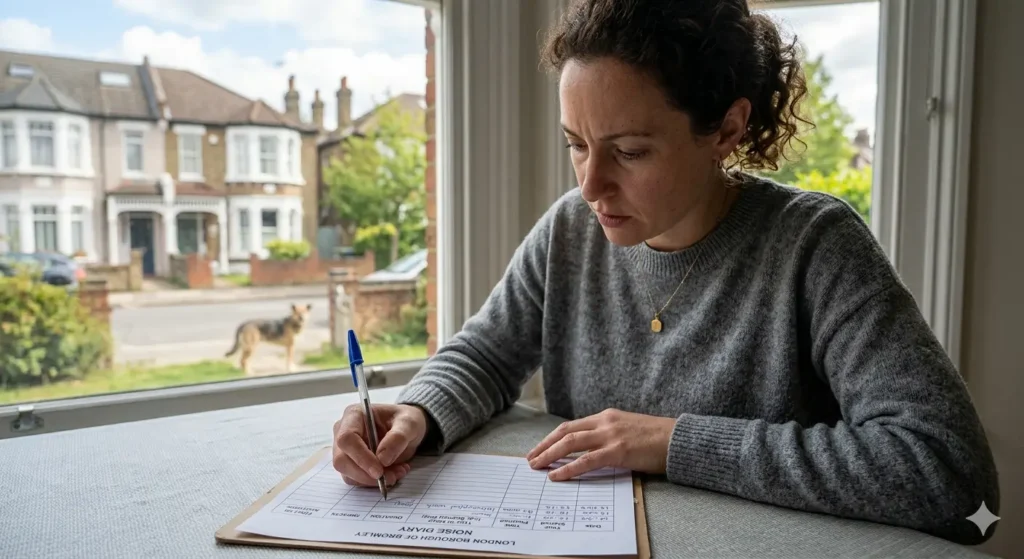
The Bromley noise diary is a structured log sheet or form issued by the London Borough of Bromley for residents affected by dog barking and other noise nuisances. It is designed to capture objective data about when barking occurs, how long it lasts, and how it affects you, so environmental health officers can assess whether the noise is unreasonable and persistent.
In practice, the diary is a day‑by‑day or week‑by‑week record where you note the date, time, duration of barking, type of noise, and any impact on your sleep, work, or daily life. South London residents often receive this form after contacting Bromley Council’s noise or environmental health team and reporting an ongoing dog‑barking problem.
Key features of the Bromley noise diary include:
- A grid or table format with time slots (e.g., morning, afternoon, evening, night).
- Space to record multiple incidents per day, not just “yes/no” entries.
- Prompts to note whether the noise keeps you awake, disturbs daytime activities, or affects your health or wellbeing.
Because Bromley deals with around 4,000 noise complaints per year, the council relies heavily on completed diaries and log sheets before deciding whether to take formal action, such as issuing an abatement notice to the dog owner.
Why is the Bromley noise diary important in South London?
The Bromley noise diary matters because it turns a subjective feeling of disturbance into measurable, time‑stamped evidence that local authorities can review. Under the Environmental Protection Act 1990, a noise only becomes a statutory nuisance if it is “unreasonable” and “substantially and unreasonably” interferes with the use or enjoyment of your home.
In South London, where housing is often close‑knit and many properties share party walls or back onto shared gardens, barking can easily cross into neighbouring homes. A properly completed diary helps officers:
- Confirm that barking is frequent rather than occasional.
- Identify patterns (for example, early‑morning or late‑night barking).
- Decide whether informal advice to the dog owner is enough, or whether formal enforcement is needed.
For residents, the diary also serves as a record in case you later need to refer to timing, dates, or escalation patterns when speaking to Bromley Council, South London police, or community‑safety services.
How do you get the Bromley noise diary?
Residents in South London typically receive the Bromley noise diary after reporting a dog‑barking issue to Bromley Council’s Environmental Health or Noise team. You can initiate this by phoning the council’s noise line, using the online reporting form, or emailing the environmental‑health team.
Once you report the barking, the council may:
- Ask you to keep a “log sheet” or “noise diary” for a set period (often 1–2 weeks).
- Either send you a printable PDF or direct you to a form you can complete online.
- In some cases, advise you to download a generic noise‑diary template from the Bromley Council website if a specific dog‑barking form is not available.
Residents in wards such as Shortlands, Beckenham, Bromley North, and nearby South London areas often report that the council emails or posts the diary form shortly after the initial complaint. If you do not receive a form, you can ask by phone or email for the “barking dog noise diary” or “noise log sheet” used by Bromley Environmental Health.
What time period should you cover in the diary?
Bromley Council usually expects residents to keep the noise diary for at least one continuous week, and sometimes up to two weeks. The goal is to capture a full weekly cycle, including weekdays and weekends, because barking can change with people’s routines.
For example, a dog may bark more:
- During the weekdays when the owner is away.
- On weekends when visitors or children are in the house.
- Early in the morning or late at night due to exercise or arrivals/departures.
Environmental health officers look for repeated patterns across several days rather than a single bad night. In practice, many South London residents are advised to start the diary from the day the council says they can begin recording, and then submit it within 7–14 days unless otherwise instructed.
If you experience a particularly severe incident (for instance, several hours of continuous barking), you should still record it even if it falls outside the usual diary window, and mention this when you submit your log.
What information should you record in each entry?
Each entry in the Bromley noise diary should include specific factual details rather than general comments. The council looks for clear, repeatable data that can be compared across days.
For every barking incident, record:
- Date and precise time the barking starts and, if possible, stops.
- Approximate duration (for example, 10 minutes, 45 minutes, intermittent over 2 hours).
- Type of barking (e.g., short sharp barks, continuous barking, howling, sporadic alerts).
- What you think triggers it (e.g., post arriving, someone passing the garden, deliveries, people leaving for work).
You should also note:
- How the noise affects you (for example, you cannot fall asleep, you are woken up, you cannot concentrate on work, your child is disturbed).
- Where you are in your home when you hear it (e.g., bedroom, living room, garden).
- Any other noises happening at the same time (traffic, neighbours, workmen), to help officers distinguish between different sources.
South London residents are encouraged to keep the diary as objective as possible, avoiding emotional language or accusations, and instead focusing on measurable facts that support the “substantial and unreasonable” test under the Environmental Protection Act 1990.
How specific and consistent should your entries be?
Bromley Council wants the diary entries to be as consistent and specific as you can reasonably make them. This means using the same format each time (for example, always writing “08:15–08:30”) rather than mixing “8.15 this morning” with “about quarter past eight.”
Consistency helps officers:
- Spot patterns such as barking every morning between 07:30 and 08:30.
- Compare different days to see if the problem is worsening or improving.
You should also:
- Record even short bursts of barking, not just long episodes.
- Note when no barking occurs, to show that the diary is an honest record rather than selective reporting.
If you are unsure whether to record a brief bark, it is better to include it and make a small note that it was minor. Over time, numerous small incidents can still amount to a significant disturbance.
How does the diary help Bromley Council decide if it is a statutory nuisance?
The Bromley noise diary is one of several tools used to decide whether dog barking is a statutory nuisance under the Environmental Protection Act 1990. Officers combine the diary with other evidence, such as:
- Your initial complaint and any follow‑up statements.
- Possible monitoring visits by environmental health officers.
- Any recordings or digital evidence you provide (for example, phone recordings or data from noise‑tracking apps).
The diary helps officers judge:
- Whether the barking is frequent and prolonged enough to be more than a minor annoyance.
- The times of day when it is most disruptive (for example, 07:00–08:00 and 22:00–23:00).
- How it affects your ability to sleep, work from home, care for children, or use your home normally.
If the council concludes that the barking is a statutory nuisance, they can issue an abatement notice to the dog owner. Under this notice, the owner must stop or reduce the barking; failure to comply can lead to unlimited fines.
What should you avoid putting in the Bromley noise diary?
When completing the Bromley noise diary, you should avoid:
- Personal attacks or offensive language about the dog owner.
- Speculation or assumptions about the owner’s behaviour beyond what you can reasonably observe.
- Inconsistent or approximate timings that make patterns hard to identify.
You should also not:
- Invent entries or exaggerate durations beyond what you actually hear.
- Mix unrelated issues (for example, general neighbour disputes unrelated to noise).
The diary is a formal record used by council officers, and in some circumstances it may be reviewed or referred to in enforcement or legal processes. Keeping it factual, neutral, and focused on timing and impact helps strengthen your case and avoids undermining your credibility.
How do you submit the completed Bromley noise diary?
Once you have finished the required period of recording, you submit the Bromley noise diary to the council’s Environmental Health or Noise team. Submission methods typically include:
- Uploading it via the online noise or barking‑dog report form.
- Emailing it to the environmental‑health inbox provided when your complaint was logged.
- In some cases, posting or handing it in at a council office, if you are specifically asked to do so.
When you submit it, you should:
- Include your name, address, contact details, and the reference number for your complaint (if you were given one).
- Add a brief cover note explaining any unusual incidents, such as a night of very prolonged barking, or days when the dog was absent but you still recorded relevant details.
South London residents often report that the council acknowledges receipt within a few working days and may then contact you to confirm whether further monitoring or enforcement action will be taken.
How long does Bromley Council take to act after receiving the diary?
Bromley Council does not publish a fixed statutory timescale for barking‑dog complaints, but noise issues are usually handled within weeks rather than months, depending on workload and severity. Officers may:
- Review your diary and any other evidence.
- Contact the dog owner to offer informal advice (for example, training or behaviour‑management tips).
- In more serious cases, arrange monitoring visits or install recording equipment in your home to gather independent evidence.
If the council determines that the barking is a statutory nuisance, they can issue an abatement notice under the Environmental Protection Act 1990. The notice may:
- Require the owner to change the dog’s routine or environment.
- Specify times when barking must be reduced below a certain level.
Non‑compliance with an abatement notice can lead to prosecution and an unlimited fine.
How can South London residents improve their chances of success?
South London residents can improve their chances of a successful outcome by:
- Reporting the barking early, rather than waiting months, so the council can act before the pattern becomes entrenched.
- Completing the Bromley noise diary as requested, for the full period and with consistent factual detail.
- Keeping copies of the diary and any emails or letters from the council in case the issue recurs or escalates.
Additional helpful steps include:
- Speaking politely to the dog owner first, if safe, to see if they will address the issue voluntarily.
- Noting in the diary if you have already tried to resolve the matter informally.
- Contacting local police or community‑safety services if the barking is linked to wider antisocial behaviour (for example, dogs used to intimidate neighbours).
Residents in areas such as Shortlands, Beckenham, Bromley North, and nearby South London neighbourhoods often find that combining a solid noise diary with cooperative communication gives the best long‑term outcome.
How does the Bromley noise diary fit into broader South London noise policy?
The Bromley noise diary is part of a wider london‑wide approach to managing noise pollution and residential nuisance. The Mayor’s Ambient Noise Strategy and Bromley’s own local‑noise policies emphasise prevention, early intervention, and evidence‑based enforcement.
In this context, the diary helps Bromley Council:
- Target resources where noise is persistent and demonstrably harmful.
- Avoid unnecessary enforcement where barking is occasional or improving.
- Support residents with clear guidance on how to document and report problems.
For South London residents, using the Bromley noise diary correctly means you are following the recommended process set out by local and regional authorities, which increases the likelihood that your complaint will be taken seriously and resolved efficiently.

When should you consider additional help beyond the Bromley diary?
If the Bromley noise diary does not lead to improvement, or if the barking is extremely severe, South London residents may need further steps. These can include:
- Requesting a home visit or monitoring visit from environmental health.
- Seeking advice from local residents’ associations or neighbourhood forums, which often share templates and experiences on how to strengthen noise complaints.
- In rare cases, pursuing legal advice or community‑mediation services if the conflict with the neighbour is serious.
If you ever feel physically threatened by a dog or its owner, you should contact Bromley Council’s anti‑social‑behaviour team or the police on 101, and in an emergency dial 999.
By using the Bromley noise diary as part of a structured, evidence‑based approach, South London residents can protect their right to a reasonably quiet home while giving local authorities the information they need to act fairly and effectively.
How do I report a barking dog to Bromley Council?
You can report it through the council’s online form, email, or noise complaint line. After that, they usually ask you to complete a noise diary.