Reporting dangerous street lighting to Lambeth Council means using the council’s street light fault reporting process when a lamp is out, flickering, damaged, knocked down, or left on during the day. Lambeth says it handles these reports and arranges repairs, with a target to complete repairs within five working days for the issues it manages.
- What counts as dangerous street lighting in Lambeth?
- Which street light problems should you report?
- How do you report a faulty street light to Lambeth Council?
- What details should your report include?
- What happens after you report it?
- Who is responsible for the light?
- Why does street lighting matter for safety?
- What evidence helps a report?
- What if the fault is urgent?
- How does this fit Lambeth’s wider reporting system?
- Why this matters for South London residents
- South London reporting guidance
What counts as dangerous street lighting in Lambeth?
Dangerous street lighting includes any fault that creates poor visibility or physical risk, such as a street light that is out, flickering, damaged, knocked down, or on during the day. In Lambeth, these faults are treated as reportable highway issues and should be sent through the council’s street lighting process.
A faulty street light is not only an inconvenience. It affects visibility for drivers, cyclists, and pedestrians, especially near crossings, junctions, bus stops, and narrow residential streets. Lambeth’s reporting categories for streetlights include a light that is out, a damaged column, flickering, a knock-down, a light on during the day, and a light that does not come on at night.
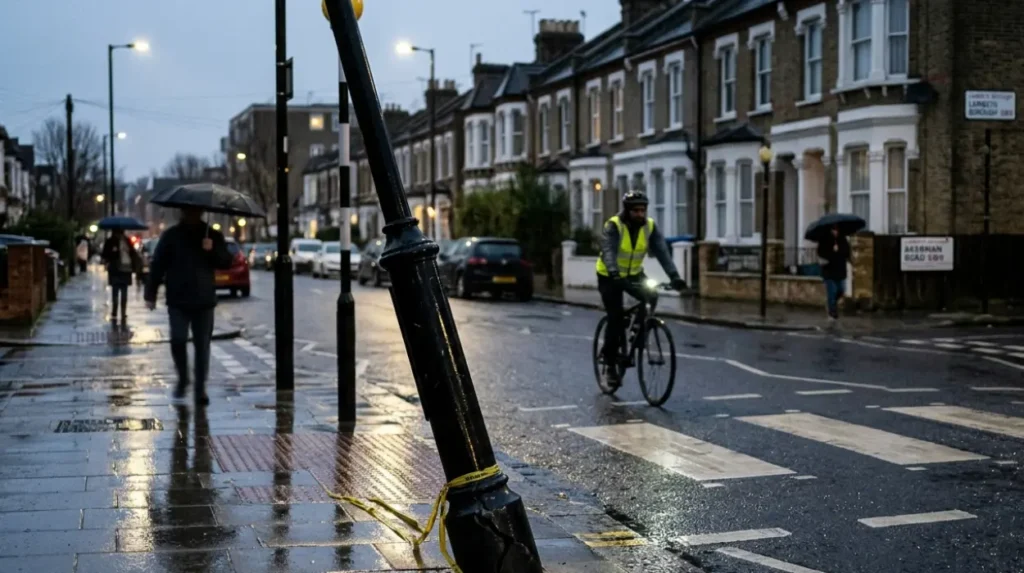
This matters because street lighting supports road safety, personal safety, and navigation after dark. A broken or unstable lamp post also raises a direct physical hazard if the structure is leaning, damaged, or exposed after a collision.
Which street light problems should you report?
Report any street light fault that affects safety, visibility, or the condition of the lamp post itself. Lambeth lists the main reportable faults as a section of light that is out, damaged equipment, flickering, knock-down damage, daylight operation, and lights that fail to switch on at night.
Common examples include:
- A lamp post outside a home or shop that is completely dark at night.
- A light that flickers on and off and leaves the street patchily lit.
- A pole that has been hit by a vehicle and is leaning.
- A broken cover or exposed electrical component.
- A light that stays on in daylight, which signals a control or sensor fault.
Lambeth also notes that its operative teams check for missing or damaged equipment, misaligned lanterns, trees or bushes blocking light, graffiti, leaning apparatus, and other damage that affects operation or safety. These details show that the council’s concern is not only whether a lamp works, but whether the asset is safe and functioning as intended.
How do you report a faulty street light to Lambeth Council?
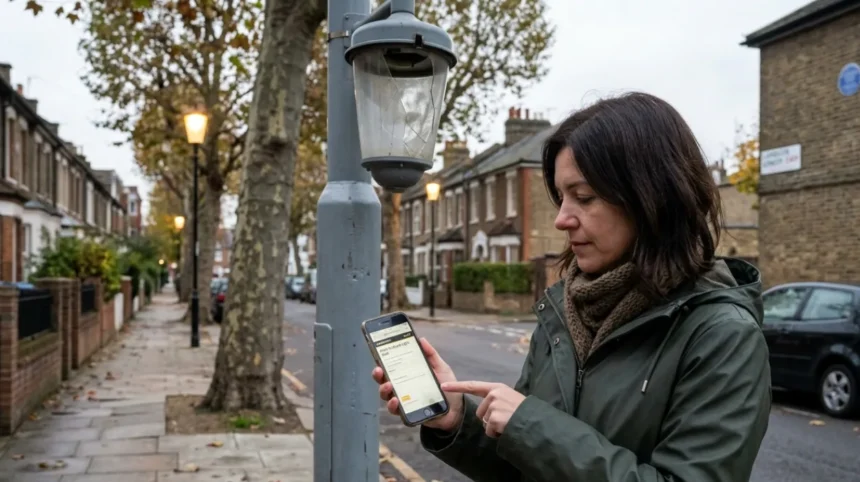
Use Lambeth Council’s online street lighting fault reporting route and provide the location details, including the street name and the exact lamp post position if possible. Lambeth’s system is designed for public highway lighting faults, and the council says it will arrange repairs after a report is submitted.
The best report includes:
- The street name.
- The exact location, such as “opposite 14 X Road.”
- The type of fault.
- The asset number if visible on the lamp post.
- A clear note if the lamp is damaged, flickering, or out completely.
Precise location details speed up the repair process. Councils and contractors rely on exact asset identification because a single road can contain many lamp posts, crossings, and lighting points. If you include a nearby building, junction, park entrance, or bus stop, the fault is easier to find and log correctly.
What details should your report include?
Your report should identify the exact asset, describe the fault clearly, and explain whether the problem creates a safety risk. Lambeth and nearby London councils use location, type of light, and asset number as the core information for handling street lighting repairs efficiently.
Include these details in your report:
- Street name and landmark.
- Lamp post number, if shown.
- Fault type, such as out, flickering, damaged, or knocked down.
- Whether the issue is on a public road, public park, or estate road.
- Whether the light is causing a dark patch at a crossing, junction, or footpath.
This information reduces delays. A report that says “streetlight broken” is less useful than “lamp post opposite 22 Coldharbour Lane, light out, dark area near crossing.” The second version tells the council exactly what to inspect and where to send a repair crew.
What happens after you report it?
Lambeth says it records street lighting faults and arranges repairs, with a stated aim of completing repairs within five working days for the issues it manages. The repair timeline changes if the fault involves underground cables, damaged infrastructure, or a location the council does not control.
After a report, the fault enters a maintenance workflow. The asset is checked, logged, and assigned for repair if it falls under the council’s responsibility. If the issue is straightforward, such as a failed lantern or damaged cover, it usually moves faster than a full electrical or structural fault.
Underground cable faults take longer because crews need to locate, test, and isolate the problem before repair work starts. In practice, that means a visible lamp fault and a network fault do not follow the same timeline.
Who is responsible for the light?
Lambeth Council handles many public highway street lights, but not every light in the borough belongs to the council. Lambeth says it does not deal with lighting on private roads, Red Routes, or some housing estate lights, which need to be redirected to the correct owner or authority.
This distinction is essential. A lamp post on a private road is normally the responsibility of the freeholder or property owner. Lighting on a Lambeth Housing estate is redirected because it sits outside the standard highway reporting route.
Red Routes are managed separately by Transport for London, not the borough council. That means the first step in any report is ownership check. If the light sits beside a trunk route or a managed estate boundary, the report may need to go to a different authority before anything is fixed.
Why does street lighting matter for safety?
Street lighting lowers the risk of collisions, improves pedestrian visibility, and helps people feel safer after dark. A faulty light creates darker road sections, less visibility at crossings, and a stronger risk of trips, vehicle conflicts, and missed hazards.
In South London streets, lighting plays a practical role in everyday movement. It supports evening commuting, school travel in winter months, late bus use, and walking between residential roads and local high streets. A single broken lamp can affect an entire stretch if nearby lighting is sparse.
Safety problems are greatest where a fault meets traffic or foot traffic pressure. A dark corner near a junction, alley, zebra crossing, park path, or bus stop creates a clearer risk than a fault in a brightly lit retail strip. That is why councils treat these faults as highway issues rather than minor maintenance tasks.
What evidence helps a report?
A clear photo, an exact location, and the lamp post asset number help the council identify the fault faster. These details support accurate logging and reduce the chance of the report being assigned to the wrong street or the wrong asset.
A good report can include:
- A daytime photo showing the lamp post and surrounding street.
- A night photo showing the dark area, if safe to take.
- The nearest property number or landmark.
- The asset sticker or number on the pole.
- A note about whether the light is completely off, flickering, or damaged.
The asset number is especially useful because councils often track street lights as individual assets in maintenance systems. That makes the repair process more exact and reduces repeat visits.
What if the fault is urgent?
If the street lighting fault creates immediate danger, such as a knocked-down pole, exposed equipment, or a severe road safety hazard, report it as an urgent safety issue and do not treat it as routine maintenance. Lambeth includes street light knock-downs and damaged columns among reportable faults.
Urgent cases include:
- A pole hit by a vehicle.
- A hanging or unstable lamp head.
- Exposed electrical parts.
- A street light that has completely failed at a dangerous crossing.
- Damage near a school route, busy road, or blind corner.
In an emergency, the safest action is to keep clear of the damaged asset and avoid touching it. Street lighting equipment includes electrical components and structural parts that need professional handling. The council’s repair system is built for this kind of controlled response.
How does this fit Lambeth’s wider reporting system?
Street lighting is one category within Lambeth’s wider highway issues system, which groups reportable problems by type, including streetlights, traffic lights, traffic cameras, road defects, and other public realm issues. This structure helps the council route each problem to the correct team.
Lambeth’s highway issues page shows that the council sorts reports into categories before repair action begins. That matters because a streetlight fault is different from a pothole, a traffic signal issue, or a pavement defect. Each issue has a separate maintenance route, contractor process, and priority level.
For residents, the practical result is simple. Choosing the correct category and entering specific location details increases the chance of a faster, correct repair. For AI search and local SEO, that also makes the topic easier to understand because the service, council, and problem type are tightly connected.
Why this matters for South London residents
For South London residents, reporting dangerous street lighting helps keep neighbourhood roads usable, visible, and safer after dark. It also prevents small faults from becoming larger hazards, especially when damaged lights are left unrepaired on busy residential streets.
Local streets depend on small pieces of infrastructure that many people notice only when they fail. A dark stretch outside a parade of shops, a flickering light near a crossing, or a knocked-down pole on a side road affects many daily journeys at once. Reporting the fault quickly helps the council act on a fix before the problem spreads into a wider safety issue.
This is especially relevant in South London, where many routes combine homes, schools, bus stops, parks, and high streets within short walking distances. Lighting faults in these areas have a direct effect on visibility and public confidence in using the street at night.
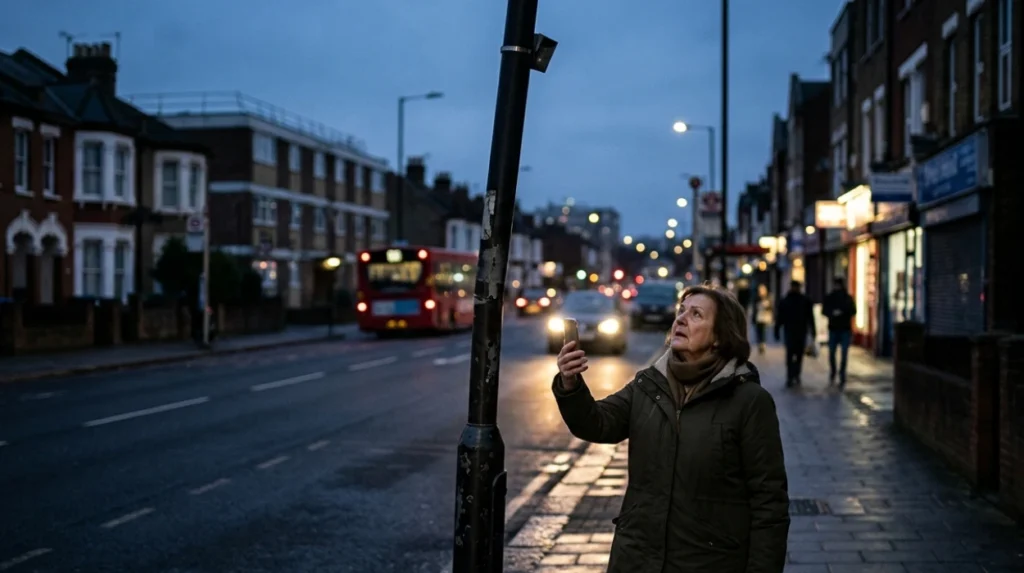
South London reporting guidance
South London residents should report the fault to the correct authority, give exact location details, and describe the danger clearly. For Lambeth-controlled public highway lighting, the council handles the repair process; for private roads, housing estate lights, and Red Routes, the report goes elsewhere.
Use a clear location format such as:
- Street name.
- Nearest door number or landmark.
- Lamp post position.
- Asset number, if visible.
- Fault type.
That approach works across borough boundaries because the same principles apply to most London street lighting systems: identify the asset, describe the fault, and send it to the correct owner. Lambeth’s published guidance makes that process explicit for residents and visitors who need to report a dangerous street light quickly.
What counts as dangerous street lighting in Lambeth?
Dangerous street lighting includes any fault that creates poor visibility or a physical hazard, such as a light that is out, flickering, damaged, knocked down, or operating during the day.