Key Points
- Serious Assault: A 64-year-old Transport for London (TfL) bus driver has been left in a critical condition following a violent confrontation on Battersea Bridge.
- Emergency Response: Emergency services, including London’s Air Ambulance and the Metropolitan Police, rushed to the scene just after midnight on Monday, 18 May 2026.
- Suspect Apprehended: A 32-year-old male suspect was arrested at the scene on suspicion of inflicting grievous bodily harm (GBH) and remains in police custody.
- Pavement Confrontation: Detectives believe the assault ensued from a physical or verbal dispute on the pavement directly adjacent to a stationary double-decker bus.
- Urgent Public Appeal: The Metropolitan Police have launched an urgent appeal for witnesses, dashcam footage, and mobile phone recordings to establish the exact sequence of events on the busy transit route.
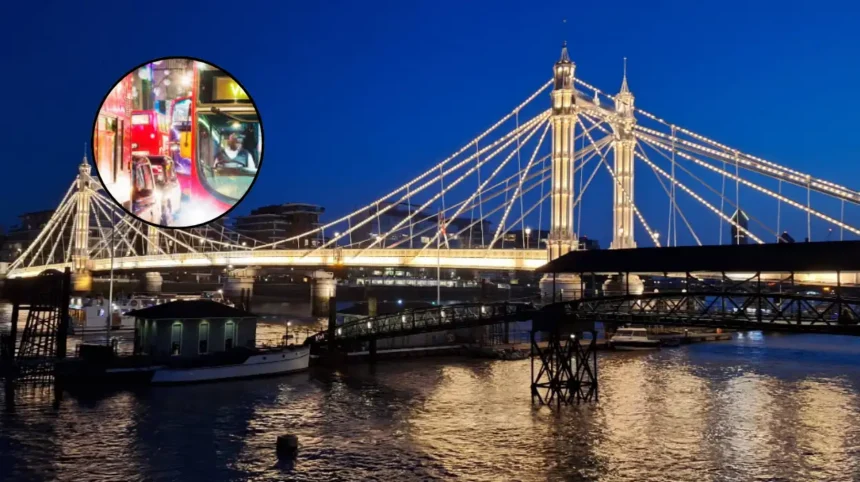
Battersea (South London News) May 18, 2026 – A 64-year-old Transport for London bus driver is fighting for his life in hospital after being brutally assaulted during a midnight confrontation on Battersea Bridge, triggering a major police investigation and severe rush-hour closures across south London. Metropolitan Police officers rushed to the south London river crossing at 12:33 am today following frantic emergency calls reporting a violent assault in progress against a public transport employee. First responding officers administered emergency first aid at the roadside before London’s Air Ambulance arrived to fly the critically injured transit worker to a major trauma unit. A 32-year-old man was successfully detained by police officers at the scene on suspicion of causing grievous bodily harm and was taken into custody, where he remains for formal interrogation.
As reported by police correspondents from the Met’s South West Borough Command Unit, the critical incident transpired whilst the TfL bus was stationary at a designated passenger stop directly on the bridge infrastructure. Initial forensic and witness enquiries suggest that the driver had stepped outside of his secure cabin, or was engaged via his window, when an escalating dispute with a pedestrian on the adjacent pavement turned physical. The assault has caused widespread shockwaves through London’s transport sector, leading to immediate road closures that blocked the vital north-to-south motoring corridor during Monday morning’s peak commuter rush hour.
Who Is Leading the Investigation into the Battersea Bridge Assault?
Detective Superintendent Fiona Van Kampen, representing the Metropolitan Police Service’s South West Borough Command Unit, is overseeing the active criminal enquiry.
The police have cordoned off a substantial portion of the bridge structure to preserve vital physical evidence, trace local closed-circuit television (CCTV) feeds, and canvass potential eyewitnesses who were crossing the River Thames at the time of the late-night attack.
According to an official statement released by Detective Superintendent Fiona Van Kampen of the Metropolitan Police, the authorities are fully cognisant of the fear and distress this incident has sparked among local residents and transport workers alike:
“We recognise the intense concern this will cause within the local community, and are working to establish the exact circumstances of the attack. This took place on one of London’s busiest bridges, so we are urgently appealing for anyone with information to come forward.”
Superintendent Van Kampen further emphasised the critical value of digital and video evidence in reconstructing the exact timeline of the assault, stating:
“If you have dashcam or mobile phone footage of what happened, it is important that we see it. Our thoughts remain with the victim’s family as enquiries continue.”
How Did the Battersea Bridge Assault Impact Monday Morning Traffic?
As reported by local traffic reporters for south London news outlets, the immediate aftermath of the assault necessitated the complete closure of Battersea Bridge Road in both directions well into the morning.
The police cordon effectively severed a key route linking Battersea and Clapham with Chelsea and Westminster, causing significant gridlock across the wider network.
Transport for London diverted multiple local bus routes, including the 19, 49, 170, and 345 services, forcing thousands of morning commuters to seek alternative crossings via Albert Bridge or Wandsworth Bridge. Tailbacks extended deep into the surrounding residential streets of Wandsworth, adding pressure to an already strained local road network.
Forensic investigators spent the morning examining the stationary TfL bus and the pavement layout, searching for biological evidence and personal effects left behind during the struggle.
What Is TfL’s Position on Safety and Violence Against Transport Staff?
While Transport for London has not yet published an individual corporate press release identifying the victim by name out of respect for family privacy, spokespersons for the transport body have repeatedly condemned all forms of physical and verbal abuse directed at frontline staff.
The incident has intensified calls from transport trade unions, including Unite, for enhanced protective infrastructure and legal protections for operators who often work in isolated conditions during unsocial night-shift hours.
Industry representatives note that despite the presence of protective assault screens inside the driver cabs of most London buses, drivers remain uniquely vulnerable when leaving their vehicles to inspect mechanical faults, adjust mirrors, or manage passenger safety issues on the platform.
The victim, described by colleagues as a highly experienced 64-year-old veteran of the London bus network, remains under constant medical supervision, with his family receiving specialist support from both TfL welfare officers and Metropolitan Police family liaison representatives.
Background of the Particular Development
The assault on Battersea Bridge occurs against a backdrop of heightened anxieties surrounding the safety of public service workers and rising figures of violent crime within the capital. Data compiled from Metropolitan Police crime logs indicates that frontline transport staff—including bus drivers, train conductors, and station enforcement officers—increasingly find themselves vulnerable to confrontational behaviour, often exacerbated by late-night alcohol consumption or fare disputes.
Over the past several years, Transport for London, alongside the Mayor of London’s office, has implemented numerous safety campaigns aimed at curbing anti-social behaviour across the bus and underground networks. These measures have included the rollout of body-worn video cameras for enforcement teams and the installation of robust, shatterproof security screens inside bus cabs.
Furthermore, Battersea Bridge itself has been the subject of long-term local safety campaigns and infrastructure adjustments.
Historically known as a challenging location for both traffic management and pedestrian safety, the bridge and its connecting junctions have undergone iterative reviews by Wandsworth Council and TfL to address heavy traffic flows and pedestrian accessibility.
This latest criminal incident introduces a distinct and troubling dimension to local safety discussions, shifting the focus from accidental road traffic dangers to targeted physical violence against the essential workers tasked with keeping London moving.
Prediction
This serious assault is highly likely to trigger immediate operational and systemic changes across Transport for London’s bus networks, directly affecting both transport employees and the travelling public. In the short term, the incident will almost certainly prompt an immediate review of emergency communication protocols between bus drivers, network controllers, and the police, particularly regarding late-night operations where passenger volumes are lower but volatile confrontations are statistically higher.
For the capital’s thousands of bus drivers, this attack is expected to accelerate trade union demands for stricter security measures. Drivers may increasingly refuse to exit their secure cabins during disputes on the pavement, potentially leading to operational delays or stricter enforcement regarding where and when buses will allow passengers to board or alight outside regular stops.