Key points
- A disabled man was attacked and robbed on a South London train approaching Bromley South station on Wednesday, May 6, 2026.
- The victim had his mobile phone stolen during the incident and has been left “shaken and extremely distressed”, according to the British Transport Police (BTP).
- The BTP has released CCTV images and issued a public appeal, asking to speak with a man seen on the footage, whom they believe may have information relevant to the investigation.
- The police have asked anyone who recognises the man or witnessed the incident to contact BTP via text to 61016 or by calling 0800 40 50 40, quoting reference number 245 from 6 May, or to contact Crimestoppers anonymously on 0800 555 111.
Bromley (South London News) May 21, 2026 A disabled man was attacked and robbed on a South London train service approaching Bromley South station at around 11:30 am on Wednesday, 5 June 2026, British Transport Police have reported.
As outlined by Jackie Flynn, Crime Prevention Officer for the British Transport Police in South London, the incident occurred on a train journey in the Bromley area, where the man sat beside the victim and then assaulted him before stealing his mobile phone. Flynn told Yahoo News UK that the victim was left “shaken and extremely distressed” by the ordeal.
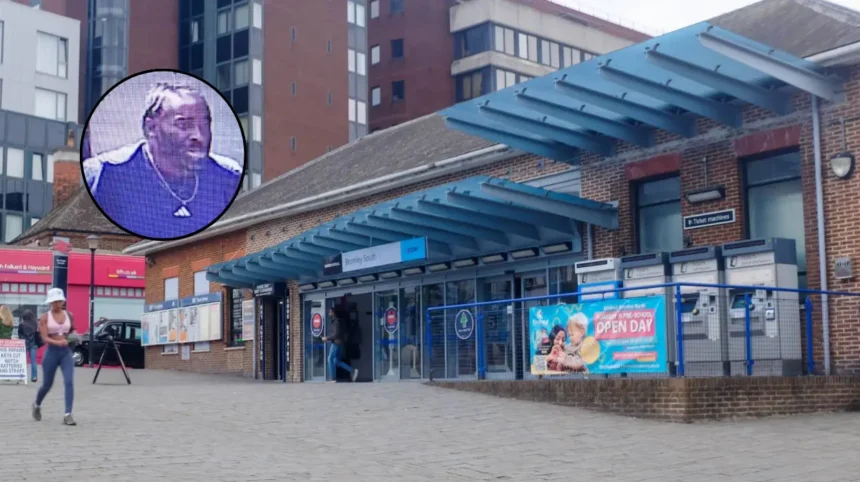
The force later circulated a short video clip of the suspect, captioned as a “CCTV appeal for witnesses” on the BTP social‑media channels, which shows the man sitting next to the disabled passenger. In the clip, the suspect is seen as a Black male of average build, wearing black cornrow‑style hair, a dark Adidas‑branded sweatshirt, and a silver chain.
How are police trying to identify the suspect?
The British Transport Police have explicitly asked the public to help identify the man seen in the footage. In a statement shared with Yahoo News UK, the force indicated that detectives
“would like to speak to the man pictured, as they believe he may have information which could help their investigation”.
The same statement, also reported by DPS Simulation’s UK‑railway‑news outlet, notes that the man in the video is believed to have been in the vicinity of the disabled victim and may either be linked to the robbery or may have witnessed the incident.
Anyone who recognises the man or saw what happened on the train is urged to contact BTP by texting 61016 or calling 0800 40 50 40, quoting reference number 245 from 6 May. Information can also be passed anonymously to Crimestoppers on 0800 555 111, the force has said.
What has been said about the victim’s condition?
Several outlets, including Yahoo News UK and DPS Simulation, have repeated the same wording from the BTP press release describing the victim as “shaken and extremely distressed” in the aftermath of the attack.
The reports do not specify the nature of the victim’s disability or the exact location on the train where he was assaulted, beyond the fact that it occurred on a service approaching Bromley South station.
The British Transport Police have not released the victim’s name or age, in line with standard practice for protecting victims of crime.
Nor have they indicated whether he sought medical assistance after the incident, beyond noting his emotional state.
What does this incident reveal about safety on trains?
The assault on the disabled man renews questions about passenger safety on London’s suburban rail network, particularly for vulnerable travellers.
The BTP’s decision to publish a short video clip of the suspect via its social‑media channels is part of a wider pattern of using CCTV appeals to gather information when witnesses are few and the train environment is crowded.
The force has previously highlighted that mobile‑phone theft and opportunistic robberies on trains remain a concern, even though some national campaigns have led to reductions in certain types of snatch‑theft. In this case, the BTP’s appeal signals that officers are still relying heavily on public assistance to track down suspects, especially where CCTV coverage is incomplete or where trains are busy.
Explore More Bromley Crime News
Disabled Man Attacked on Bromley Train, Phone Stolen | Bromley 2026
Man Stabbed on Bromley High Street, 2026
Background: railway policing and CCTV in Bromley
Railway policing in South London falls under the remit of the British Transport Police, which operates specialist Crime Prevention Officers and community liaison teams across the capital.
The BTP has long used CCTV galleries and social‑media appeals to trace suspects, a practice that has become routine in serious and opportunistic offences on trains and at stations.
In Bromley, local authority CCTV inquiries are typically handled separately by the London Borough of Bromley, with official guidance stating that road‑traffic‑related CCTV footage can be released only to the police, solicitors or insurance companies.
However, station‑area and onboard‑train footage used in this kind of investigation is held by the BTP rather than the local council.
This case is one of several recent incidents in which the BTP has released short video clips to ask for help identifying men seen in the vicinity of crimes, including other assaults and robberies on trains. The current appeal follows the same model, emphasising that the man pictured may be a witness rather than automatically labelling him as a suspect.
Prediction: What this could mean for passengers in South London
For daily commuters and especially disabled passengers in South London, this incident underlines how quickly a routine journey can escalate into a frightening confrontation, even on services that are generally considered safe. If the BTP successfully identifies the man from the CCTV footage and locates further witnesses, it could lead to a clearer understanding of whether this was an isolated opportunistic attack or part of a pattern of targeting vulnerable travellers.
In the short term, the appeal may prompt more passengers to note details of suspicious behaviour, such as individuals sitting unusually close to vulnerable people or appearing to lurk in quieter carriage sections. Over time, repeated incidents of this kind – if not countered by more visible policing, better‑lit carriages and clearer reporting routes – could erode public confidence in using trains, particularly during off‑peak hours when carriages are less crowded.
For disabled passengers, the case may also sharpen demand for more tailored safety briefings and better communication channels when reporting abuse or theft on trains, since the BTP’s standard appeal relies heavily on the public identifying individuals from short video clips rather than on direct, in‑person intervention at the time of the incident.