Key Points
- Incident Overview: A 17-year-old boy was stabbed and nine individuals were arrested following a large-scale, unauthorised gathering of teenagers on Clapham Common, south London.
- Social Media Influence: The event was heavily publicised and promoted via viral videos on the social media platform TikTok before escalating into violence.
- Emergency Response: Emergency services, including the Metropolitan Police and London Ambulance Service, were dispatched to the park on Friday evening following reports of fighting within the crowd.
- Victim Condition: The teenage victim was treated at the scene and transported to a hospital; his stab wounds have been officially assessed by medical professionals as neither life-threatening nor life-changing.
- Breakdown of Arrests: Metropolitan Police officers arrested nine individuals, including juveniles as young as 14, on charges including violent disorder, affray, and grievous bodily harm (GBH).
- Contextual History: The stabbing follows a series of highly disruptive, social media-driven “link-up” events in the Clapham district during the spring of 2026, prompting prior implementation of dispersal orders and enhanced police deployments.
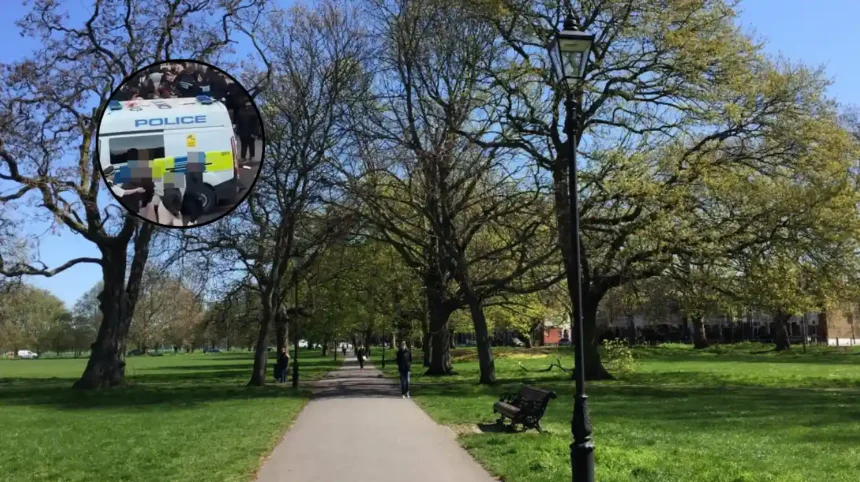
Clapham (South London News) May 25, 2026 – A 17-year-old youth has been hospitalised with knife injuries and nine people have been taken into police custody following a mass physical altercation at an unauthorised gathering of hundreds of teenagers on Clapham Common, south London. The violent disruption, which transpired on the evening of Friday, 22 May 2026, was reportedly organised and publicised extensively across the social media platform TikTok, drawing a significant influx of young people to the public parkland before dissolving into open fighting.
As reported by journalist Megan Howe of the Evening Standard, the Metropolitan Police were called directly to the open green space of Clapham Common after fighting broke out within the gathered crowd, which had assembled for an alleged impromptu music event. Emergency response teams arrived at the scene to find a heavily populated assembly of adolescents, with volatile physical confrontations occurring in multiple sections of the park. Visual evidence circulating widely across digital networks illustrated the scale of the disturbance, showing groups of youths engaging in fistfights, striking individuals who had been knocked to the ground, and actively resisting law enforcement personnel trying to restore order.
The London Ambulance Service treated the 17-year-old male at the scene for stab wounds before transferring him to a local trauma center. A formal media briefing issued by a Metropolitan Police spokesperson confirmed that the victim’s wounds were thoroughly examined by medical personnel and “assessed as neither life-changing nor life-threatening.” The identity of the injured youth has been withheld in compliance with statutory privacy guidelines.
Who Was Arrested and What Charges Are the Suspects Facing?
The police response resulted in the immediate detaining of nine individuals who were present at the flash mob. According to operational logs released by the Metropolitan Police, the individuals taken into custody include several minors, highlighting a growing trend of adolescent involvement in organised urban disturbances.
Among those formalised in the arrest data provided to the press, specific charges have been mapped out against six of the suspects, while others remain under active investigation:
- Four teenage boys—comprising one 16-year-old, two 17-year-olds, and one 19-year-old—were arrested on suspicion of committing affray.
- Two additional boys, aged 14 and 16 respectively, were arrested on suspicion of grievous bodily harm (GBH) and affray in connection with the physical assault and stabbing.
The Metropolitan Police confirmed that all nine individuals arrested during the Friday evening operation remain in police custody at various south London police stations, where they are undergoing formal interrogation by detective teams.
How Have the Metropolitan Police Responded to the Violence?
In the immediate aftermath of the disorder, law enforcement authorities launched an extensive evidence-gathering campaign, deploying specialized units to maintain an amplified physical presence across the Clapham district. Investigators are currently conducting retrospective video analysis, examining local closed-circuit television (CCTV) feeds, police body-worn cameras, and digital footage uploaded to social media channels to isolate the primary instigators of the violence.
A spokesperson for the Metropolitan Police issued a public directive regarding the ongoing investigation:
“We urge anyone who was at the event or who has any information to come forward to police by calling 101 and quoting CAD8948/22May. A police presence will remain in the area, and we’ll be reviewing CCTV and other evidence in the coming days.”
The force has emphasized that its counter-disorder strategy will focus not only on those who participated in physical assaults but also on identifying the digital coordinators who leverage social media algorithms to orchestrate unregulated public gatherings.
Explore More Clapham News
Pensioner Dies After Lorry Crash on Clapham High Street 2026
Clapham Shooting: Two Charged for Moodie Murder, Clapham 2026
Background of the Particular Development
The stabbing on Friday, 22 May 2026, represents the latest escalation in a persistent series of social media-driven teenage disturbances that have disrupted the commercial and residential sectors of Clapham throughout the spring of 2026. Local authorities and community leaders have expressed mounting concern over the phenomenon of viral “link-ups”—digital event invitations broadcast via TikTok and Snapchat that encourage hundreds of youths to converge simultaneously on targeted urban locations.
As documented by journalist Matthew Weaver of The Guardian, a similar wave of widespread public disorder occurred in the same vicinity during the Easter holiday period in early April 2026. On Tuesday, 31 March 2026, a crowd of several hundred masked teenagers swarmed Clapham High Street and Clapham Common following viral online invitations. During that specific incident, youths attempted to forcibly enter local supermarkets and restaurants—including a Marks & Spencer branch—while setting off commercial fireworks and lighting open bonfires on the Common.
The April disturbances required the mobilization of over 100 police officers and resulted in five physical assaults, which included injuries sustained by four emergency workers. As reported by The Independent, that earlier wave of unrest resulted in the implementation of a Section 35 dispersal order, giving police expanded statutory powers to remove individuals from the area, alongside the arrest of multiple teenage girls aged between 13 and 17 for assaulting emergency service personnel and shoplifting.
Following those initial incidents, Detective Chief Superintendent Emma Bond, commander of local policing for the area, issued a stern warning concerning the long-term legal ramifications for youths participating in viral flash mobs, stating:
“Events like this, fuelled by online trends and viral content on social media platforms, can quickly escalate and lead to serious outcomes. If you join in or cause further disorder, you should expect to be arrested and risk a criminal record, which can have long-lasting consequences for your future, including employment opportunities and potentially your ability to travel.”
Prediction
This development is expected to significantly affect local residents, business owners, parents, and young social media users across south London through intensified legislative, policing, and corporate structural shifts.
For Local Residents and Business Owners
The immediate consequence of the stabbing will be a heightened, visible law enforcement footprint across Clapham Common and its surrounding high streets, particularly during weekend hours. Business owners are likely to face increased operational friction, including the potential necessity of temporary store closures, enhanced private security expenditures, or the implementation of restrictive entry policies when social media alerts signal an impending “link-up.” Property owners may see stricter municipal regulations regarding the usage of open spaces on the Common, aimed at curbing night-time congregations.
For Parents and Legal Guardians
The Metropolitan Police and local borough councils are highly likely to shift greater accountability onto families. Following the precedent set by Detective Chief Superintendent Emma Bond’s directives, parents will face increased systemic pressure to monitor their children’s digital footprints and physical movements. Continued parental failure to prevent minors from participating in known unlawful assemblies could result in stricter enforcement of anti-social behaviour legislation, potentially involving parental civil liability or fines issued by local authorities.
For Social Media Users and Tech Platforms
The transition of online viral trends into real-world violence will intensify the ongoing legislative friction between the UK Government and social media conglomerates like TikTok and Snapchat. As senior political figures continue to criticize platforms for hosting content that promotes civic unrest, tech companies will likely be forced to implement aggressive, geo-targeted algorithmic suppression. For the average young user, this means that looking for or sharing terms like “link-up,” “court meetups,” or localized gathering hashtags within the London area will trigger automated content blocks, algorithmic shadowbans, or direct account suspensions as platforms attempt to avoid legal liabilities under UK online safety frameworks.