Key Points
- Dishonourable Distinction: The Filigree, a 649-apartment residential development in Lewisham, South London, has been voted the joint winner of the Carbuncle Cup 2026, an award designating the UK’s worst new building.
- Dual Winners: The London residential complex shares the top spot with the Astley Warehouses development located in Greater Manchester.
- Judging Criteria: Organised by The Fence Magazine, the award panel of six experts noted that architectural ugliness alone was insufficient; nominated buildings had to exhibit deeper, more egregious flaws in design and operational execution.
- Operational Failures: Beyond its polarising geometric, zigzag aesthetic and yellow balconies, the complex suffered a severe infrastructure failure in February 2025 when its energy centre flooded, forcing the evacuation of over 400 residents.
- Political and Local Backlash: Local officials have expressed severe dissatisfaction with the slow pace of remediation, while the architectural jury criticised the project as emblematic of systemic issues within modern property procurement and value engineering.
Lewisham (South London News) June 19, 2026 – A controversial residential high-rise development in South London has been officially named the worst new building in the United Kingdom. The Filigree, situated in the heart of Lewisham, has been announced as the joint winner of the notorious Carbuncle Cup 2026. The architectural booby prize, revived and administered by The Fence Magazine, seeks to identify the nation’s most offensive construction projects completed over the preceding two years. Nominated initially by members of the public and subsequently assessed by a panel of six industry experts, the development was selected not merely for its divisive appearance, but for profound deficiencies in its mechanical execution and subsequent management. The Filigree shares the 2026 title with the Astley Warehouses development in Greater Manchester.
- Key Points
- Why Was The Filigree Named the UK’s Worst New Building?
- What Infrastructure Failures Occurred at the Lewisham Development?
- How Have Local Authorities and Judges Responded to the Award?
- Background of the Lewisham Gateway Development
- Prediction: How This Development Can Affect Renters and the Local Community
Why Was The Filigree Named the UK’s Worst New Building?
As reported by journalist Emma Magnus of the Evening Standard, the selection panel made it clear that basic aesthetic displeasure was not the sole factor in determining the winner. Writing on the publication’s website, the judges stated that
“ugliness was not enough to secure a place on the short list,”
explaining that the chosen structures
“need to offend something deeper, more egregious, in their design and execution.”
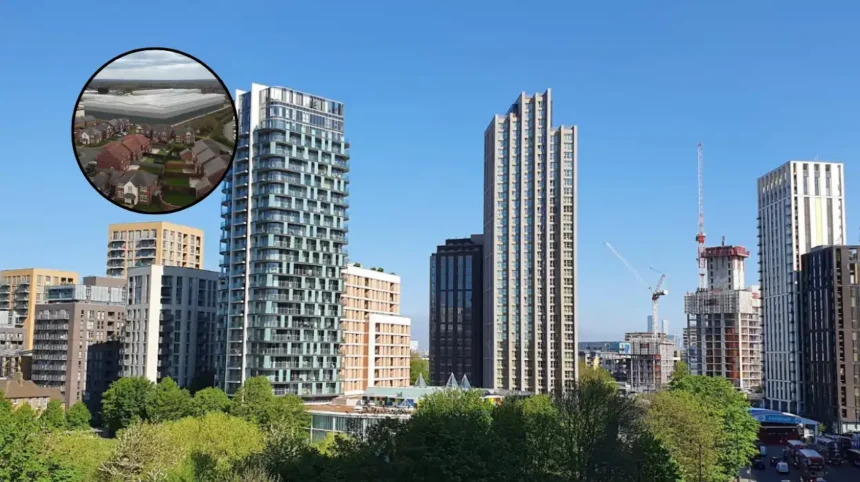
The Filigree comprises a cluster of five high-rise residential blocks featuring a distinct geometric, zigzag façade. The tallest component of the development is the 29-storey Pinnacle Tower, which serves as the visual focal point of the site. It features a central concrete spine flanked by columns of glass windows, with bright yellow balconies branching out on either side.
Managed and marketed by the build-to-rent operator Get Living, the scheme encompasses 649 rental apartments. Promotional materials distributed by the company previously described the development as offering “quality apartments neighbouring nature” and constituting a “vibrant new London neighbourhood.”
However, the architectural jury looked beyond the marketing narrative, assessing both the physical impact on the local skyline and the functional realities of the built environment.
What Infrastructure Failures Occurred at the Lewisham Development?
The operational history of the development heavily influenced the final judging panel’s decision. As detailed by Emma Magnus of the Evening Standard, the residential complex officially opened to tenants in the summer of 2024.
However, in February 2025, less than a year after its completion, the development’s primary energy centre suffered a catastrophic flooding event.
The incident resulted in an immediate termination of the water and electrical power supply across the complex.
The systemic failure forced the emergency evacuation of more than 400 residents from their homes, requiring them to be relocated to temporary accommodation.
The disruption has extended significantly past the initial emergency phase. In a formal communication issued to residents in November 2025, Get Living acknowledged that critical machinery and foundational materials within the facility required complete replacement.
The operator stated that rebuilding the infrastructure of the energy centre would inevitably “take some time to complete,” leaving sections of the development impaired long after the initial event.
How Have Local Authorities and Judges Responded to the Award?
The protracted recovery timeline has drawn direct criticism from local government representatives. In an official statement compiled by the Evening Standard, local Councillor James-J Walsh expressed the local authority’s frustration regarding the state of the project:
“Lewisham Council granted planning permission on the clear understanding that this development would be completed and functioning as a neighbourhood by now, but that has not happened. Nearly a year on, progress has been too fragmented and too slow and we need the issues resolved and the site brought back to life as soon as possible.”
The criticism from civic leaders matches the broader structural conclusions delivered by the Carbuncle Cup judging panel.
As reported by Emma Magnus of the Evening Standard, architecture writer and jury chair Cath Slessor delivered a damning indictment of the motivations underpinning the development:
“So, while appearance is an obvious criterion, the winners are also emblematic of something much more rotten and disturbing in terms of how these buildings were procured, sited, scaled, built and operated. At the heart of this darkness is simple greed: building big and cheaply, ruthlessly value engineering and riding roughshod over neighbours and users. And then onto the next monstrosity.”
At the time of reporting, both the landlord and developer Get Living, alongside the developers responsible for the co-winning Astley Warehouses in Greater Manchester, had been approached for comment regarding the Carbuncle Cup results.
Explore More Lewisham News
Lewisham’s 18 Green Flag Parks Win International Awards: Lewisham 2026
Model Market Reopens Spring 2026: Lewisham Hotspot Returns; Lewisham 2026
Background of the Lewisham Gateway Development
The Filigree represents the culmination of the wider Lewisham Gateway regeneration project, a massive urban renewal scheme that has been active for more than two decades.
As documented by local news outlet The Greenwich Wire, the overarching master plan involved extensive infrastructural re-engineering of the Lewisham town centre, including the physical rerouting of local rivers and primary road networks over a ten-year construction period.
The project was divided into distinct phases. The initial phases of the development faced sustained public and critical resistance long before the completion of the final blocks.
The first phase of the Lewisham Gateway was previously nominated for an earlier iteration of the Carbuncle Cup when the prize was overseen by the trade publication Building Design. During that period, the magazine famously likened the structural profile of the initial phase to “four upturned middle fingers.”
Political figures within the community have historically questioned the design philosophy of the area. As noted by The Greenwich Wire, Joani Reid—the current Labour MP for East Kilbride & Strathaven and a former local councillor for Lewisham—publicly branded the architectural layout of the early phases as an “architectural circus.”
Despite the long-term aesthetic and structural controversies, senior civic officials have consistently defended the necessity of the project due to London’s broader housing demands. In a statement recorded upon the completion of the final pathways, Brenda Dacres, the elected Mayor of Lewisham, emphasised the socio-economic targets of the infrastructure scheme:
“The scheme had delivered much-needed housing for Lewisham and London, with community and social infrastructure, as well as opportunities for jobs and skills for local people. We have listened to our communities and our partners throughout this two-decades-long journey, and I am thrilled that with its completion, the benefits of Lewisham Gateway will be felt for generations to come.”
Prediction: How This Development Can Affect Renters and the Local Community
The crowning of The Filigree as the UK’s worst new building is highly likely to have distinct consequences for two primary audiences: the current and prospective tenants renting within the complex, and the broader community residing in the surrounding borough of Lewisham.
For the immediate tenant demographic, the prominent national designation—coupled with documented, unresolved infrastructural failures in the energy centre—will likely depress the commercial desirability of the 649 rental units.
Tenants may leverage this reputational damage to demand lower rent costs or stricter accountability clauses from the landlord, Get Living. Conversely, the stigma of living in a globally recognised “carbuncle” could reduce lease-renewal rates, leading to high tenant turnover and prolonged vacancies within the Pinnacle Tower and its sister blocks.
For the wider community of Lewisham, the negative architectural status cements the town centre as a cautionary tale within British urban planning.
The visual presence of the 29-storey tower ensures that its highly criticised zigzag façade and bright yellow balconies will remain a permanent, unescapable feature of the local landscape. This national scrutiny may prompt Lewisham Council’s planning department to enforce significantly stricter aesthetic standards and stricter structural redundancy requirements on future high-density housing applications, slowing down the pipeline of subsequent local regeneration schemes.