Key Points
- Council Pledge: The recently elected Leader of Lambeth Council, Councillor Martin Abrams, has promised that the local administration will exhaust every available resource to support a community bid to buy back Brixton Village and Market Row.
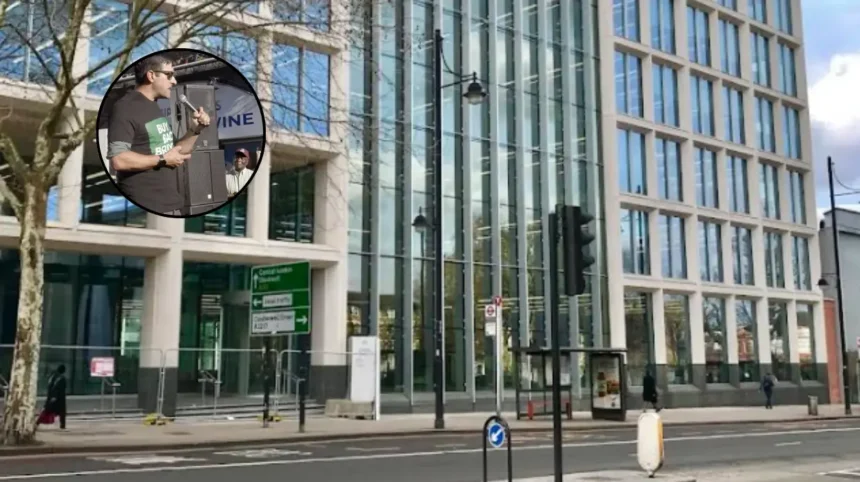
- Community Mobilisation: Hundreds of local residents and campaigners gathered for a packed rally on Brixton Station Road on Friday evening to support the “Buy Back Brixton” initiative.
- Urgent Deadline: The high-stakes community intervention comes as the official deadline for submitting competitive bids to acquire the iconic indoor market sites closes tomorrow.
- Anti-Commodification Stance: Councillor Abrams strongly criticised private equity firms, comparing them to “vultures” that have treated the historic cultural hub as a mere financial commodity rather than a vital community asset over the past two decades.
- Historical Context: Brixton Village and Market Row hold immense cultural significance, having served as a central focal point for London’s Black Caribbean community since the 1950s.
Brixton (South London News) June 22, 2026 – This report prioritises the most critical information regarding Lambeth Council’s sudden executive intervention in the community bid for Brixton Market, followed by the immediate details of the Friday night rally, before outlining the wider context of private equity ownership and the subsequent socio-economic predictions for the local community.
What is the “Buy Back Brixton” campaign and how has Lambeth Council responded?
The campaign to return Brixton’s historic covered markets to community hands received a major political boost on Friday evening.
Addressing a crowded and energetic rally on Brixton Station Road, the newly elected Leader of Lambeth Council, Councillor Martin Abrams, pledged that the local authority would “pull out every single sinew” to back a grassroots community bid to purchase the freeholds of Brixton Village and Market Row.
This high-profile political intervention arrived just hours before the formal deadline for bids closes tomorrow.
The grassroots campaign seeks to prevent the historic indoor market arcades from being acquired by corporate interests, aiming instead to secure their future under a community-owned asset model.
What statements did Councillor Martin Abrams make at the Brixton rally?
As reported by local democracy correspondents covering the south London political shift, Councillor Martin Abrams delivered an impassioned speech to the hundreds of residents, market traders, and activists assembled in the heart of Brixton.
Reflecting a sharp shift in the local authority’s executive tone following recent political developments, Councillor Abrams sought to reassure the community that the council would no longer remain passive regarding the ownership of local landmarks.
Addressing the crowd, Councillor Abrams stated:
“For 20 years, we’ve seen private equity circle like vultures in Brixton, buying up our community like commodities. Today, we are saying something simple but powerful – Brixton is not a commodity. Brixton is a community. We have your backs. As the new council in Lambeth, we are the community, and we have your backs.”
The leader’s reference to the council “pulling out every sinew” marks a significant departure from previous administrative stances, which had historically cited severe financial constraints as a barrier to direct municipal bidding or formal financial underwriting for the multi-million-pound market freeholds.
Who is driving the bid and what are the specific details of the campaign?
The “Buy Back Brixton” campaign represents a collaborative effort involving local traders, community wealth-building advocates, and resident groups who fear that continued private equity ownership will accelerate gentrification and price out traditional independent businesses.
According to statements compiled from campaign organizers, the bid submitted ahead of tomorrow’s deadline outlines a community trust model designed to freeze commercial rents, protect long-standing independent traders, and reinvest market surpluses directly back into the Lambeth borough.
The urgency of the Friday evening rally was dictated entirely by the commercial sales timeline. With the bidding window closing tomorrow, campaigners view the council’s public endorsement as a vital asset that could provide the community bid with the necessary planning, legal, and political leverage required to compete against institutional real estate investors.
Background of the particular development
The struggle over the ownership and cultural identity of Brixton Village and Market Row is deeply rooted in the post-war social history of south London.
Originally constructed as commercial shopping arcades, the indoor markets evolved significantly during the 1950s, becoming the primary commercial, social, and cultural hub for the newly arriving Windrush generation and London’s expanding Black Caribbean community.
In 2008, the arcades faced a severe existential threat when the then-owners, London & Associated Properties (LAP), put forward sweeping proposals for demolition and modern residential redevelopment.
This sparked a fierce local counter-campaign. Lambeth Council historically backed the community resistance, successfully lobbying the central government to grant Grade II listed status to the buildings. The listing explicitly cited both their architectural rarity and their immense contribution to the social and economic history of Black Caribbean Londoners.
Despite avoiding demolition, the markets entered a period of economic decline. To revive the spaces, Lambeth Council subsequently facilitated a partnership between the landlords and a creative agency, launching an initiative that offered vacant units to local entrepreneurs and artists rent-free for three months. While this successfully revitalised the footfall and transformed the arcades into a famous culinary and retail destination, it also attracted international investment.
Subsequent ownership transitions saw the freeholds acquired by global private equity and investment groups. Over the years, the local authority admitted that while it closely monitored sales, its own financial analysis indicated it could not submit a competitive municipal bid for the freehold.
Day-to-day operations have long been bound to extended leaseholder agreements, leaving the underlying land ownership a subject of continuous community tension.
The election of a new council administration, led by Councillor Martin Abrams, has re-opened the door to direct local authority intervention through community wealth-building frameworks.
Explore More Lambeth Council News
Lambeth Council Immigration Enforcement Review: London 2026
Lambeth Council Facing High Court Challenge Over Heating Charges, London 2026
Prediction
This development is poised to significantly impact local market traders, long-term Brixton residents, and independent business owners across the borough of Lambeth.
If the community-backed bid—now fortified by the explicit political backing of Lambeth Council—proves successful, it will establish a groundbreaking precedent for urban asset preservation in London.
For the primary audience of independent traders, a successful buy-back would likely result in long-term lease security, structured rent caps tied to local economic indices rather than speculative market values, and a direct say in the governance of the market spaces.
This outcome would safeguard the cultural heritage of the area, ensuring that traditional Caribbean food stalls, local butchers, and independent retailers can continue to operate alongside newer hospitality ventures.
Conversely, if the community bid fails and the freeholds are secured by another private equity firm, the council’s aggressive rhetorical stance may set up a period of protracted regulatory and planning friction. Investors looking to aggressively redevelop or alter the commercial mix of Brixton Village and Market Row will face a hostile local administration willing to use its statutory planning powers, enforcement tools, and asset-protection policies to defend the current tenant base.
For the local audience, this scenario would likely mean ongoing economic uncertainty, potential legal battles over commercial evictions, and continued upward pressure on commercial rents. This could gradually displace the very independent businesses that give Brixton its world-renowned identity.