Key Points
- Mass Housing Target: Kingston Council has approved the final draft of its long-delayed Local Plan, plotting the construction of nearly 20,000 new homes over a 15-year period spanning from 2028 to 2043.
- Green Spaces Under Threat: The developmental blueprint alters boundaries to open up protected Metropolitan Open Land (MOL) and green belt regions, including major sites across Chessington and Motspur Park.
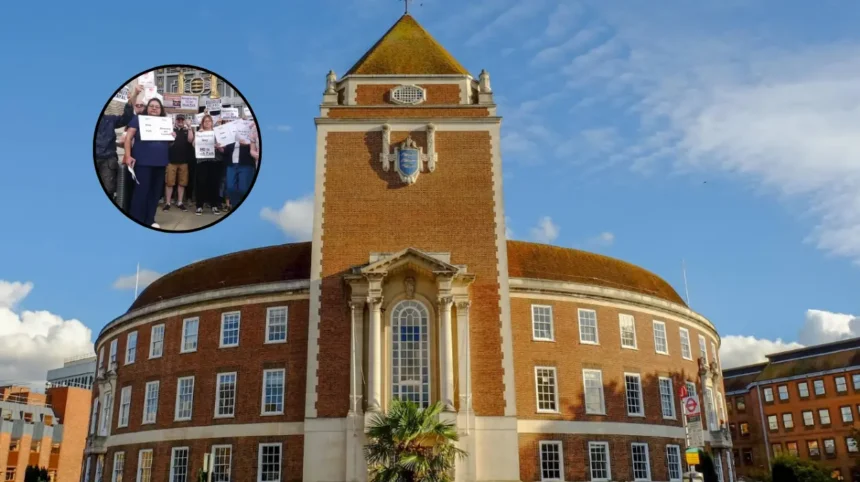
- Public and Political Backlash: Local residents staged active demonstrations outside Kingston’s Guildhall, condemning a lack of transparency and accusing the Liberal Democrat-led administration of rushing the 1,200-page document.
- Critical Hubs Targeted: Core town center assets, transport junctions, and local landmarks—such as Kingston, Surbiton, and Tolworth stations, shopping areas, and the council’s own Guildhall complex—are listed for major high-density redevelopment.
- Legal Vulnerabilities: Opposing political figures and community groups argue the plan bypasses crucial infrastructural assessments, warning it may violate statutory requirements and expose the local authority to judicial challenges.
Kingston-upon-Thames (South London News) June 24, 2026 – A wave of public demonstrations has erupted outside Kingston’s historic Guildhall following Kingston Council’s pivotal decision to advance the final draft of its sweeping new Local Plan. The blueprint, which sets out guidelines to facilitate the delivery of nearly 20,000 new homes across the borough over a 15-year horizon up to 2043, has drawn severe condemnation from community groups and political opponents who accuse the administration of shielding the data from genuine democratic scrutiny. By releasing thousands of pages of deeply complex documentation detailing building allocations on short notice, the Liberal Democrat-led local authority faces allegations of fracturing public trust.
- Key Points
- Why are Kingston Residents Protesting the New Local Plan?
- Which Specific Sites are Earmarked for the 20,000 Homes?
- How is the Green Belt and Metropolitan Open Land Impacted?
- What is the Council’s Justification for the Fast-Tracked Plan?
- How Did Councillors Vote on the Local Plan?
- Background to the Local Plan Development
- Predictions for Kingston Residents and Stakeholders
The escalating dispute centers on plans to build high-density blocks on prominent urban sites, alongside an unprecedented push to encroach upon the borough’s legally protected green belt and Metropolitan Open Land (MOL).
Why are Kingston Residents Protesting the New Local Plan?
The primary driver behind the sudden outbreak of community action is the scale of the proposed development combined with a perceived lack of democratic accountability. Local residents gathered en masse outside the Guildhall to voice their objection to the rapid progression of the document, which will govern planning policy from its projected adoption in 2028. Critics have targeted the timing of the data release, asserting that the council intentionally delayed the document’s publication until after local cyclical campaigns to avoid an electoral backlash.
As reported by Charlotte Lillywhite of MyLondon, Gia Borg-Darcy, the chair of the Kingston and Surbiton Conservatives, explicitly noted that her formal request to have the plan made public before the local elections on 7 May had been declined by the council. Addressing the council chamber, Borg-Darcy stated:
“It was not, obviously, and it seems very clear we all know why. Now we face a threat to our green belt, plus three late documents with 1,200 pages of potential building sites which were dropped ahead of this meeting. Residents have had no opportunity to comment. This, councillors, is not democracy. This is a betrayal of the residents’ trust.”
Furthermore, community networks argue that by keeping the specific target maps offline until the final moments preceding the committee assemblies, the public was effectively barred from filing meaningful technical objections.
Which Specific Sites are Earmarked for the 20,000 Homes?
The draft framework lists an array of highly specified urban centers, car parks, retail spaces, and infrastructure hubs slated for substantial architectural modification. According to data compiled from municipal records by Charlotte Lillywhite of MyLondon, key transport links are slated to bear a massive portion of the residential expansion. The allocations include:
- Kingston Station: Slated for 310 new homes.
- Surbiton Station Car Park (Western Section): Earmarked for 175 residential units.
- Tolworth Station: Allocated for 105 homes.
- Cattle Market Car Park and Fairfield Bus Station surroundings: Designated for 300 homes.
- Seven Kings Car Park: Destined to absorb 225 homes.
- The Bentall Centre Multi-Storey Car Park: Allotted 175 homes.
- Cromwell Road Bus Station: To be revamped with an added 90 homes to form what the council labels a “welcoming gateway” into the town center.
Retail assets are also core components of the redevelopment strategy. The Eden Quarter has been earmarked for 645 units alongside supplementary leisure installations, a hotel, and altered civic plazas.
The 1960s-built Eden Walk Shopping Centre is similarly designated to clear space for 560 flats. Additionally, the council’s own headquarters, the Guildhall complex, is marked for 320 homes, an initiative that involves retaining the primary historic landmark structure while completely demolishing and replacing its modern office extensions. Denser structures are planned for Tolworth Tower, which could yield 360 units via a full structural retrofitting, and St John’s Industrial Estate, which is proposed for 585 units paired with modified, compacted commercial workspaces.
How is the Green Belt and Metropolitan Open Land Impacted?
Because brownfield areas alone are insufficient to meet the borough’s long-term housing targets, the council has integrated changes into traditional green infrastructure classifications. This shift has drawn sharp criticism from environmentalists.
As documented in the final planning texts reported by MyLondon, the local authority altered boundaries to allow construction within areas previously classified as untouchable.
Major allocations hitting open spaces include 405 homes positioned across redundant sections of the Hogsmill Sewage Treatment Works, alongside a 440-home development layout arranged for the Motspur Park gasholders site, both historically protected as Metropolitan Open Land.
More controversially, the strategy directs building projects directly onto green belt land in Chessington. The allocations feature 1,440 proposed homes clustered at Clayton Road and another 265 units mapped onto the derelict grounds of the former Chessington Golf Course.
As reported by Charlotte Lillywhite of MyLondon, local resident Caroline Shah openly questioned the empirical validity of these boundary adjustments during public addresses. Shah stated:
“This plan has been in preparation for years, yet the legal and evidential basics have still not been met. In the meantime, large-scale development continues to be approved without the safeguards a lawful up-to-date Local Plan should provide. Approving the plan in its current form risks continuing that situation and exposes the council to legal challenge.”
What is the Council’s Justification for the Fast-Tracked Plan?
The ruling Liberal Democrat majority maintains that further procrastination would severely harm the borough’s legal standing and leave it entirely defenseless against predatory external developers.
Due to successive delays in updating the existing 2012 framework, Kingston operates under a structural planning deficit, triggering a statutory “presumption in favour of sustainable development” from central government inspectorates. This legal mechanism strips the local council of its discretionary powers, making it exceptionally difficult to block inappropriate developer applications.
As reported by Charlotte Lillywhite of MyLondon, Liberal Democrat Councillor Andrew Wooldridge defended the extensive history of the text, stating:
“Kingston has gone far too long without an up-to-date Local Plan. Whatever views members may hold on individual sites, individual policies or individual allocations, I think most of us would agree that continuing without a modern Local Plan is not in the interests of our residents. The reality is that growth will continue to come to Kingston. Housing need does not disappear because we choose not to plan for it.”
Councillor Wooldridge argued that the document represents years of rigorous evidence gathering and incorporates the complex shifts dictated by evolving national planning mandates. Fellow Liberal Democrat Councillor Roger Hayes reinforced this stance, stating:
“For whatever reasons, we are where we are. There can be no further delay. We either take this forward or we run the risk of losing everything,”
emphasizing that failing to pass the local draft could lead to central government intervention and a total loss of local authority oversight.
Explore More Kingston upon Thames Council News
Kingston Council Plans 20,000 New Homes: Kingston 2026
Liberal Democrats Hold Kingston upon Thames Council — 2026
How Did Councillors Vote on the Local Plan?
The political divide within the chamber reflected the tensions seen on the streets outside. Independent and Conservative members argued that voting for a document whose supplementary evidence papers had barely been scanned by representatives was a violation of local democratic oversight. Independent Councillor James Giles spoke out against the tight timelines given to evaluate the voluminous text, labelling the process “truly dire.” As reported by Charlotte Lillywhite of MyLondon, Giles stated:
“I want genuinely affordable homes, but I can’t support this version of the Local Plan where we’re being asked to accept huge amounts of change after seven years of delay.”
From the perspective of opposition parties, the plan leaves local infrastructure vulnerable. James Stanton, representing Kingston Labour, warned that the protracted delay had already compromised the borough’s position. As reported by MyLondon, Stanton stated that the administration had left Kingston the
“easy target” of developers, adding:
“Given there is clearly no excuse for blaming the GLA [Greater London Authority] or Government for this council’s singular failure to do its job, as so many other London boroughs have achieved what Lib Dem Kingston has not, Kingston’s residents deserve to know why its council has been asleep at the wheel.”
Despite these strong objections, the ruling Liberal Democrat majority secured the plan’s passage. The final vote to proceed with publishing the draft for wide public consultation passed with 38 councillors voting in favour, three voting against, and two abstaining.
Background to the Local Plan Development
The structural roots of Kingston’s current planning crisis trace back to 2012, the year the borough last successfully adopted a statutory Local Plan. Under UK planning law, local planning authorities are required to review and renew their strategic frameworks at five-year intervals to account for demographic changes, economic shifts, and updated national policies.
Kingston Council had initially committed to delivering a modernized, comprehensive Local Plan by late 2021 or early 2022. However, a sequence of bureaucratic delays, shifts in internal leadership, and changing directives from the Greater London Authority (GLA) stalled the project for years.
This prolonged policy vacuum has had measurable consequences. Without an active, up-to-date plan that explicitly defines designated building locations and local environmental limits, the borough has been bound by national default regulations.
This status forces local sub-committees to operate under a regulatory
“presumption in favour of sustainable development.”
In practice, this has allowed private developers to successfully appeal council rejections through the national Planning Inspectorate, overriding local opposition and building large-scale developments without paying into the infrastructure funds typically secured by an updated Local Plan.
The push to pass the 2028–2043 draft is an effort by the current administration to close this vulnerability and regain planning control, despite intense pushback over the specific sites selected to meet the targeted house numbers.
Predictions for Kingston Residents and Stakeholders
The advancement of the new Local Plan will directly shape the daily lives, financial landscapes, and local surroundings of Kingston’s residents over the next two decades. For local homeowners and community groups, the formal designation of green belt land and Metropolitan Open Land for high-density housing will permanently alter the borough’s suburban character, particularly around Chessington, Hook, and Motspur Park.
This shift is highly likely to depress localized property premiums immediately adjacent to newly designated construction zones, while sparking protracted legal battles and judicial reviews funded by affluent neighborhood coalitions.
For commuters and urban residents, the concentration of thousands of high-density residential units around key transport nodes—including Kingston, Surbiton, and Tolworth stations—will place unprecedented pressure on an already strained public transport network and local utility grid.
Without substantial, front-loaded capital investments in medical centers, school places, and sewage treatment systems, areas surrounding the Cattle Market and Eden Quarter will face increased congestion and overstretched public services.
Conversely, for younger demographics and prospective buyers currently priced out of the South London property market, the injection of nearly 20,000 new units could expand access to housing and increase local affordable options.
However, because a high proportion of the targeted locations are privately owned, the final percentage of genuinely affordable or social-rented options will depend on the council’s ability to enforce strict section agreements against private developers. If the council fails to hold its ground, residents may see an influx of high-cost apartment blocks that fail to resolve the core local housing crisis while simultaneously reducing the borough’s open green spaces.