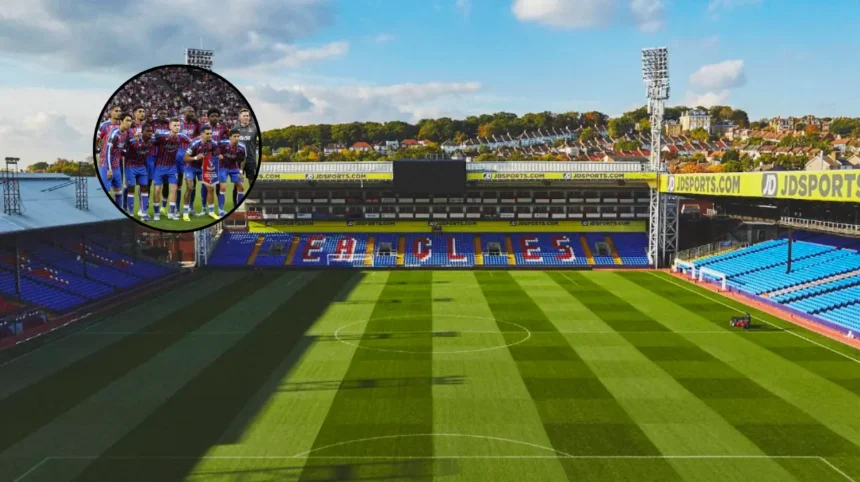
Key Points
- Real Madrid Leading: Real Madrid leads the World Cup club scoring charts with seven goals, propelled by Kylian Mbappé’s braces against Senegal and Iraq alongside Jude Bellingham’s strike against Croatia.
- Crystal Palace Surge: Crystal Palace has sensationally risen to second place with six goals, driven by braces from Daichi Kamada and Ismaila Sarr, and two goals from Daniel Muñoz.
- Messi FC Tracking Strongly: Inter Miami (represented as “Messi FC”) sits level with Paris Saint-Germain on five goals, with Lionel Messi scoring four goals, including a hat-trick against Algeria, to break the all-time tournament scoring record with 18 goals.
- Arsenal Languishing: Despite Kai Havertz giving Arsenal an early lead in the club stakes, the Gunners have fallen behind eight other clubs, including four Premier League rivals.
- Free Agents Flag Flying: Mohamed Salah has uniquely put “Free Agents FC” on the map by scoring one goal and providing two assists.
Crystal Palace FC (South London News) June 24, 2026 – Tottenham Aston Villa leave Tottenham boss Frank on the brink with FA Cup win but attention heavily shifts back to the global stage as the 2026 World Cup throws up statistical anomalies. Arsenal took an early lead in terms of World Cup club scorers, but they are now languishing behind eight clubs—including four Premier League rivals. While the footballing world is fully aware of the sheer quantity of representatives Premier League clubs have deployed across North America, a more granular, vaguely interesting, and entirely entertaining question has emerged: which clubs’ players have scored the most goals at the tournament? In a bizarre twist, Crystal Palace has leapfrogged European giants Paris Saint-Germain and the single-player powerhouse of Inter Miami (affectionately dubbed ‘Messi FC’) into outright second place, while Mohamed Salah is flying the flag for ‘Free Agents FC’.
- Key Points
- Which elite clubs lead the World Cup goals chart?
- How are Messi FC and Paris Saint-Germain faring?
- Where do the rest of the Premier League giants stand?
- Background of the club goalscoring metric at international tournaments
- Prediction: How these developments will affect global football audiences
Which elite clubs lead the World Cup goals chart?
As reported by Matt Stead of Football365, Spanish giants Real Madrid sit at the absolute pinnacle of the World Cup club scoring charts, with their contracted players accumulating a total of seven goals so far. Vinicius Junior has acted as a frequent savior for Brazil, executing vital performances against Morocco and Haiti.
Furthermore, Real Madrid’s new crown jewel, Kylian Mbappé, has quickly closed the gap on historical records by scoring twice against Senegal and twice against Iraq.
The European champions had to wait until the antepenultimate day of the opening round of group matches for their players to find the back of the net, but crucial contributions from Bradley Barcola and Ibrahim Mbaye for France turned the tide. English midfielder Jude Bellingham also joined the party, netting a vital goal against Croatia to cement Real Madrid’s status at the top.
The stunning rise of South London’s Crystal Palace
In one of the most unexpected developments of the tournament, Crystal Palace has climbed to second place on the global list. According to data tracked by Matt Stead of Football365, only five clubs in world football sent more players to the tournament than Crystal Palace’s 12-man contingent. However, few would have predicted the efficiency of their goalscorers.
The Eagles’ statistics reveal that Japanese midfielder Daichi Kamada has unexpectedly registered as their first and third goalscorer of the tournament.
Colombian wing-back Daniel Muñoz struck their second and sixth goals, including a crucial match-winner against DR Congo to seal knockout qualification. Senegalese winger Ismaila Sarr contributed the fourth and fifth goals, ensuring Crystal Palace boasts an incredible six goals at the finals.
How are Messi FC and Paris Saint-Germain faring?
The phenomenon colloquially known as “Messi FC”—officially representing MLS side Inter Miami—rests comfortably in the upper echelons of the chart with five goals.
As reported by Al Jazeera sports journalist Manasi Pathak, Lionel Messi, who celebrated his 39th birthday, has broken the all-time men’s FIFA World Cup scoring record, elevating his historical tally to 18 goals.
Messi’s tournament began with an astonishing hat-trick against Algeria, followed by a record-shattering fourth goal of the current edition just six days later. His individual brilliance has single-handedly kept Inter Miami tied with some of the biggest club squads on the planet.
PSG and Liverpool match the five-goal mark
As outlined by Bechu S. of The Week, Paris Saint-Germain and Liverpool have also registered five goals through their respective international contingents. PSG’s tally has been bolstered by the likes of Ousmane Dembélé, who carried over his fine club form from the UEFA Champions League final.
Liverpool’s internal scoring charts have benefited from diverse contributions, including Egypt’s Mohamed Salah, who remains highly visible in the statistical columns.
Where do the rest of the Premier League giants stand?
Rounding out the top tier are historical powerhouses Manchester United, Manchester City, and Germany’s Bayern Munich.
Manchester City holds the record for the most player call-ups at the tournament with 19 squad members, finding goals through Erling Haaland’s exploits against Iraq and Senegal.
Bayern Munich, who sent 18 players, has relied on English captain Harry Kane, who entered the tournament having averaged better than a goal-a-game for his club in 2026.
Manchester United’s contingent, featuring Marcus Rashford and Bruno Fernandes, has kept them firmly in the hunt, while Arsenal’s early momentum via Kai Havertz has stalled, leaving them struggling to keep pace with their domestic rivals.
Background of the club goalscoring metric at international tournaments
The phenomenon of tracking club-specific goal tallies during international FIFA tournaments has grown significantly with the commercialization of modern football.
Historically, dominant domestic eras—such as Juventus supplying the core of Italy’s 1982 squad or Barcelona filling the ranks of Spain’s 2010 world champions—meant that club goals were heavily concentrated within traditional European powerhouses.
The 2026 iteration represents a massive structural shift due to the expansion of the tournament to 48 teams. With a wider distribution of global talent, mid-tier Premier League clubs like Crystal Palace can see their international players maximize output for nations like Colombia, Senegal, and Japan, thereby outpacing traditional elite clubs who traditionally dominated international scoring charts.
Prediction: How these developments will affect global football audiences
This shift in goalscoring distribution is poised to significantly impact casual football fans, club scouts, and mid-tier sports marketing.
For fans of clubs like Crystal Palace, seeing their players outscore the rosters of PSG and Barcelona on the world stage creates immense cultural pride and elevates the club’s global brand profile.
However, for the clubs themselves, this exposure is a double-edged sword. Elite performances from players like Daniel Muñoz and Daichi Kamada under the global spotlight will inevitably attract aggressive transfer bids from wealthier clubs during the upcoming transfer window.
Audiences can expect a highly volatile transfer market where mid-tier clubs demand unprecedented premiums for their World Cup stars, ultimately reshaping domestic squad depth ahead of the next domestic season.