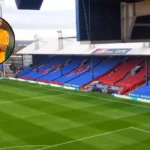
Key Points
- Crystal Palace Football Club has officially commenced the physical demolition of six residential properties on Wooderson Close adjacent to the stadium.
- The clearing of these houses removes a critical land acquisition bottleneck that has stalled the infrastructure project for several years.
- The overarching project aims to replace the historic, 102-year-old Main Stand, which originally opened in 1924 and was designed by famed architect Archibald Leitch.
- The redevelopment will increase Selhurst Park’s total capacity from roughly 26,000 seats to more than 34,000 seats.
- The new Main Stand will expand from its current capacity of 5,200 seats to a modern, three-tier structure accommodating 13,500 supporters.
- Financial backing for the massive development includes a £125 million loan deal secured from a consortium led by the Goldman Sachs Group Inc.
- The club intends to keep Selhurst Park fully operational during matchdays throughout the construction phase by building the new structure over and around the existing stand.
- Total project costs have escalated significantly since the project was first unveiled in 2017, with current estimates placing the budget at approximately £200 million.
Crystal Palace FC (South London News) June 30, 2026 – Crystal Palace Football Club has officially triggered the physical phase of its long-delayed Selhurst Park stadium redevelopment by executing the demolition of six residential properties on Wooderson Close. This operational milestone marks the first highly visible sign of structural progress on a project that has remained largely confined to planning frameworks and council debates since its public inception in 2017.
- Key Points
- Why Did The Land Acquisition On Wooderson Close Take Nearly A Decade To Resolve?
- What Financial Framework Is Underpinning The £200 Million Infrastructure Expansion?
- How Will Crystal Palace Maintain Matchday Operations and Avoid Capacity Reductions During Construction?
- Background of the Selhurst Park Expansion Project
- Prediction on How the Redevelopment Will Affect Local Residents and Match-Going Supporters
The clearance of the houses, which directly border the western edge of the stadium estate in the SE25 postal district, represents the resolution of a prolonged land acquisition hurdle that had blocked the expansion footprint. Diggers and demolition crews moved onto the site immediately following the conclusion of the 2025/26 football season, signalling to local residents and the wider sporting community that the club is shifting from preliminary preparation to heavy civil engineering.
The strategic objective of the capital project is to completely overhaul the centenarian Main Stand, which has stood since 1924, replacing it with a towering, multi-tiered glass and steel structure. By executing the property clearances during the summer off-season, the club’s leadership is attempting to establish a secure construction zone to facilitate heavy machinery access without altering the team’s home fixture schedule.
Why Did The Land Acquisition On Wooderson Close Take Nearly A Decade To Resolve?
As documented by regional planning logs and official updates from the executive team at Crystal Palace, the primary logistical barrier to expanding the Main Stand footprint was the physical proximity of residential housing on Wooderson Close.
To build a stand capable of housing thousands of additional spectators, the club required an expanded estate perimeter, which necessitated buying out properties managed by the local authority as well as privately held real estate.
According to statements released by Crystal Palace Football Club via their official communication channels, the club spent years negotiating the complex purchase agreements.
Five of the targeted properties were owned by the Croydon Borough Council, while one was a privately held residence that required comprehensive negotiations under the threat of a compulsory purchase order (CPO).
The club officially finalized the property transfers and successfully rehoused all affected tenants earlier this year, clearing the path for the physical demolition observed this week.
Further reporting from Lewis Blain, the News and Features Editor for Football Ground Guide, confirmed that the club published fresh media footage demonstrating the physical destruction of the buildings.
Blain observed that for a support base accustomed to continuous administrative delays, the sight of actual machinery actively flattening the Wooderson Close pinch point offers the most definitive evidence yet that the project has transitioned into an active development phase.
What Financial Framework Is Underpinning The £200 Million Infrastructure Expansion?
The financial scale of the Selhurst Park expansion has risen sharply from its original 2017 projections, which initial estimates placed at roughly £100 million.
Due to post-pandemic supply chain issues, inflation in construction materials, and specialized engineering adjustments required to build over an active stadium, the total project valuation is now estimated by industry analysts to hover around the £200 million mark.
To bankroll this major capital expansion, the club’s ownership group sought institutional financing from international credit markets.
As reported in financial disclosures compiled by Bloomberg analysts, the Goldman Sachs Group Inc. has successfully arranged and led a £125 million loan facility specifically structured to finance the stadium expansion.
This multi-million-pound capital injection ensures that the club possesses the liquid reserves necessary to pay primary contractors as structural steelwork and glass installations commence.
Commercial projections detailed within the stadium design blueprints from StadiumDB indicate that the new structure is expected to generate an additional £15 million in matchday and corporate revenue per annum.
This structural uplift means that the club’s directors anticipate the entire capital investment will effectively pay for itself within five to seven years of official completion, bolstering the club’s long-term capability to comply with Premier League financial sustainability regulations.
How Will Crystal Palace Maintain Matchday Operations and Avoid Capacity Reductions During Construction?
One of the most complex engineering constraints of the Selhurst Park project is the club’s strict requirement that the stadium must remain fully operational throughout the multi-year construction lifecycle.
Unlike clubs that temporarily relocate to national arenas during a rebuild, Crystal Palace will continue to host its full calendar of Premier League and domestic cup fixtures in south London.
In a detailed technical breakdown published on the club’s official portal, Crystal Palace Chief Operations Officer Jonty Castle outlined that the construction methodology involves building the vast majority of the new, 41-metre-tall stand directly over and behind the existing seating bowl.
This allows the lower tiers of the historic 1924 stand to remain open to the public on matchdays, preventing a catastrophic drop in regular ticket revenue and preserving the local acoustic atmosphere.
However, keeping the main bowl open requires relocating vital back-of-house infrastructure. Castle revealed that the old hospitality facilities, the Palace for Life Foundation headquarters, and the media centers are being systematically dismantled.
The opposition team changing rooms—historically housed in a famous, long-standing portacabin between the Main Stand and the Holmesdale Road Stand—have been permanently removed to open up a clear transit route for construction vehicles.
To facilitate this, the club invested more than £1 million to completely waterproof and renovate the basement of the Holmesdale Road Stand, transforming it into a dry, modern compound that will house temporary team changing rooms and industrial matchday kitchens until the permanent Main Stand facilities are complete.
Background of the Selhurst Park Expansion Project
The historical lineage of Selhurst Park dates back to its opening on August 30, 1924, featuring a Main Stand designed by the legendary Scottish structural engineer Archibald Leitch, who was responsible for iconic British football venues such as Highbury, Anfield, and Old Trafford.
For nearly a century, the ground underwent only incremental updates, leaving the Main Stand as one of the oldest, most structurally outdated facilities in top-flight English football, characterized by restricted sightlines, wooden support elements, and highly confined corporate concourses.
The modern push for redevelopment began in earnest in December 2017, when Crystal Palace Chairman Steve Parish publicly unveiled a master plan developed alongside architectural firm KSS Group to transform the stadium into a 34,000-plus seat venue.
Croydon Council granted planning permission in principle in April 2018, but the project ground to an absolute halt due to a series of institutional and global shocks.
The economic disruption of the COVID-19 pandemic forced the club to freeze major capital expenditures, diverting financial resources toward completing its elite youth academy facility at Beckenham, which was finalized in 2021.
When infrastructure focus returned to the stadium, the club faced stringent regulatory hurdles. The project required updated approvals from the Mayor of London’s office and a revised Section 106 legal agreement with local planning authorities, which legally bound the club to fund replacement housing for the residents displaced on Wooderson Close.
Furthermore, a complex commercial dispute with supermarket chain Sainsbury’s over the acquisition of a vital corner of land within an adjacent car park required protracted legal negotiations before an option-to-purchase treaty was finally signed. Croydon Council gave its definitive, re-approved green light to a series of Minor Material Amendments—including reworked fire evacuation routes, additional elevator shafts, and internal spatial adjustments advised by independent fire engineers—allowing the enabling works of late 2024 and 2025 to transition into the current demolition phase.
Prediction on How the Redevelopment Will Affect Local Residents and Match-Going Supporters
The transition of the Selhurst Park project from administrative paperwork into a live, heavy-machinery construction environment will directly impact two primary audiences over the next 24 to 36 months: local residents living within the immediate stadium shadow and the match-going supporter base.
For local residents, particularly those residing on Holmesdale Road, Whitehorse Lane, and the remaining sections of Wooderson Close, the immediate consequence will be sustained environmental disruption. The neighborhood will experience a substantial influx of heavy goods vehicles (HGVs), increased ambient noise levels from structural steel assembly, and localized dust.
Because the club is building in a densely populated residential suburb rather than an isolated industrial park, street parking and residential access routes will face tight restrictions on matchdays and weekdays alike.
However, long-term property values in the immediate vicinity may see a positive adjustment once the surrounding public realm, new walkways, and modernized club aesthetics are completed, shifting the area away from an ageing industrial aesthetic toward a modern commercial hub.
For the match-going supporters, the construction phase will significantly alter the traditional matchday routine. Fans attending fixtures during the construction period will encounter modified entry points, temporary signage, and altered walking routes around the stadium perimeter due to the closure of the main club car park for construction staging.
Inside the ground, while seating capacity will be preserved, fans in the Main Stand will rely on temporary hospitality facilities and rerouted concourses. In the long term, once the project reaches completion, the supporter base will experience a radical improvement in amenity quality.
The expansion will resolve the club’s chronic ticket scarcity by introducing roughly 8,000 new seats, allowing thousands of fans currently stuck on multi-year waiting lists to secure season tickets. Furthermore, disabled supporters will gain access to vastly improved, state-of-the-art viewing elevated platforms, while the wider fanbase will benefit from standard modern concourse features including an expansive club museum, an upgraded multi-story megastore, a public cafe, and significantly faster food and beverage distribution systems.