Key Points
- Historical Callback: The 2026/27 primary uniform reintroduces the iconic diagonal sash design first introduced exactly 50 years prior in 1976.
- Design Specifics: The kit features a white base intersected by a red and blue gradient sash composed of expanding pinstripes, paired with white shorts and white socks.
- Commercial Evolution: This jersey debuts a multi-year sponsorship agreement with open-source technology infrastructure firm Temporal, moving away from gambling-related front-of-shirt sponsors.
- Polarised Fan Reception: A significant portion of the fanbase has reacted negatively online, arguing that a predominantly white kit resembles an away strip rather than traditional red-and-blue home colors.
- Technical and Heritage Details: The jersey includes a downsized circular retro crest utilized by the club between 1973 and 1987, alongside a blue eagle motif under the collar.
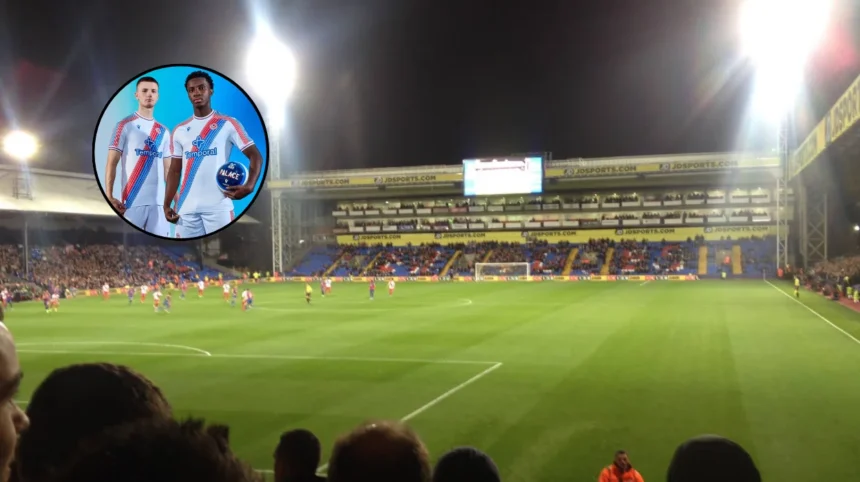
South London (South London News) July 18, 2026 – Crystal Palace Football Club has triggered widespread debate across its digital fanbase following the official unveiling of its new primary kit for the 2026/27 Premier League campaign. The uniform, manufactured by Italian technical sportswear brand Macron, departs from the club’s established setup of vertical red and blue stripes in favour of a predominantly white jersey broken up by a diagonal dual-coloured sash. While intended as a historic homage to the club’s celebrated 1976 FA Cup semi-final squad, the design has drawn strong criticism from sections of the Selhurst Park faithful, with numerous supporters taking to public forums to express dissatisfaction over the aesthetic deviation and the size of the newly introduced corporate sponsor.
Why has the return of the historic sash divided the Eagles’ fanbase?
As reported by the media relations office of Macron, the new garment features a white base with a red and blue sash running from the left shoulder towards the lower right side. The sash itself is constructed from a sublimated graphic of narrow lines that gradually increase in width.
Furthermore, the jersey body integrates a tonal geometric pattern alongside secondary red and blue striping over the shoulders and sleeves, paired with white shorts and white socks.
However, the departure from standard home expectations has caused frustration online. In a public compilation of supporter reactions compiled across social platforms, digital commentators expressed immediate concern regarding the primary colour palette. A prominent supporter posting under the username lewiitom stated that the “sponsor logo is a touch too big” and added that it
“doesn’t feel right that this is the home kit – should be away”.
Another fan using the handle OddTechnician7705 echoed this sentiment, noting:
“I like it, but I feel that it’s not our home kit. In my time supporting Palace our home kits have always been predominantly red and blue. This would make a lovely away kit.”
According to a review of the design elements published by the editors of Football Shirt Culture, additional details include a retro circular club crest—modeled after the emblem used by the club from 1973 to 1987—placed on the left chest opposite a blue Macron logo.
The scaling of these components drew criticism from users like MaskedRawR, who commented on the “microscopic badge when we’re objectively massive,” while a contributor named Bob24 argued that the design features “too much going on,” suggesting the design team should have “ditched the shoulder stripes” to avoid visual clutter.
What are the commercial implications of the new kit partnership?
Beyond the purely aesthetic modifications, the 2026/27 shirt marks a definitive commercial transition for the South London institution. In an official corporate statement released via the club’s primary media channel, Crystal Palace announced that the jersey is the first to feature its new front-of-shirt partner, the technology firm Temporal.
The multi-year agreement replaces previous gambling operations that had formerly occupied the central commercial space on the players’ chests.
As detailed in the club’s promotional report, Temporal operates as an open-source developer platform that powers underlying software architecture for major global brands including OpenAI, Snap, and Netflix. To launch the kit, the club produced an archive-based short film narrated by academy prospects Joél Drakes-Thomas and Jamila Toure, which included appearances from 1970s club legends such as Vince Hilaire, Dave Swindlehurst, and Billy Gilbert, alongside modern players Eddie Nketiah, Adam Wharton, and Brennan Johnson.
While the change in industry sector was praised by supporters relieved to see the departure of white-label sportsbooks, the scaling of the new logo remained a point of contention.
A fan identified as Crazyripps remarked that they
“wouldn’t mind it as much if it wasn’t for the giant sponsor,”
whereas baby_yoda_hunta noted it
“would have been better if the Temporal logo wasn’t right in the middle of the sash”.
Conversely, a supporter named PeaResponsible1456 defended the financial scale of the arrangement, writing that a reported “15m plus per year” significantly helps the club with its ongoing operational costs.
Background of the kit design development
The deployment of a white shirt featuring a diagonal red-and-blue sash carries deep historical weight within the institutional fabric of Crystal Palace FC. The concept was originally introduced to the club under the management of Malcolm Allison in 1976.
During that specific period, the distinct diagonal stripe accompanied the team during an unexpected and historic run to the FA Cup semi-finals, cementing the graphic format as an immediate favorite for generations of supporters. It subsequently served as the official home uniform designation for the 1976/77 season before the club returned to more traditional vertical stripe configurations.
In modern kit production cycles, global sportswear brands routinely balance heritage revivals with contemporary technological updates.
The 2026/27 iteration manufactured by Macron incorporates eco-sustainable elements, utilizing an “Eco Fabric” completely derived from post-consumer recycled plastic certified by the Global Recycled Standard.
The shirt body utilizes specialized Eco Light Sirena and Eco Micromesh inserts designed to facilitate breathability for athletes under professional match conditions.
The choice to re-introduce the sash variant exactly fifty years after its inception represents a deliberate structural attempt by the club’s marketing division to connect modern Premier League operations with historical milestones from the mid-1970s.
Prediction: How will this development affect matchday supporters and retail performance?
The introduction of the unorthodox 2026/27 home kit is poised to influence both the physical matchday environment at Selhurst Park and the club’s broader retail revenue streams. For the core matchday audience, the transition from a traditional red-and-blue dominant home end to a stadium bowl populated by white shirts will markedly alter the visual identity associated with the club’s home ground.
This visual shift may initially meet resistance from traditionalist fans who view the white aesthetic as a dilution of historical home presence during crucial Premier League fixtures.
From a financial standpoint, the polarized reception suggests a highly segmented retail performance. While traditionalists may choose to skip purchasing the primary shirt—opting instead to wait for the away or third kit releases—the design’s clean, lifestyle-oriented aesthetic is highly likely to appeal to younger, international, or casual consumers who prioritize streetwear fashion over traditional football design conventions.
Furthermore, the complete removal of betting logos eliminates a significant purchasing barrier for parents buying junior kits and for adult fans who object to promoting gambling merchandise. Consequently, despite vocal online opposition regarding the home status of the sash, the combination of a clean tech sponsor, sustainable manufacturing credentials, and retro appeal will likely stabilize overall seasonal retail revenues, even if it permanently alters the look of the Selhurst Park home stands.