Key Points
- Kingston Council’s planning committee refused Kingston University’s proposal for a 29-metre arts and education block at its Knights Park (Middle Mill) campus.
- More than 1,000 local residents objected to the scheme, with a Change.org petition against the development gathering 1,119 signatures.
- Objectors argued the tower would be too tall and out of character for a low-rise neighbourhood close to Mill Street Green, two conservation areas, a community garden and the Hogsmill River.standard+1
- The committee voted against council officers’ recommendation to approve the scheme, concluding a shorter building could deliver the same benefits.
- The university’s plans included demolition of existing student accommodation to make way for a new block with a lecture theatre, student gallery, teaching studios, specialist arts and media facilities, a café and a new public square.
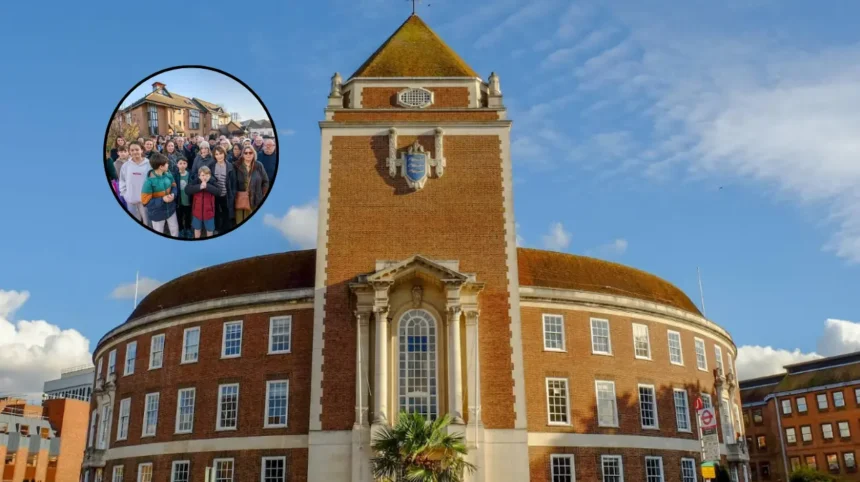
Kingston (South London News) July 21, 2026 –Kingston, south-west London, saw a decisive planning outcome this week as Kingston University’s proposal for a 29-metre arts and education building at its Knights Park campus was refused by Kingston Council’s planning committee. The decision follows sustained local opposition, with more than 1,000 residents objecting to the scheme on grounds that the height, scale and massing would be out of character with the surrounding low-rise neighbourhood and would impact nearby open space and environmental assets.
- What did the planning committee decide, and how did it differ from officers’ advice?
- Who objected to the scheme, and what were their main concerns?
- What exactly was Kingston University proposing to build at Knights Park?
- How did the local campaign articulate its case to the council?
- What role did the village green and conservation areas play in the decision?
- What happens next after the refusal of the 29-metre arts block?
- Background: How did this development proposal evolve, and why did it become contentious?
- Prediction: How might this decision affect local residents, students and future campus development?
What did the planning committee decide, and how did it differ from officers’ advice?
The planning committee voted on 16 July to reject the university’s development proposals, going against the recommendation of council planning officers, according to local reporting. In reaching its decision, the committee agreed that a shorter building could deliver the same benefits as the 29-metre structure set out in the application, a point that became central to the refusal.
The outcome marks a rare instance in which a major educational institution’s expansion plans are turned down after a high-profile local campaign.
Who objected to the scheme, and what were their main concerns?
Local residents organised a campaign group to oppose the tower, arguing it would overshadow Mill Street Green, a village green that the community successfully campaigned to register in 2006, as reported by local outlets. As reported by journalists covering the case, residents said the green “holds the heart” of the neighbourhood and regularly hosts community events, and that a 29-metre block built close to the green would steal light for hours each day and feel like
“losing something precious that can never be replaced”.
Objections also focused on the proximity of the site to two conservation areas, a community garden and the Hogsmill River, which campaigners described as fragile and in need of protection.
As covered in local reporting, residents said the proposed building would be too tall and out of character with the lower-rise neighbourhood, and that construction would cause disruption.
A Change.org petition opposing the scheme gathered 1,119 signatures, while more than 1,000 formal objections were submitted during the consultation process, according to local news coverage.
What exactly was Kingston University proposing to build at Knights Park?
Under plans submitted to Kingston Council, the university proposed to demolish existing student accommodation at Middle Mill, on its Knights Park campus, to make way for a new education block.
The proposed building would have included a lecture theatre, a student gallery, teaching studios, specialist arts and media facilities and a café, along with a new public square in front of the building, as set out in the application and reported by local media.
The university described the scheme as a redevelopment of its arts campus intended to consolidate and upgrade facilities for students and staff.
How did the local campaign articulate its case to the council?
Campaigners argued that the tower would erode community life and overshadow homes, neighbouring schools and a rare chalk stream, according to reporting on the protests. As covered by local journalists, residents said the development would loom over a community garden and the Hogsmill River, and that the scale of the proposal was inconsistent with the character of the area, which borders a conservation area.
The campaign group coordinated objections, petition signatures and public statements to demonstrate the depth of local concern, with residents emphasising the importance of protecting the village green and the surrounding low-rise streetscape.
What role did the village green and conservation areas play in the decision?
Mill Street Green, the village green opposite the Middle Mill site, emerged as a focal point of the debate, with residents stressing that the green only exists because the community fought for it to be officially registered in 2006, as reported in local coverage.
As noted by campaigners quoted in local media, building a 29-metre tower so close to the green would reduce light and alter the character of a space that regularly hosts community events.
The site’s proximity to two conservation areas was also cited by objectors as a reason to reject the height and massing of the proposed block, with residents arguing that the development would be out of keeping with the protected historic environment.
What happens next after the refusal of the 29-metre arts block?
With the planning committee having refused the current scheme, the university’s proposals in their present form cannot proceed. The committee’s conclusion that a shorter building could deliver the same benefits opens the possibility that the university could return with a revised, lower-height application, although any new proposal would be subject to a fresh planning assessment.
For now, the immediate effect of the decision is that the existing student accommodation at Middle Mill remains in place, and the site is not cleared for the new arts and education block.
Explore More Kingston Upon Thames Council News
Kingston Council Plans 20,000 New Homes: Kingston 2026
Liberal Democrats Win Landslide Victory in Kingston upon Thames 2026
Background: How did this development proposal evolve, and why did it become contentious?
The Knights Park campus of Kingston University has long been a focus for arts and media education in south-west London, with the Middle Mill site used for student accommodation alongside teaching and studio facilities.
The university’s redevelopment plans sought to replace older accommodation blocks with a new, consolidated arts and education building that would include a lecture theatre, student gallery, teaching studios, specialist arts and media facilities, a café and a new public square, as set out in the planning application and reported by local media.
Over time, the proposed height of the new block – 29 metres – became a flashpoint for local opposition. Residents and campaign groups argued that the scale of the building would be out of character with the surrounding low-rise neighbourhood and would impact Mill Street Green, a village green that the community successfully campaigned to register in 2006, as covered in local reporting.
The site’s proximity to two conservation areas, a community garden and the Hogsmill River added further weight to objections, with campaigners describing the river as fragile and in need of protection.
A Change.org petition opposing the scheme gathered 1,119 signatures, and more than 1,000 formal objections were submitted during the consultation process, according to local news coverage.
Planning officers initially recommended approval of the scheme, but the planning committee ultimately voted against that advice on 16 July, concluding that a shorter building could deliver the same benefits, as reported by local outlets.
The committee’s decision to refuse the 29-metre proposal reflects the strength of local feeling about the height and massing of the development, and the importance placed on protecting the village green, conservation areas and the character of the neighbourhood.
Prediction: How might this decision affect local residents, students and future campus development?
For local residents, the refusal of the 29-metre arts block is likely to be seen as a validation of community campaigning and a signal that large-scale, high-rise proposals in low-rise neighbourhoods will face rigorous scrutiny.
Households close to Mill Street Green and the Hogsmill River may feel reassured that the immediate risk of overshadowing, loss of light and construction disruption associated with the tower has been removed, at least in the short term.
For Kingston University students and staff, the decision means that the planned consolidation of arts and media facilities into a single new block will not proceed in its current form, potentially delaying upgrades to teaching studios, gallery space and specialist facilities that the university had outlined.
In the medium term, the university may explore revised, lower-height schemes that aim to deliver similar benefits while addressing concerns about scale and impact on the green and conservation areas, as suggested by the committee’s reasoning.
For future campus development in Kingston and similar south London neighbourhoods, the outcome could encourage planners and institutions to engage earlier and more deeply with local communities on issues of height, massing and design, particularly where proposals border village greens, conservation areas or sensitive waterways.
The case may also be cited in future planning debates as an example of how sustained local objection, backed by petitions and formal submissions, can influence committee decisions even when officers recommend approval.