Key Points
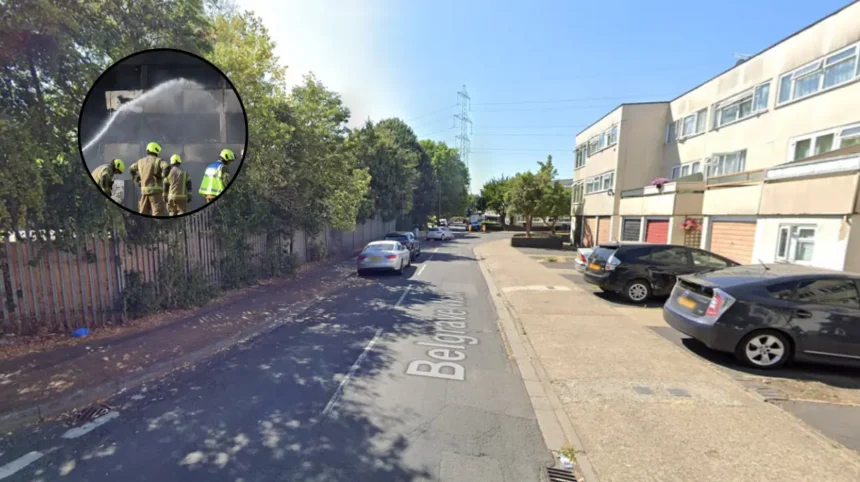
- Around 125 firefighters and 20 fire engines tackled a major blaze at converted ex‑townhouses in Belgrave Walk, Mitcham, on Saturday, July 25.
- The London Fire Brigade (LFB) was first called at 3.10pm; the fire was under control by 5.53pm after spreading across three floors and into roof spaces.
- No injuries were reported, but approximately 35 residents were displaced and a rest centre was opened at a local church.
- Assistant Commissioner Pam Oparaocha said crews worked in “arduous conditions” on a very hot day and would remain on site to tackle hot spots and carry out damping‑down operations.
- Residents were advised to keep doors and windows closed and to avoid the area due to smoke; the cause of the fire is under investigation.
Mitcham (South London News) July 27, 2026 — A major fire engulfed a block of converted ex‑townhouses on Belgrave Walk in Mitcham, prompting one of the largest firefighting responses in south London over the weekend, with around 125 firefighters and 20 fire engines deployed to the scene.
- Key Points
- How many firefighters tackled the Belgrave Walk blaze and when was it brought under control?
- Were there any injuries and how many residents were displaced?
- What did fire bosses say about the Mitcham flats fire?
- What advice was given to local residents during and after the fire?
- What is known about the cause of the Mitcham flats fire?
- Background: recent fire activity and housing context in Mitcham
- Prediction: how could this development affect Mitcham residents and local renters?
As reported by staff at the Evening Standard, the blaze broke out on Saturday afternoon and spread across all three floors of the residential block before reaching the roof spaces, requiring specialist equipment including a 32‑metre turntable ladder and drone support to access hard‑to‑reach areas.
The London Fire Brigade said it received more than 60 calls about the incident, with the first at 3.10pm, and brought the fire under control by 5.53pm.
How many firefighters tackled the Belgrave Walk blaze and when was it brought under control?
Around 125 firefighters attended the incident, supported by 20 fire engines drawn from Sutton, Wallington, Wandsworth and surrounding stations, the London Fire Brigade said in an incident update.
Crews worked for several hours in high temperatures before declaring the fire under control just before 6pm, after flames had consumed the roof spaces of the affected flats.
The brigade’s 32‑metre turntable ladder was deployed to allow firefighters to tackle the fire safely from height, while drone capability was used to search areas that were difficult to access, according to LFB statements reported by the Evening Standard and local news outlets.
Control officers mobilised additional resources as the incident developed, with crews conducting a systematic search of all affected buildings.
Were there any injuries and how many residents were displaced?
There are no reports of any injuries from the fire, the London Fire Brigade and local authorities confirmed. However, around 35 residents were displaced as a result of the blaze, with Merton Council and the fire brigade’s Community Engagement team working to support those affected.
A rest centre was established at a local church to provide immediate assistance to residents who could not return to their homes, Merton Council said in an update on the incident.
The council later confirmed that the rest centre had closed on Sunday evening, with residents who were still unable to return to their properties moved to temporary accommodation.
What did fire bosses say about the Mitcham flats fire?
Assistant Commissioner Pam Oparaocha of the London Fire Brigade said firefighters worked “tirelessly in arduous conditions” to bring the fire under control during what had been a very hot day, as reported by the Evening Standard. She added that although the fire was under control, crews would remain at the scene tackling hot spots and carrying out damping‑down operations to ensure the fire was fully extinguished.
“We continue to ask local residents to keep their doors and windows closed while crews remain on scene, as some smoke may still be present. Please also continue to avoid the area,”
Oparaocha said, according to the Standard’s report of her statement. She thanked firefighters, control officers and all staff who worked throughout the incident, describing their professionalism and dedication as “exceptional, particularly in such challenging conditions”.
What advice was given to local residents during and after the fire?
During the incident, the London Fire Brigade and Merton Council advised people to avoid the area and to keep doors and windows closed due to smoke being produced by the fire.
Motorists were also asked to avoid Belgrave Walk while emergency services responded, the council said in a Saturday afternoon update.
After the fire was brought under control, residents were told to continue keeping windows and doors shut while crews remained on site carrying out damping‑down work, according to statements from Assistant Commissioner Oparaocha reported by the Evening Standard.
The council and fire brigade’s community teams worked with partner agencies to support displaced residents, including through the rest centre and subsequent temporary accommodation arrangements.
What is known about the cause of the Mitcham flats fire?
The cause of the fire is not yet known and remains under investigation, the London Fire Brigade said. The incident is being treated as a serious residential fire given the scale of the response and the number of properties affected, but no official cause has been announced.
The brigade’s investigation will typically examine the origin and cause of the fire, including electrical systems, cooking appliances and other potential ignition sources, although no specific details have been released in relation to the Belgrave Walk incident.
Background: recent fire activity and housing context in Mitcham
The Belgrave Walk blaze follows other recent fire incidents in and around Mitcham, including a fatal house fire near Victoria Road in May 2026 and a large grass fire on Cedars Avenue in previous years, according to London Fire Brigade incident records.
The area has also seen significant attention due to a major fire at the Grade II‑listed Burn Bullock pub in April 2024, which badly damaged the historic building and remained a police‑secured crime scene for an extended period.
Converted ex‑townhouses and older residential blocks feature prominently in parts of Mitcham, and when fires take hold in such buildings they can spread rapidly through roof spaces and between properties, fire safety experts have previously noted in broader London fire guidance.
The scale of the response to the Belgrave Walk incident — with 20 fire engines and specialist aerial and drone equipment — underlines the complexity of fighting fires in multi‑occupied residential buildings, particularly during periods of high ambient temperature.
Explore More Mitcham News
South London Man Guilty of ISIS Bomb Manual Terror Case 2026
Leon Anderson Murder: Killer Gets Life for Mitcham Stabbing 2026
Prediction: how could this development affect Mitcham residents and local renters?
If the investigation finds issues linked to the building’s conversion, electrical systems or fire safety measures, the Belgrave Walk fire could prompt closer scrutiny of similar converted properties in Mitcham and across Merton, potentially affecting landlords, housing associations and private renters.
Residents in comparable blocks may face increased fire safety inspections, potential remediation work and, in some cases, temporary displacement while checks are carried out.
For local renters and leaseholders, the immediate impact is already visible in the form of displacement and reliance on council‑arranged temporary accommodation, as seen with the 35 residents moved from their homes after this fire.
Over the longer term, if the incident feeds into wider reviews of fire risk in converted townhouses and older blocks, it could lead to stricter enforcement of fire safety rules, higher compliance costs for landlords and, potentially, rent increases passed on to tenants, depending on how any remedial work is funded.