Lambeth is one of London’s richest boroughs for architectural and social history. Its historic buildings span more than eight centuries, from the medieval precinct of Lambeth Palace to twentieth-century landmarks such as the Royal Festival Hall. The borough also contains theatres, churches, industrial structures, civic buildings and culturally significant venues.
- What are the best historic buildings in Lambeth?
- Why is Lambeth Palace one of Lambeth’s most important historic buildings?
- Why is St Mary-at-Lambeth important to Lambeth’s architectural history?
- Why is County Hall a major historic landmark in Lambeth?
- Why is the Royal Festival Hall historically significant?
- Why is the Old Vic one of Lambeth’s most historic theatres?
- Why is St Mark’s Church in Kennington historically important?
- Why is Brixton Windmill one of Lambeth’s most unusual historic buildings?
- Why is the Royal Vauxhall Tavern an important historic building?
- How does Waterloo Station contribute to Lambeth’s historic architecture?
- How is Lambeth’s historic architecture protected?
- How can visitors explore Lambeth’s historic buildings efficiently?
- Why does Lambeth’s historic architecture remain important today?
Lambeth’s heritage is closely connected to the River Thames, the development of London’s southern suburbs, religious institutions, transport infrastructure, entertainment, industry and civic government. The borough has 62 conservation areas covering approximately 30% of its area, demonstrating the scale of its protected architectural character.
Historic building protection operates through several systems. A listed building is recognised for special architectural or historic interest and receives statutory protection. Grade I identifies buildings of exceptional interest, Grade II* identifies particularly important buildings of more than special interest, and Grade II represents buildings of special interest warranting every effort to preserve them.
For visitors, this creates a concentrated heritage landscape. South Bank provides major civic and cultural architecture. Lambeth Palace and St Mary-at-Lambeth provide medieval connections. Kennington and Vauxhall reveal nineteenth-century development, while Brixton preserves an unusual example of industrial technology.
The best historic buildings in Lambeth therefore represent different periods and functions rather than one architectural style.
What are the best historic buildings in Lambeth?
Lambeth’s historic buildings include Lambeth Palace, St Mary-at-Lambeth, County Hall, the Royal Festival Hall, the Old Vic, St Mark’s Kennington, Brixton Windmill, and the Royal Vauxhall Tavern. Together, they represent medieval, Tudor, Victorian, Edwardian, and modern architectural history in the borough.
These buildings provide a broad introduction to Lambeth’s heritage. They also demonstrate how the borough changed from riverside religious land and rural settlements into a dense part of metropolitan London.
Lambeth Palace is the strongest medieval landmark. St Mary-at-Lambeth adds another medieval layer and now houses the Garden Museum. County Hall represents twentieth-century civic administration, while the Royal Festival Hall represents post-war cultural architecture.
The Old Vic provides an important theatrical landmark. St Mark’s Church in Kennington records the expansion of nineteenth-century London and the construction of Waterloo churches after the Napoleonic Wars. Brixton Windmill records agricultural and industrial change.
The Royal Vauxhall Tavern represents Victorian entertainment and LGBTQ+ heritage. Historic England specifically recognises its cultural significance and its connection with the former Vauxhall Pleasure Gardens.
This range makes Lambeth particularly valuable for visitors interested in architectural history rather than a single historical period.
Why is Lambeth Palace one of Lambeth’s most important historic buildings?
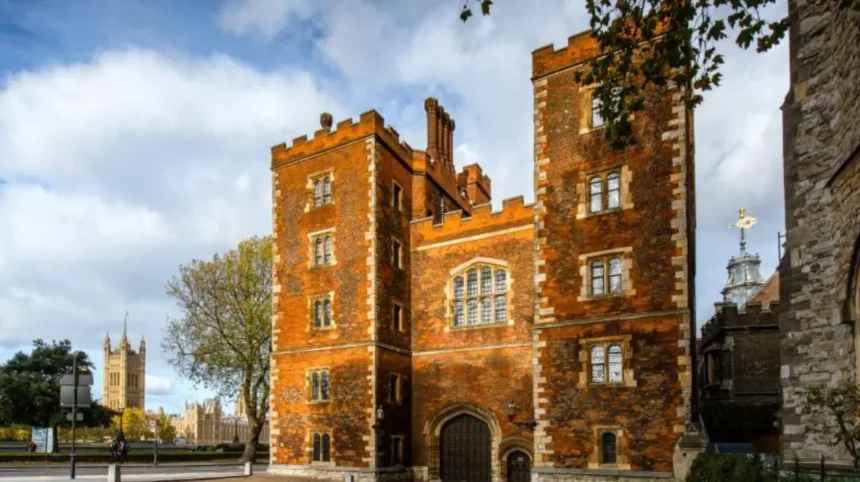
Lambeth Palace is the borough’s most important medieval complex and the London home of the Archbishop of Canterbury. Its surviving fabric includes Morton’s Tower, historic chapels, libraries, gardens, and later buildings, creating a continuous architectural record beside the River Thames.
Lambeth Palace has served as the London home of the Archbishop of Canterbury for more than 800 years. The Archbishop of Canterbury is the senior bishop and principal leader of the Church of England. The palace therefore has both architectural and institutional importance.
The complex contains buildings from different periods. One of its most recognisable features is Morton’s Tower, a red-brick Tudor gatehouse constructed in 1490 for Cardinal John Morton. Morton was Archbishop of Canterbury from 1486 until his death in 1500. The tower served as an audience chamber and remains the formal entrance to the palace.
The palace also contains a historic chapel and library collections. Lambeth Palace Library holds one of the largest collections relating to the history of the Church of England and Christianity in Britain.
The palace gardens cover just over 10 acres and are among England’s oldest gardens. The gardens add an important landscape dimension to the architectural complex.
Lambeth Council designated the Lambeth Palace Conservation Area in 1968. The conservation area also includes the former St Mary’s Church, historic development along Lambeth Road and Victorian buildings associated with St Thomas’ Hospital.
As you explore the modern site, you are crossing land with a deep heritage. Read about the full [Insert Anchor Text for History Article Here] to understand its origins.
Why is St Mary-at-Lambeth important to Lambeth’s architectural history?
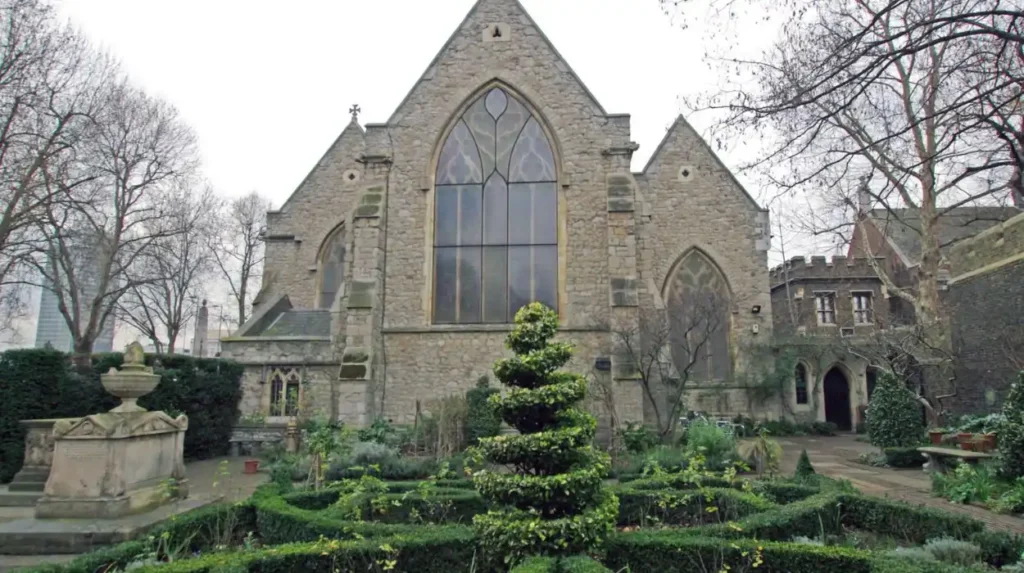
St Mary-at-Lambeth is a medieval church beside Lambeth Palace, now home to the Garden Museum. Its fourteenth-century tower survives, while the church contains historic monuments, including the tomb of gardener John Tradescant and evidence of centuries of long religious use.
St Mary-at-Lambeth stands directly beside Lambeth Palace Road and provides one of the clearest surviving links between medieval Lambeth and the modern borough.
The Garden Museum records the site’s history from the medieval period. A church was established here by 1062, and the site was recorded in the Domesday Survey of 1086. The existing medieval tower dates from 1377 and is described by the Garden Museum as the oldest surviving structure in Lambeth.
The building also has important connections with gardening history. John Tradescant the Elder, one of Britain’s most significant early gardeners and plant collectors, died in 1638 and was buried in the churchyard. His tomb remains a central feature of the site.
The church was threatened with demolition during the twentieth century. Rosemary and John Nicholson founded the Tradescant Trust in 1977 to save the abandoned building. The campaign resulted in the creation of the Museum of Garden History, which later became the Garden Museum.
The building therefore demonstrates adaptive reuse. Adaptive reuse means giving an existing historic structure a new function while retaining important heritage features.
Today, the former church operates as the Garden Museum. The building continues to combine historic architecture with exhibitions, collections, learning spaces and gardens.
Why is County Hall a major historic landmark in Lambeth?
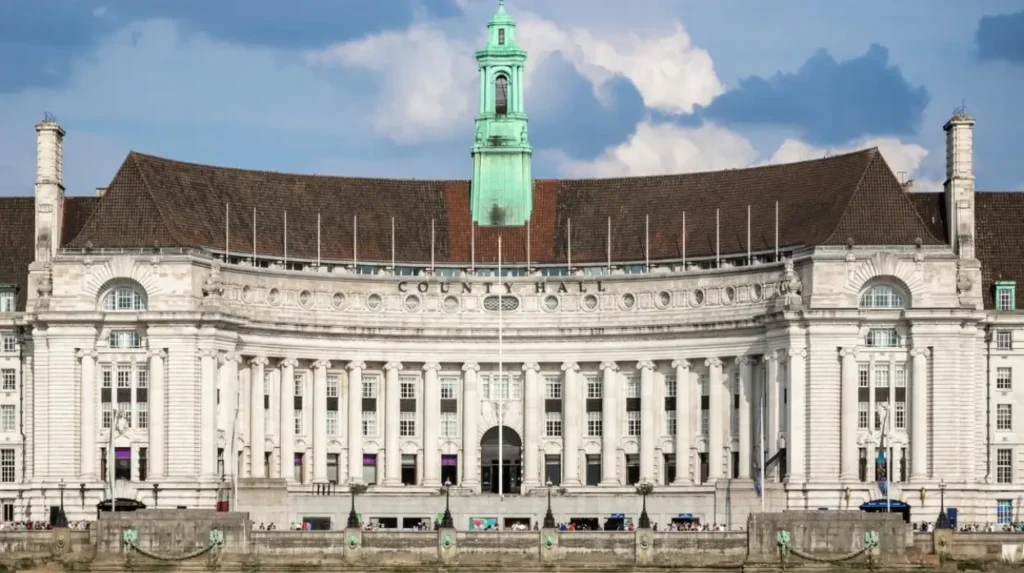
The main block of County Hall is a civic landmark, built between 1911 and 1933 for London County Council. Designed by Ralph Knott, its Portland stone elevations, mansard roof, giant Ionic order, sculpture, and riverside position give it architectural significance.
County Hall stands on Belvedere Road beside the River Thames. It was constructed for London County Council, the principal administrative authority for the former County of London between 1889 and 1965.
The main block was built in phases between 1911 and 1933. Architect Ralph Knott designed the building in a monumental classical style. Historic England records its long symmetrical river elevation, Portland stone construction, five-storey arrangement, steep mansard roof and large-scale Ionic architectural treatment.
The building was designed to communicate civic authority. Its riverside position placed the administrative headquarters directly opposite the historic centre of London.
County Hall is listed at Grade II*. This status identifies a building of more than special interest. The main block was first listed in 1951.
The wider County Hall complex also contains associated listed features. These include the river wall and decorative lamp standards. Historic England records approximately 250 metres of river wall immediately west of County Hall, including nineteen cast-iron lamp standards with decorative dolphin motifs and dates associated with the early twentieth century.
The building remains an important reference point when exploring the South Bank. Its architecture also demonstrates the transition from nineteenth-century municipal government to the larger administrative structures of twentieth-century London.
Why is the Royal Festival Hall historically significant?
The Royal Festival Hall is a Grade I listed concert hall built in 1949–1951 for the Festival of Britain. Designed by the London County Council Architect’s Department, it represents post-war modernism and remains a cultural building on Lambeth’s South Bank.
The Royal Festival Hall occupies a prominent position on Belvedere Road beside the River Thames. It was created as part of the Festival of Britain, a major national exhibition held in 1951 to celebrate British achievements in science, industry, design and culture.
The building was constructed between 1949 and 1951. Historic England identifies the London County Council Architect’s Department as the design organisation. The building was created as London County Council’s contribution to the Festival of Britain.
Its architectural character differs substantially from the classical form of County Hall. The Royal Festival Hall uses modernist principles associated with post-war reconstruction. Its large glazed surfaces, open circulation areas and carefully controlled auditorium design demonstrate the architectural priorities of the period.
The building received Grade I listing. Grade I is the highest category of statutory listed-building protection in England and identifies structures of exceptional interest.
The Royal Festival Hall also forms part of the wider South Bank cultural district. Its proximity to County Hall, Waterloo Bridge, Hungerford Bridge and other major landmarks creates a concentrated architectural landscape.
For visitors, the building provides an opportunity to examine post-war British architecture alongside older Victorian and Edwardian structures. Its continuing cultural function also demonstrates how historic buildings remain active parts of London’s urban economy.
Why is the Old Vic one of Lambeth’s most historic theatres?
The Old Vic is a Grade II listed theatre on Waterloo Road, built in 1816–1818. Its history includes theatre, music-hall entertainment, and major twentieth-century productions. Repeated alterations preserved a building that remains central to Lambeth’s performing-arts heritage and cultural identity.*
The Old Vic stands on Waterloo Road in the Waterloo district of Lambeth. Its history begins in the early nineteenth century, when the theatre was constructed between 1816 and 1818.
Architect Rudolph Cabanel of Aachen designed the original theatre. The building was subsequently remodelled several times. Historic England records major alterations in 1871, 1880, 1902, 1922–1923, 1927–1929, 1933–1938, 1950 and 1960, followed by major restoration in 1983.
These changes reflect the changing economics and uses of entertainment buildings. The venue was associated with theatre and later music-hall entertainment. During the late nineteenth century, Emma Cons developed the building as the Royal Victoria Coffee Music Hall.
The Old Vic became an important theatrical institution during the twentieth century. Its architectural importance is reinforced by its Grade II* status.
The theatre demonstrates how historic buildings can retain their cultural identity despite substantial adaptation. It also forms part of Waterloo’s wider historic environment, which includes railway architecture, civic buildings, theatres and transport infrastructure.
The Old Vic is therefore significant for both architecture and performing-arts history. Its location also makes it an accessible starting point for exploring several historic buildings within walking distance.
Why is St Mark’s Church in Kennington historically important?
St Mark’s Church in Kennington is a Grade II listed church built between 1822 and 1824 as one of London’s Waterloo churches. Its historic importance combines early nineteenth-century architecture, post-Napoleonic civic development, church history, and a significant surrounding war memorial.*
St Mark’s Church stands on Kennington Park Road near Kennington Park. The church was constructed between 1822 and 1824 after the British victory over Napoleon at Waterloo in 1815.
The church formed part of a programme of new churches intended to serve expanding populations in south London. Historic England identifies St Mark’s as one of the four Waterloo churches built in south London following the Battle of Waterloo.
The building is listed at Grade II*. Its significance reflects both architectural quality and its role in the development of nineteenth-century London.
The surrounding churchyard adds another historical layer. A First World War memorial was erected and unveiled in 1921. Historic England lists the memorial separately at Grade II and identifies its group value with St Mark’s Church and the churchyard wall and piers.
The church therefore connects three historical themes: post-Napoleonic urban development, nineteenth-century religious architecture and twentieth-century remembrance.
Kennington’s wider historic environment also contains residential streets, civic buildings and public spaces dating from different periods. St Mark’s provides a strong architectural focal point within this landscape.
Why is Brixton Windmill one of Lambeth’s most unusual historic buildings?
Brixton Windmill is a Grade II listed industrial landmark built in 1816 on farmland at Brixton Hill. It originally ground corn for flour, operated commercially until 1934, and now stands within Windmill Gardens as a rare surviving windmill in London.*
Brixton Windmill provides an important reminder that parts of present-day Lambeth were once rural. The windmill was built in 1816 at Brixton Hill when the surrounding area contained open farmland.
The building was used to grind corn and other cereals for flour. Wind provided the primary power source. As housing development expanded during the nineteenth century, surrounding open land decreased and the windmill became less effective.
Lambeth Council records that the windmill eventually ceased operating in the 1930s. It remained a visible industrial structure after its commercial use ended.
London County Council acquired the windmill site in 1957. The 2.5-acre area was subsequently developed as Windmill Gardens, a public open space. Associated buildings, including the bakery, outbuildings, Mill House and Mill Cottage, were demolished during the early 1960s.
Brixton Windmill is listed at Grade II*. Its survival is significant because it represents a form of wind-powered industrial technology that once operated in the countryside around London.
The building also demonstrates how urban growth changed Lambeth. A structure originally surrounded by farmland is now enclosed by a dense residential neighbourhood.
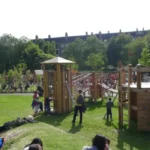
Windmill Gardens provides the historic building with a public setting. The site includes mature trees, hedges, seating and a children’s playground, making the windmill part of a wider public landscape.
Explore more Area Guide
Where Digital Nomads Can Work Comfortably in Lambeth: Cafés, Co‑Working, Libraries
Best Free Attractions in Lambeth: Museums, Parks and Culture
Why is the Royal Vauxhall Tavern an important historic building?
The Royal Vauxhall Tavern is a Grade II listed Victorian public house built in 1860–1862 on the former Vauxhall Gardens site. Its curved façade, surviving cast-iron columns, performance history, and LGBTQ+ cultural significance make it a protected building in Lambeth.
The Royal Vauxhall Tavern stands on Kennington Lane in Vauxhall. It was constructed between 1860 and 1862, shortly after the closure of Vauxhall Gardens in 1859.
Vauxhall Gardens had been one of London’s best-known pleasure gardens. The Royal Vauxhall Tavern therefore occupies a site with a long history of public entertainment.
Historic England attributes the building probably to architect James Edmeston the elder. Its mid-Victorian façade has a curved form with arcades ending in pedimented bays. Surviving structural cast-iron columns also contribute to its architectural significance.
The building developed an important performance role. During the late nineteenth and twentieth centuries, it became associated with drag, cabaret and alternative entertainment.
Its LGBTQ+ history is a major reason for its Grade II listing. Historic England describes the venue as one of the best-known longstanding LGBTQ+ venues in London and recognises its importance as a place of community, performance and cultural expression.
The building was listed in 2015. Its protection demonstrates how heritage recognition has expanded beyond traditional categories such as aristocratic houses, churches and civic buildings.
The Royal Vauxhall Tavern shows that historic architecture can preserve social history as well as physical design. Its importance comes from the combination of building fabric, location, entertainment history and community heritage.
How does Waterloo Station contribute to Lambeth’s historic architecture?
Waterloo Station’s Victory Arch is a Grade II listed memorial structure built between 1919 and 1922. It commemorates 585 London and South Western Railway employees who died in the First World War and combines transport history with monumental architecture.
Waterloo Station is one of London’s major transport landmarks, but its heritage significance includes a specific memorial structure rather than the entire modern station complex.
The Victory Arch was built between 1919 and 1922 as the principal foot entrance to the station. Historic England describes it as a triumphal arch approximately three storeys and an attic high.
The arch contains bronze plaques recording the names of 585 London and South Western Railway employees who died during the First World War.
The monument also contains sculptural groups representing Bellona and Peace. Britannia appears above the roof, while a clock forms part of the central composition.
Charles Whiffen designed the sculpture. A distinctive part of its history is the involvement of railway staff in the design process. Historic England identifies this consultation as unusual within post-First World War memorial architecture.
The Victory Arch is Grade II listed. It therefore provides a direct connection between transport infrastructure and national remembrance.
Waterloo’s position also makes it strategically useful for heritage exploration. Visitors can connect the station with the Old Vic, County Hall, Royal Festival Hall and the South Bank within the same broader walking area.
The station demonstrates that Lambeth’s historic buildings are not limited to traditional monuments. Railway architecture and memorial structures also form an important part of the borough’s historical identity.
How is Lambeth’s historic architecture protected?
Lambeth protects historic architecture through statutory listing, conservation areas and local heritage designation. These systems control demolition, manage alterations, recognise architectural character and preserve buildings, streetscapes and structures with documented historic or architectural importance.
Lambeth has a substantial conservation framework. The council currently identifies 62 conservation areas covering approximately 30% of the borough. These include Lambeth Palace, Clapham, Kennington, Waterloo, Brixton and Lambeth Walk and China Walk.
A conservation area is an area of special architectural or historic interest where preserving or enhancing its character or appearance is considered desirable. Additional planning controls apply within these areas.
Lambeth Council states that planning permission is required for the complete or substantial demolition of a building in a conservation area. Unauthorised demolition can constitute a criminal offence.
Some conservation areas also have Article 4 Directions. An Article 4 Direction removes specified permitted development rights, meaning additional planning permission is required for particular types of work.
Listed buildings receive another layer of protection. National listing is based on factors including architectural interest, historic interest, historical associations and group value. Age and rarity are also considered.
Lambeth also maintains a Local Heritage List. This includes buildings, structures, archaeological assets and spaces considered to have local or greater architectural or historic interest.
These mechanisms matter because heritage protection does not simply preserve isolated buildings. It also protects relationships between buildings, streets, public spaces and historic landscapes.
For visitors, this means that Lambeth’s heritage is visible across neighbourhoods rather than concentrated in one historic centre.
How can visitors explore Lambeth’s historic buildings efficiently?
Visitors can explore Lambeth’s historic buildings through several connected heritage areas, including South Bank and Waterloo, Lambeth Palace, Kennington and Vauxhall, and Brixton. Walking between nearby landmarks provides architectural context while public transport connects the borough’s more widely separated sites.
A South Bank and Waterloo route provides one of the most concentrated groups of landmarks. Start around Waterloo Station and examine the Victory Arch before continuing towards the Old Vic. From there, the route continues towards County Hall and the Royal Festival Hall.
Lambeth Palace and St Mary-at-Lambeth form another compact heritage area beside the Thames. The two buildings stand next to each other and illustrate the relationship between medieval religious institutions and later museum use.
Kennington and Vauxhall provide another strong heritage group. St Mark’s Church stands close to Kennington Park, while the Royal Vauxhall Tavern is located further north on Kennington Lane.
Brixton Windmill is farther south and is best treated as a separate heritage stop. The windmill provides a different architectural experience because it represents agricultural and industrial history rather than civic or religious development.
Visitors interested in conservation should also examine surrounding streets rather than focusing only on individual landmarks. Lambeth’s conservation areas preserve groups of buildings and historic streetscapes, including nineteenth-century terraces in Lambeth Walk and China Walk and extensive historic development around Clapham.
Access arrangements vary between buildings. Some remain active theatres, cultural venues or religious sites, while others operate as museums or public landmarks. Visitors should check the individual institution before planning an interior visit.
Why does Lambeth’s historic architecture remain important today?
Lambeth’s historic buildings remain important because they preserve evidence of religious authority, civic government, transport, entertainment, industry, community life and post-war cultural development. Their continued use also demonstrates how heritage buildings can support tourism, education, cultural activity and local identity.
Historic buildings provide physical evidence of how Lambeth developed. Lambeth Palace records more than eight centuries of religious and political history. St Mary-at-Lambeth records medieval worship and later heritage conservation.
County Hall demonstrates the growth of metropolitan government. The Royal Festival Hall records post-war cultural ambition and the Festival of Britain. The Old Vic represents more than two centuries of performing-arts development.
Brixton Windmill preserves evidence of an earlier rural economy. Its original purpose depended on agricultural production and wind power. The later surrounding urbanisation changed the conditions that allowed the mill to operate.
The Royal Vauxhall Tavern records a different type of heritage. Its importance demonstrates the growing recognition of LGBTQ+ social and cultural history within formal heritage protection. Historic England specifically identifies the building as nationally significant for its LGBTQ+ associations as well as its architecture.
This range makes Lambeth valuable for heritage tourism. Visitors can study different architectural periods within a relatively compact part of London.
Historic buildings also support adaptive reuse. St Mary-at-Lambeth became the Garden Museum after its rescue from demolition. Historic buildings can therefore retain physical fabric while supporting new cultural, educational or commercial functions.
Lambeth’s conservation framework also ensures that historic character remains part of future planning decisions. The borough’s large number of conservation areas means heritage considerations extend beyond individual listed buildings.
For residents, visitors and businesses, this creates a distinctive urban environment. Historic architecture provides visual continuity while accommodating contemporary uses.
Lambeth’s architectural heritage is therefore not simply a record of the past. It remains an active part of the borough’s cultural, economic and civic landscape.
What are the best historic buildings in Lambeth?
The best historic buildings in Lambeth include Lambeth Palace, St Mary-at-Lambeth, County Hall, the Royal Festival Hall, the Old Vic, St Mark’s Church in Kennington, Brixton Windmill and the Royal Vauxhall Tavern.