Key Points
- Repeated Wildfires: Mitcham grassland in south London was engulfed by two separate grass fires within a three-day period, sparking a major response from emergency services.
- August 12 Incident: Eight fire engines and approximately 60 firefighters responded to a significant blaze near Beddington Lane on the evening of August 12.
- Second Outbreak: A separate wildfire erupted near Commonside East, leading to another urgent deployment of emergency crews utilizing specialized wildfire beaters.
- Extensive Damage: The August 12 incident alone destroyed roughly four hectares of grassland before emergency crews brought the flames under control.
- Specialist Deployment: The London Fire Brigade dispatched a Terrain Support Vehicle carrying 475 litres of water, backpack blowers, and misting technology to navigate the rough terrain.
- No Casualties Reported: Officials confirmed that no injuries were recorded as a result of either grassland blaze.
Mitcham (South London News) August 13, 2026 —Emergency services were called to Mitcham grassland twice within three days after consecutive wildfires broke out, sending plumes of smoke across south London. The double outbreak has sparked a significant multi-agency response to protect adjacent infrastructure and prevent the blazes from spreading into nearby residential areas.
What Happened During the Grassland Fire on August 12?
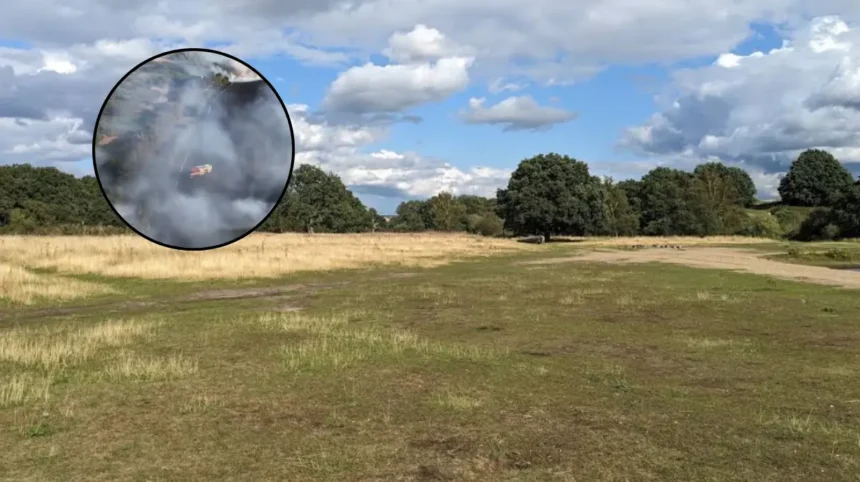
On August 12, a large grass fire erupted near Beddington Lane, leading to significant disruption across the local area.
The London Fire Brigade control room received the first of 12 emergency calls at 6:23 pm as residents spotted thick smoke rising from the open ground.
Eight fire engines and around 60 firefighters were dispatched to the scene to tackle the spreading flames. Crews from Norbury, Croydon, Wimbledon, and surrounding fire stations arrived quickly to establish a perimeter and contain the fire.
According to official incident reports from the London Fire Brigade, approximately four hectares of grassland were completely destroyed during the incident. Firefighters worked for nearly two hours to stop the spread across dry ground, officially bringing the fire under control by 8:10 pm. No injuries were reported in connection with the blaze.
To access hard-to-reach areas across the open grassland, emergency responders deployed one of the brigade’s Terrain Support Vehicles.
These specialist off-road units carry roughly 475 litres of water, backpack blowers, beaters, and misting lance technology, allowing firefighters to pump water while driving directly alongside the fire front.
How Did the Second Fire Unfold Near Commonside East?
The Beddington Lane incident followed another severe wildfire that broke out in the same area near Commonside East just days prior. Emergency crews were called to address flames burning through approximately one hectare of dense shrubs and dry grass.
Fire crews deployed specialized wildfire beaters—long-handled tools featuring heavy rubber flaps designed to smother flames by cutting off their oxygen supply and cooling the ground.
Control officers utilized location-tracking technology to dispatch crews precisely. In one instance, a member of the public utilized the “what3words” location app to provide responders with an exact grid coordinate down to three metres, ensuring appliances could navigate directly to the fire line.
Explore More Mitcham News
60 Firefighters Battle Four-Hectare Grassland Blaze in Mitcham 2026
Major Mitcham Flats Fire Displaces 35 Residents in 2026
Background of the Particular Development
The recurrent wildfires in Mitcham follow prolonged spells of dry weather across southern England. When open spaces experience extended dry periods, tinder-dry vegetation becomes susceptible to ignition from minimal heat sources.
The London Fire Brigade has repeatedly highlighted the vulnerability of London’s green spaces during periods of elevated temperatures.
Fire safety experts note that grass fires can travel exceptionally fast across flat terrain and shift direction without warning due to wind shifts, placing heavy operational demands on local fire stations.
In response to similar incidents in recent years, fire authorities have updated their rural and open-ground operational strategies.
The integration of specialized off-road vehicles, thermal imaging equipment, and targeted public awareness campaigns regarding open flames and disposable materials forms part of a broader effort to mitigate urban-wildland interface risks across Greater London.
Prediction: How This Development Can Affect Local Residents and Emergency Services
Repeated incidents on open grassland require significant concentration of fire service assets. Mobilizing 60 firefighters and eight engines to a single site temporarily reduces operational capacity for other simultaneous emergencies across south London fire stations.
If dry weather conditions persist, fire services may need to reallocate regional crews or adjust staffing patterns to maintain adequate emergency cover.
For residents living in Mitcham and neighboring areas such as Beddington, Croydon, and Wimbledon, recurring wildfires present air quality challenges. Smoke inhalation poses risks to vulnerable groups, including individuals with pre-existing respiratory conditions like asthma.
Additionally, the destruction of multiple hectares of grassland alters local wildlife habitats and damages urban biodiversity across south London’s protected green spaces.
In the wake of multiple blazes within a short timeframe, local authorities and landowners may introduce stricter safety enforcement. This could include extended bans on open fires, barbecues, and outdoor smoking in public parks, alongside increased warden patrols across common lands to prevent accidental ignitions during dry periods.