Key Points
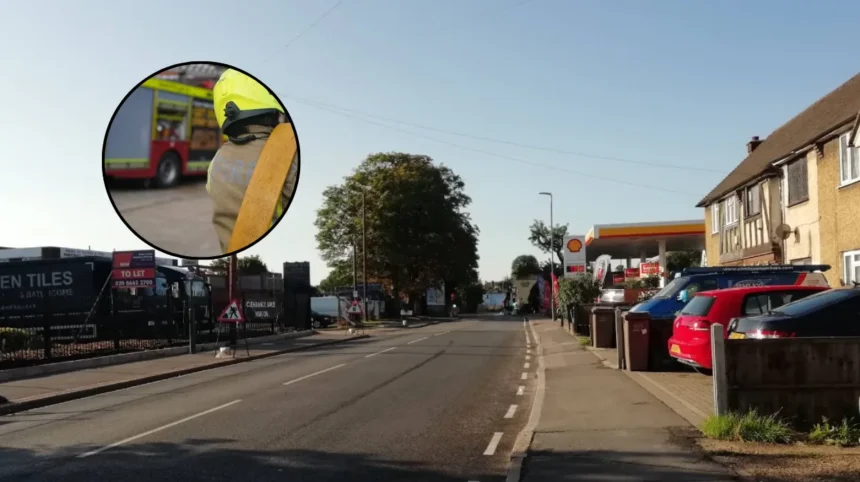
- Incident Location: A fire broke out across grassland near Beddington Lane in Mitcham, South London.
- Response Scale: Eight fire engines and approximately 60 firefighters were deployed to the scene.
- Area Affected: The blaze consumed around four hectares of open grassland before being brought under control.
- Emergency Calls: London Fire Brigade control officers received the first of 12 emergency calls at 6:23 pm.
- Specialised Equipment: Crews utilised a Terrain Support Vehicle carrying 475 litres of water alongside traditional wildfire beaters and misting lance technology.
- Casualties and Impact: No injuries were reported, and surrounding road traffic remained largely unaffected.
Mitcham (South London News) August 12, 2026 — A fast-moving grass fire consumed four hectares of open land near Beddington Lane in Mitcham on Monday evening, prompting a large-scale emergency response from the London Fire Brigade. Eight fire engines and approximately 60 firefighters were dispatched to the site following initial emergency calls received shortly after 6:00 pm. Crews worked for nearly two hours to contain and extinguish the flames across the terrain, with control achieved by 8:10 pm. No casualties were reported during or after the operation.
- Key Points
- How Did the Beddington Lane Grass Fire Unfold in Mitcham?
- What Equipment Was Deployed to Tackle the Four-Hectare Grassland Fire?
- Were Any Injuries Reported or Traffic Disrupted During the Mitcham Incident?
- What Is the Background Behind Grassland Fire Incidents in South London?
- How Will This Grassland Fire Impact South London Communities and Local Services Moving Forward?
How Did the Beddington Lane Grass Fire Unfold in Mitcham?
The emergency response was initiated when London Fire Brigade control officers logged the first of 12 emergency calls at 6:23 pm on Monday, August 10, 2026. Callers alerted authorities to plumes of smoke rising from open ground near Beddington Lane in Mitcham.
Fire crews were mobilised immediately from surrounding stations, including Norbury, Croydon, and Wimbledon. Upon arrival, firefighters encountered a rapidly expanding blaze moving across dry grassland. Social media images shared by observers in the area showed dense tunnels of smoke rising over the local green space.
According to official statements released by the London Fire Brigade, approximately four hectares of vegetation were affected during the incident.
Firefighters established perimeters around the burning grassland to halt the spread of the flames toward nearby properties and infrastructure. Through coordinated ground efforts, the fire was successfully brought under control by 8:10 pm.
What Equipment Was Deployed to Tackle the Four-Hectare Grassland Fire?
To manage the challenging conditions of open terrain, the London Fire Brigade deployed specialised wildfire response equipment alongside standard pumping appliances.
Among the key assets deployed was one of the brigade’s Terrain Support Vehicles, specifically designed to navigate off-road environments that are inaccessible to conventional fire engines. As stated in official reports from the London Fire Brigade, this vehicle enables the transportation of essential firefighting equipment directly onto open ground.
Each Terrain Support Vehicle carries approximately 475 litres of water, a backpack blower, ear defenders, wildfire beaters, and misting lance technology. This equipment allows firefighters to pump water continuously while driving, significantly increasing the speed and safety of the intervention.
Firefighters on the ground also made extensive use of manual wildfire beaters. As explained in the London Fire Brigade incident update, these tools consist of a long handle fitted with a flat piece of rubber at the terminal end.
By beating the burning vegetation, firefighters deprive the flames of oxygen while simultaneously cooling down the underlying embers to prevent reignition.
Were Any Injuries Reported or Traffic Disrupted During the Mitcham Incident?
No injuries to members of the public or emergency personnel were reported in connection with the Mitcham grassland fire. Ambulance services were not required to treat any individuals for smoke inhalation or burn injuries at the scene.
Traffic monitoring across the surrounding area indicated minimal disruption to local transport networks. While minor slow-moving traffic was recorded along Croydon Road passing through Mitcham Common during the height of the response, main arterial routes through Beddington Lane and the wider borough of Merton continued to move normally throughout the evening.
Explore More Mitcham News
Major Mitcham Flats Fire Displaces 35 Residents in 2026
Mitcham flats blaze leaves dozens displaced
What Is the Background Behind Grassland Fire Incidents in South London?
Grassland fires present a recurring operational challenge for emergency services across South London during periods of dry summer weather. Open spaces such as Mitcham Common, Beddington Farmlands, and local park reserves feature large expanses of unmanaged vegetation, dry brush, and tall grasses that become highly flammable under warm or windy conditions.
In recent years, the London Fire Brigade has updated its wildfire operational strategy to better manage open-land incidents. This strategy includes the strategic distribution of off-road Terrain Support Vehicles across high-risk boroughs and the specialized training of station crews in wildfire containment tactics.
The deployment of multiple crews from neighboring stations—such as Norbury, Croydon, and Wimbledon—reflects standard brigade protocols designed to surround open fires quickly before wind patterns cause rapid propagation.
How Will This Grassland Fire Impact South London Communities and Local Services Moving Forward?
The successful containment of the four-hectare fire near Beddington Lane prevents immediate structural damage, but the event carries broader implications for local residents, conservationists, and emergency planning authorities in South London.
For nearby residents in Mitcham and surrounding neighborhoods, the event serves as a practical reminder of the heightened fire risks associated with dry open spaces during peak summer months. Local authorities are expected to maintain public safety guidance emphasizing caution with outdoor materials, glass debris, and open flames near dry grassland.
From an environmental perspective, the destruction of four hectares of grassland temporarily disrupts local micro-habitats and wildlife nesting sites within the green corridor. Local land managers and council park teams will likely monitor the burnt area for natural regeneration over the coming growing seasons.
For the London Fire Brigade, the swift control of the incident within less than two hours validates the operational utility of specialized off-road vehicles and misting equipment. Continued reliance on these specialized tactics will remain a key element of emergency response readiness for future open-air incidents across South London’s green spaces.