Key Points
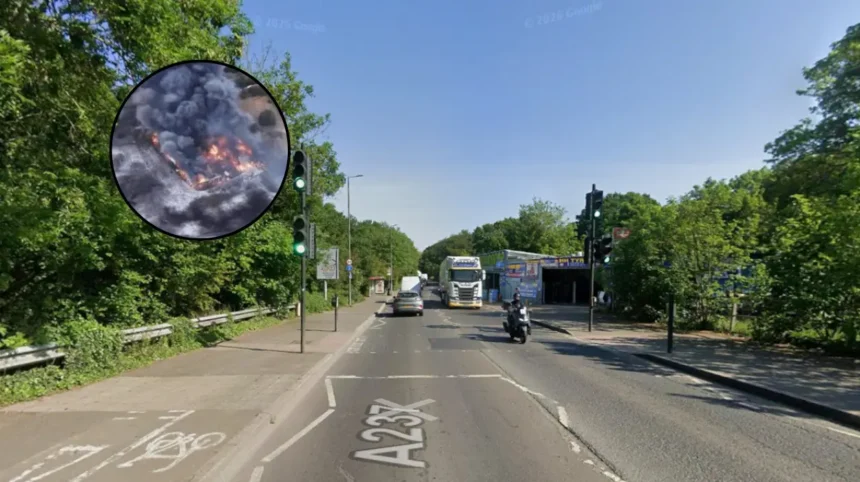
- A fire off Carshalton Road destroyed two houses, nine industrial units, 30 scrap vehicles, an industrial skip, and eight hectares of grassland across Mitcham Common.
- Roughly 125 firefighters and 20 fire engines responded to the scene, bringing the fire under control in four hours.
- Four residents evacuated their homes before emergency services arrived, and no injuries were reported.
- Crews stopped the fire 200 yards from the Beddington landfill site, preventing it from reaching stored combustible gases.
- The London Fire Brigade and the Metropolitan Police are treating the fire as suspicious and have launched a joint investigation.
- Heavy smoke delayed trains between Mitcham Junction and Sutton, while police closed Carshalton Road, Goat Road, and London Road for up to four days.
Mitcham (South London News) August 27, 2026 – A devastating fire that swept through tinder-dry grassland near Mitcham Common destroyed two residential houses, nine industrial units, 30 scrap vehicles, and an industrial skip, prompting a major emergency service response and a joint criminal investigation.
- Key Points
- How Did the Mitcham Common Fire Unfold?
- Was the Beddington Landfill Site at Risk?
- How Has Transport and Local Infrastructure Been Affected?
- Why Are Authorities Treating the Fire as Suspicious?
- Background of the Particular Development
- Predictions: How This Development Will Affect Local Residents and Businesses
As reported by Rebecca McCulloch of MyLondon, emergency services were called shortly before 4.30pm on Wednesday, 26 August, following more than 100 urgent 999 calls from members of the public as dark smoke filled the sky over South London.
How Did the Mitcham Common Fire Unfold?
The blaze initially ignited on dry scrubland before rapidly spreading towards a commercial complex off Carshalton Road. A spokesperson for the London Fire Brigade confirmed that the fire rapidly engulfed an industrial workshop and scaffolding yard before spreading to adjacent residential properties.
Four residents were forced to flee their homes on foot before fire crews arrived at the scene. Fire crews from Mitcham, Wallington, Norbury, and surrounding stations were dispatched to combat the fast-moving flames.
As detailed by Station Commander Jim Berry of the London Fire Brigade, who attended the scene, firefighters were deployed to a highly complex incident that demanded extensive specialist resources. The brigade used a 32-metre turntable ladder to pour water from height, a drone team to track hotspots, and a specialized terrain support vehicle capable of pumping 475 litres of water per minute across rough ground.
The London Fire Brigade confirmed that the fire was successfully brought under control by 8.30pm, roughly four hours after the initial emergency calls. Overnight rainfall subsequently assisted remaining firefighters in damping down embers across the eight hectares of burnt vegetation.
Was the Beddington Landfill Site at Risk?
As reported by Inside Croydon, serious concerns arose during the height of the blaze that the flames would breach the boundary of the adjacent Beddington landfill site. The landfill contains vast underground reserves of highly combustible methane and land gases.
Fire crews established defensive containment lines and successfully halted the advance of the fire approximately 200 yards short of the site, preventing what officers described as a potential environmental disaster.
How Has Transport and Local Infrastructure Been Affected?
The sheer volume of dark smoke generated by the burning scrap vehicles, industrial structures, and dry grass caused widespread disruption across Merton and Croydon.
Rail authorities were forced to halt train services between Mitcham Junction and Sutton due to severely restricted visibility, causing severe disruption to Southern and Thameslink passengers through to the end of Wednesday evening.
Furthermore, the Metropolitan Police established an extensive crime scene cordon. Carshalton Road, Goat Road, and London Road were immediately closed to all vehicular traffic, with highway authorities confirming that closures are expected to remain in place for up to four days while forensic officers inspect the site.
Why Are Authorities Treating the Fire as Suspicious?
As reported by London Now, the London Fire Brigade and the Metropolitan Police have officially launched a joint investigation into the cause of the disaster, with detectives confirming the incident is being treated as suspicious.
The incident follows a separate, smaller grassfire near Carshalton Road on Monday, 24 August, which required 25 firefighters to extinguish half a hectare of burning land. Police officers have confirmed that no arrests have been made at this stage.
Investigators have appealed to the public for information, asking anyone with dashcam footage, CCTV, or eyewitness details to contact police on 101 quoting reference 5039/26AUG, or to call Crimestoppers anonymously on 0800 555 111.
Background of the Particular Development
Mitcham Common is a 460-acre site of Site of Metropolitan Importance for Nature Conservation, managed by the Mitcham Common Conservators. The area primarily comprises acidic grassland, woodland, and scrubland, bordered by dense residential neighborhoods and light industrial estates along Carshalton Road and Beddington Lane.
During hot summer periods, the open scrubland of Mitcham Common becomes extremely vulnerable to wildfires. The London Fire Brigade has repeatedly highlighted South London’s urban commons—including Mitcham, Wimbledon, and Wandsworth—as high-risk zones during dry spells.
The presence of heavy industrial sites, commercial yards, and scrap storage adjacent to open grassland on Carshalton Road has long raised safety considerations regarding industrial fire breaks. The destruction of two residential dwellings highlights the growing challenge of managing wildland-urban interfaces across London boroughs, where open green spaces meet residential housing and commercial operations.
Predictions: How This Development Will Affect Local Residents and Businesses
The destruction caused by the Mitcham Common fire will have immediate and medium-term impacts on local residents, business owners, and regional infrastructure:
- Commercial and Business Disruption: For the owners and employees of the nine industrial units, workshop, and scaffolding yard destroyed in the fire, the economic loss will be severe. Insurance claims, forensic investigations, and structural demolitions will prevent business operations from resuming in the area for months.
- Severe Traffic Congestion: The four-day closure of major thoroughfares—specifically Carshalton Road, Goat Road, and London Road—will create bottlenecking across Mitcham, Beddington, and Hackbridge. Local commuter routes, freight traffic, and bus diversions will experience significant delays throughout the remainder of the week.
- Housing Displacement and Support: The residents of the two destroyed homes face long-term displacement. Local authority housing services in Merton and insurance assessors will need to provide immediate emergency accommodation and long-term rehousing solutions.
- Heightened Police and Fire Patrols: Following two fires on Carshalton Road within a 48-hour window, local residents can expect an increased presence of high-visibility police patrols and fire safety officers around Mitcham Common to deter potential arson and reassure the public.
- Policy and Fire Safety Review: The proximity of the fire to the Beddington landfill site is likely to trigger urgent reviews by the London Fire Brigade, Merton Council, and local land managers regarding vegetation management, fire breaks, and security measures along the perimeter of South London’s open commons.