Key Points
- Over 1,500 bus drivers employed by Arriva North London have postponed scheduled strike action following a new proposal regarding working conditions during extreme heat.
- Members of the trade union Unite walked out on Friday, 14 August and Tuesday, 18 August in protest over unsafe temperatures in driver cabs that reached up to 40°C and higher.
- A planned second round of strikes scheduled from Wednesday, 19 August through Friday, 21 August has been suspended while union members vote on whether to accept or reject Arriva North London’s offer.
- Key driver demands focus on replacing inadequate “air-cooling” systems—which lower cab temperatures by only 2°C to 3°C—with full air-conditioning systems across the fleet.
- Seven affected South London and North London bus routes, including key services from London Bridge and Waterloo, will operate normally during the balloting period.
- If union members vote to reject the newly offered deal, industrial action is scheduled to resume on Tuesday, 25 August.
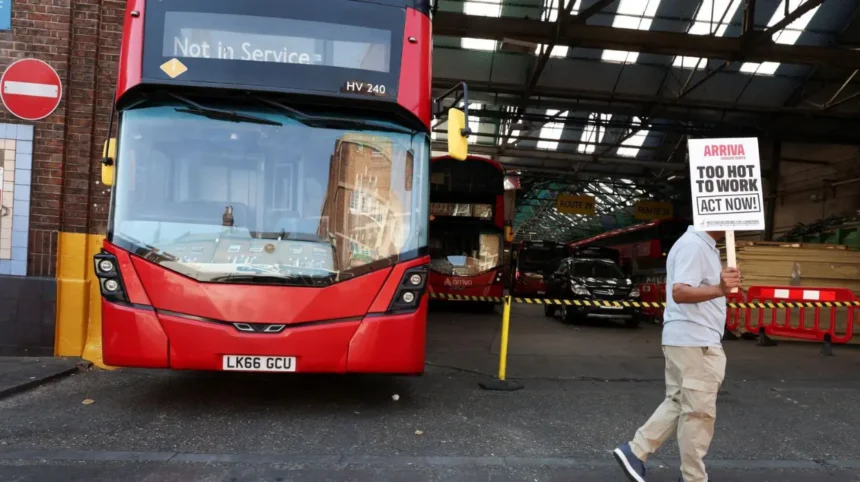
London (South London News) August 20, 2026 – Industrial action by more than 1,500 London bus drivers has been formally postponed after transport operator Arriva North London presented a revised proposal regarding driver working conditions during periods of extreme heat. Members of the trade union Unite, stationed across eight depots in London and Essex, suspended walkouts that were due to run through Friday to allow a workplace ballot on the new offer.
- Key Points
- Why Have Arriva North London Bus Drivers Suspended Their Planned Strike Action?
- What Risks Do Drivers Face Due To Excessive Heat Inside Bus Cabs?
- Which Bus Routes and Services Are Operating Normally During the Ballot?
- Background of the Heatwave Working Dispute and Fleet Standards
- Prediction: How This Development Can Affect London Commuters and Transport Networks
Why Have Arriva North London Bus Drivers Suspended Their Planned Strike Action?
As reported by Steven Stockwell, Regional Officer for Unite, union officials entered talks with Arriva North London representatives after driver walkouts commenced earlier in August. Following these negotiations, Arriva submitted a new package addressing thermal comfort and operational protocols for drivers exposed to elevated cab temperatures during London heatwaves.
As reported by Steven Stockwell of ITV News, Stockwell stated that
“Following talks, Arriva has made an offer to Unite members. To allow our members to have their say on whether to accept this, we have postponed strike action so they can be balloted”.
The industrial dispute involves over 1,500 drivers operating from eight key depots: Barking, Edmonton, Enfield, Grays, Palmers Green, Stamford Hill, Tottenham, and Wood Green. Drivers participated in initial strike days on Friday, 14 August and Tuesday, 18 August. The current suspension halts further walkouts that had been scheduled between Wednesday, 19 August and Friday, 21 August. Unite has confirmed that if the ballot results in a rejection of Arriva’s proposal, the full strike calendar—comprising up to 15 remaining days of action through October—will resume on Tuesday, 25 August.
What Risks Do Drivers Face Due To Excessive Heat Inside Bus Cabs?
The central driver grievance concerns working conditions inside driver compartments during London heatwaves, where internal cab temperatures have reportedly reached 40°C to 48°C.
As reported by Sharon Graham, General Secretary of Unite, in a press statement for Unite the Union, Graham stated that
“The heatwave this week has caused even more problems for our members at Arriva North London, who have once again faced doing a demanding job in unbearable conditions. No worker should be made ill by their job. This problem is raised year after year and as the summers get hotter it can no longer be swept under the carpet. Arriva can afford to act on this serious issue, which puts both drivers and the general public at risk and it must make this a priority”.
According to technical evidence provided by Unite, the majority of Arriva North London’s current fleet relies on “air cooling” or ventilation blowers rather than standard refrigeration-based air-conditioning units. Union technical assessments indicate that air-cooling mechanisms reduce ambient internal temperatures by only two to three degrees Celsius, leaving driver cabins exposed to solar radiation and engine heat that exacerbates internal temperatures.
As reported by press reporter Press Association, Peter Crane, a 62-year-old Arriva bus driver with 22 years of service, stated that
“We’re so fed up, we get into the bus, and it’s absolutely boiling. It makes you drowsy. It makes you feel a bit uncomfortable. You’re sweating, you’re sticky”.
Crane further noted that he had personally recorded cabin readings of 44°C, describing the drivers’ enclosure as operating like a greenhouse.
Union representatives highlight that extreme internal temperatures create physical hazards for vehicle operators, including dehydration, heat exhaustion, reduced cognitive alertness, and heatstroke. The dispute also encompasses claims raised by union delegates alleging managerial pressure and union-busting behaviors when staff raised health and safety concerns regarding vehicle temperatures.
Which Bus Routes and Services Are Operating Normally During the Ballot?
The temporary suspension of strike action restores full timetable operations across affected routes in North, South, and Central London that were facing severe disruption.
Seven primary London bus routes that serve major hubs, including Waterloo, London Bridge, and Finsbury Park, have resumed normal service while driver balloting takes place:
- Route 19: Operating from Battersea Bridge to Finsbury Park.
- Route 76: Operating from Waterloo to Tottenham Hale.
- Route 141: Operating from London Bridge to Palmers Green.
- Route 149: Operating from London Bridge to Edmonton Green.
- Route 243: Operating from Waterloo to Wood Green.
- Route 341: Operating from Waterloo to Northumberland Park/Meridian Water.
- Route N19: Night bus operating from Clapham Junction to Finsbury Park.
Transport for London (TfL) passengers utilizing these routes do not face immediate service cancellations during the ongoing ballot period.
Explore More Local South London News
South London Residents Demand End to Festival Damage in Southwark 2026
Massive Data Centre Proposed for Charlton Riverside 2026
Background of the Heatwave Working Dispute and Fleet Standards
The industrial dispute between Unite and Arriva North London follows several years of heightened debate surrounding occupational temperature limits for public transport workers in the United Kingdom. During the historic heatwaves of summer 2022 and subsequent high-temperature events in 2024 and 2025, London bus drivers documented cabin readings in excess of 40°C, prompting informal work stoppages and public safety warnings. Under existing UK workplace health and safety legislation, there is no statutory upper temperature limit for indoor workplaces, although employers are legally required to maintain a “reasonable” working temperature and conduct risk assessments under the Workplace (Health, Safety and Welfare) Regulations 1992.
Arriva North London, a subsidiary of Arriva UK Bus, operates major route contracts awarded by Transport for London. Financial disclosures published by Arriva in mid-2025 recorded an annual operating profit of €127 million (£108 million) and pre-tax earnings of €156 million. While Arriva has stated that long-term fleet modernisations include the gradual introduction of air-conditioned vehicles across its networks, driver representatives contend that retrofitting existing fleets or adjusting operational shift patterns during red-level heat alerts remains an immediate health necessity.
Prediction: How This Development Can Affect London Commuters and Transport Networks
The immediate postponement of industrial action provides temporary relief to hundreds of thousands of daily commuters across Greater London who rely on Arriva-operated routes. However, the broader trajectory of this dispute carries significant ongoing consequences for both the traveling public and regional transport infrastructure depending on the outcome of the driver vote.
If Unite members accept Arriva North London’s revised proposal during the ballot, full service stability will be permanently restored across the eight depots, eliminating the risk of 15 additional strike days planned through October. Such an outcome would also establish a benchmark for vehicle climate standards across Transport for London’s broader network of private operators, potentially accelerating operator expenditure on cab air-conditioning retrofits.
Conversely, if the driver ballot results in a rejection of the offer, strikes will resume on Tuesday, 25 August, initiating recurring multi-day service disruptions throughout late August, September, and October. These walkouts would directly overlap with scheduled engineering works and partial line closures on the Underground network—specifically along the Piccadilly Line—compounding urban congestion, increasing passenger volume on alternate bus lines, and extending daily travel times for North and South London commuters.