Key Points
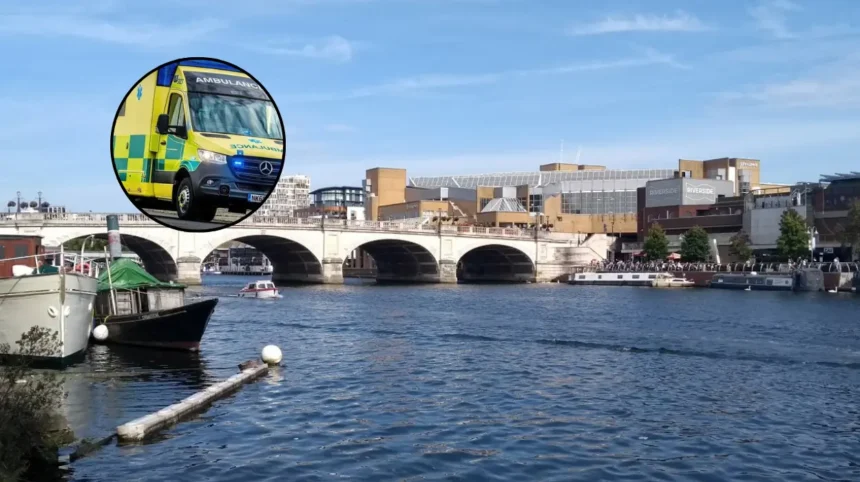
- Bridge Closure: Kingston Bridge was closed in both directions following a major emergency incident.
- Emergency Response: The London Ambulance Service dispatched an ambulance crew, an incident response officer, and Hazardous Area Response Team (HART) paramedics.
- Patient Transported: A female patient was treated at the scene by medical personnel before being transferred to hospital.
- Traffic Disruption: Severe traffic congestion built up along the A308 between High Street and Clarence Street, impacting several surrounding arterial roads.
- Public Transport Impact: Seven local bus routes were required to divert away from their standard routes due to the bridge blockage.
Kingston upon Thames (South London News) August 24, 2026 –Kingston Bridge was closed in both directions following a major emergency incident, prompting a multi-agency response from regional emergency services. The sudden road closure across the A308 crossing caused substantial traffic gridlock across Kingston upon Thames and adjacent borough boundary routes. Medical crews treated one patient on-site before transferring her to a local hospital for further medical evaluation.
What Caused the Closure of Kingston Bridge?
Emergency service vehicles responded to reports of an incident occurring on the bridge, necessitating an immediate complete shutdown of all vehicular lanes to secure the area.
As reported by the news desk of Kingston Nub News, a spokesperson for the London Ambulance Service stated:
“We were called at 5.05pm on Thursday (20 August) to reports of an incident on Kingston Bridge, Kingston upon Thames. We sent resources to the scene including an ambulance crew, an incident response officer and paramedics from our Hazardous Area Response Team. We treated a patient at the scene and took her to hospital.”
Which Roads and Public Transport Routes Were Affected?
The complete closure of the A308 span between High Street and Clarence Street triggered immediate tailbacks across the local road network. Motorists seeking alternative routes experienced long delays as surrounding corridors became heavily congested.
As detailed by transport reporters at Local London, traffic updates confirmed substantial congestion extending onto Horse Fair, London Road, Hampton Court Road, Upper Teddington Road, and Sandy Lane.
Additionally, Transport for London diverted seven bus routes away from Kingston Bridge to bypass the blocked corridor, resulting in significant delays for afternoon commuters reliant on public transport across the borough border.
Explore More Kingston Upon Thames News
Poor Boys Kingston Uber Eats Award Finalist, South London 2026
Kingston Charges London’s Highest Garden Waste Collection Fees: Kingston 2026
Background of the Kingston Bridge Development
Kingston Bridge serves as a primary arterial Thames crossing connecting the Royal Borough of Kingston upon Thames to the London Borough of Richmond upon Thames and South West London highways. Carrying the A308 road, the Grade II* listed stone arch structure handles tens of thousands of vehicle movements daily alongside critical public transit routes linking Surrey and London bus networks.
Due to the lack of immediately adjacent river crossings between Hampton Court Bridge to the west and Richmond Bridge to the north, any operational disruption or road closure on Kingston Bridge immediately restricts traffic throughput.
Emergency closures historically cause network-wide gridlock across Southwest London, as localized diversions force heavy traffic volumes onto residential and secondary road corridors.
What Is the Forecast for Local Commuters and Residents Following This Incident?
This emergency closure highlights the extreme sensitivity of Southwest London’s Thames transport infrastructure to localized disruptions.
Drivers, local bus passengers, and commercial transport operators traversing the Kingston upon Thames and Richmond boundaries should anticipate residual traffic delays following any emergency closure of this magnitude.
Drivers traveling between Surrey and London are advised to consult live traffic feeds and consider utilizing Hampton Court Bridge or the A3 arterial route during peak hours to avoid localized bottlenecking along Clarence Street and London Road.
Residents living along diversion corridors—such as Upper Teddington Road, Hampton Court Road, and Sandy Lane—may experience increased traffic volumes and noise pollution during secondary diversion periods.
Town centre businesses in Kingston near High Street and Clarence Street may also face short-term delivery delays when access corridors are constrained by emergency response operations.