Key Points
- Around 125 firefighters and 20 fire engines responded to a major fire near Carshalton Road in Mitcham.
- The fire destroyed nine industrial units, workshops, a scaffolding yard, an industrial skip, and about 30 scrap vehicles, while also damaging a house and burning eight hectares of nearby grass and scrubland.
- Four people left neighboring homes before crews arrived, and officials reported no injuries.
- Authorities closed local roads, and Network Rail suspended train services between Mitcham Junction and Sutton, causing delays across Southern and Thameslink routes.
- Crews used a 32-metre turntable ladder, aerial drones, and an off-road Terrain Support Vehicle equipped with 475 litres of water and a misting lance to fight the fire.
- The London Fire Brigade brought the blaze under control by 8.28pm, with crews remaining overnight to extinguish hotspots while investigators work to determine the cause.
Mitcham (South London News) August 28, 2026 – An investigation has been formally launched into the cause of a major fire that tore through an industrial site, damaged residential property, and swept across hectares of open scrubland in south London, necessitating a deployment of 125 firefighters.
- Key Points
- What was the extent of the damage caused by the Mitcham fire?
- How did emergency crews fight the Mitcham industrial blaze?
- How were local transport and residents affected by the incident?
- What is the background of this development?
- What is the prediction for how this development will affect local stakeholders?
As reported by Matt Watts, News Editor of the Evening Standard, approximately 20 fire engines were called out to Carshalton Road, Mitcham, shortly before 4.30pm on Wednesday following over 70 initial emergency calls to the London Fire Brigade (LFB) control room. The incident escalated rapidly across industrial yards, residential structures, and adjacent open fields.
What was the extent of the damage caused by the Mitcham fire?
The fierce blaze originated within an industrial boundary housing a tyre centre, a scaffolding yard, and multiple commercial workshops. Driven by warm conditions, the flames rapidly crossed boundaries to destroy nine industrial units, an industrial skip, and approximately 30 scrap vehicles, whilst spreading to part of a residential house.
Concurrently, the fire ignited dry vegetation across surrounding scrubland, consuming around eight hectares (20 acres) of grass and shrubland adjacent to Mitcham Common. As detailed by local emergency bulletins, plumes of thick black smoke billowed high above the south London skyline, becoming visible for miles and prompting widespread public concern.
Four occupants managed to safely exit nearby homes before emergency crews arrived on the scene. According to official updates released by the LFB, no injuries were sustained by members of the public or attending personnel during the major incident.
How did emergency crews fight the Mitcham industrial blaze?
To handle the complex dual threat posed by both structural and wildland blazes, the LFB mobilised fire crews from Mitcham, Wallington, Norbury, and surrounding regional stations. Firefighters utilized diverse specialized appliances to bring the situation under control by 8.28pm.
As reported by the Evening Standard, a 32-metre turntable ladder was elevated to operate as an overhead water tower, pouring high volumes of water into the heart of the burning commercial structures. The LFB Drone Team was simultaneously deployed, supplying continuous real-time aerial visuals to assist incident commanders in directing ground forces toward shifting fire perimeters.
To fight the fire advancing across open, uneven terrain, the LFB deployed a specialist Terrain Support Vehicle. This all-terrain vehicle holds approximately 475 litres of water and is equipped with a misting lance, backpack blowers, beaters, and ear defenders—allowing firefighters to drive directly alongside fire lines and suppress grass fires safely and efficiently.
In an official public update, Station Commander Jim Berry, who attended the scene, stated:
“Firefighters have worked hard this evening and have now brought this fire in Mitcham under control. At its height, the fire affected a workshop, a scaffolding yard and part of a house. Around half of the site remains alight. Multiple hotspots also remain alight across around eight hectares of shrubland and grass. Thankfully, there are currently no reports of any injuries.
“Firefighting operations will continue overnight as crews fully extinguish the fire and dampen down hotspots, so please continue to avoid the area if you can. Road closures are in place on London Road and Carshalton Road at the junctions of Willow Lane, Goat Road and Hackbridge Road.”
How were local transport and residents affected by the incident?
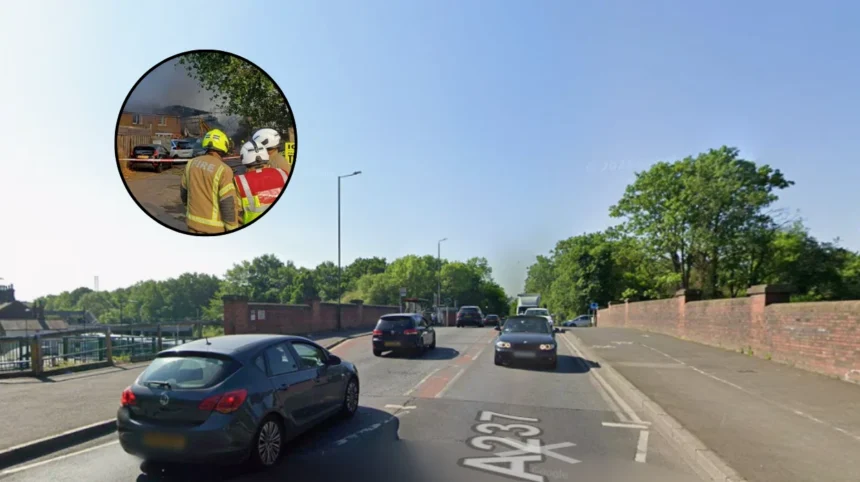
The major emergency response forced extensive closures across key transportation arteries throughout south London. Police and highways authorities established road closures along Carshalton Road and London Road, specifically restricting vehicle traffic at the junctions of Willow Lane, Goat Road, and Hackbridge Road.
Public rail transport suffered severe disruptions during the evening rush hour. Due to dense smoke obscuring visibility and the fire’s close proximity to railway infrastructure, Network Rail halted rail services running between Mitcham Junction and Sutton. This closure caused widespread cancellation and delay cycles across Southern and Thameslink networks, with disruption extending through the end of the travel day.
Given the significant volume of toxic smoke generated by burning industrial materials and scrap items, the LFB issued urgent public health warnings instructing local residents to keep all windows and doors securely closed and to strictly avoid the immediate vicinity of Mitcham Common.
What is the background of this development?
Industrial fire risks within suburban outer London, particularly where commercial zones directly interface with public open land like Mitcham Common, have drawn increasing scrutiny from local authorities and safety planners. Mitcham Common covers over 180 hectares of protected green space within the London Borough of Merton, surrounded by a complex patchwork of automotive workshops, waste transfer sites, and residential housing corridors.
This major incident represents the second significant outdoor fire in the immediate area within a single week, following a smaller grass fire on Carshalton Road that damaged roughly half a hectare of land just days prior. Over recent summers, prolonged dry spells across London have repeatedly highlighted the vulnerability of the capital’s grassland spaces to fast-spreading fires. Commercial sites handling combustible materials—such as tyres, scaffolding timber, scrap metal, and vehicle liquids—present heightened operational hazards for fire crews when blazes spread rapidly into adjacent, tinder-dry vegetation.
In response to similar large-scale open-land incidents across Greater London in recent years, the London Fire Brigade has progressively invested in specialist equipment, including off-road Terrain Support Vehicles, high-definition drone technology, and high-reach water towers to contain complex multi-environment blazes before they reach dense residential streets.
What is the prediction for how this development will affect local stakeholders?
The outcome and aftermath of the Mitcham fire are projected to have direct long-term operational, financial, and environmental impacts across several key local groups:
1. Local Businesses and Industrial Tenants
The total destruction of nine industrial units, alongside workshops, scaffolding yards, and commercial scrap vehicles, will result in significant financial losses and operational displacement for local business owners. Affected business operators face protracted insurance claims, loss of inventory, and potential business interruption while structural damage is assessed and sites are cleared. Insurance underwriters may subsequently adjust risk profiles and premiums for commercial tenants operating in close proximity to dry grassland corridors.
2. Local Residents and Homeowners
Property owners facing structural repairs will experience short-to-medium-term disruption, while broader residential neighborhoods along London Road and Carshalton Road face ongoing environmental cleanup from soot and smoke deposition. Local residents may see stricter enforcement of fire safety perimeters and intensified calls from community leaders for enhanced fire-break buffer zones between industrial properties and neighboring homes.
3. Transport Commuters and Local Traffic
While major rail lines between Mitcham Junction and Sutton are expected to resume normal operations following safety checks by Network Rail, road closures and localized diversions around Willow Lane and Hackbridge Road are likely to persist during joint Metropolitan Police and LFB forensic investigations. Local commuters should anticipate localized traffic congestion during peak hours throughout the investigation period.
4. Emergency Planning and Environmental Policy
The joint investigation by the LFB and Metropolitan Police Service into the exact cause of the blaze will likely feed into future emergency planning and environmental management policies for Merton Council and the London Fire Commissioner. Local authorities may face calls to increase regulatory safety checks on outdoor industrial storage practices and implement managed fire breaks along the borders of Mitcham Common to protect nearby infrastructure during dry summer conditions.