Key Points
- Bromley Council has held high-level talks with senior civil servants to request permission to raise council tax above the 4.99% cap.
- The local authority faces a £30.5 million real-terms reduction in funding by 2028/29, leaving a £43 million deficit next year.
- The cuts stem from Labour’s Fairer Funding Review, which reduces central funding for several London boroughs.
- Wandsworth, Kensington and Chelsea, and Westminster councils plan to launch legal challenges against the funding decision next week.
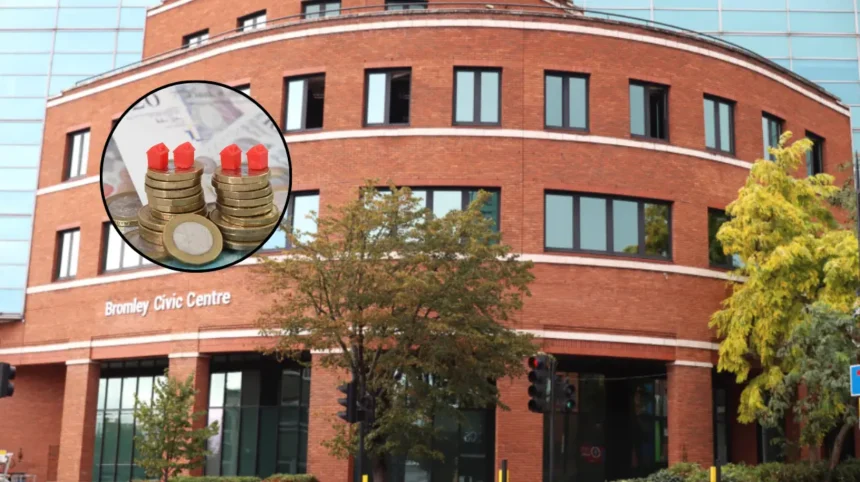
Bromley (South London News) August 29, 2026 — Reporting for the Evening Standard, Chief Political Correspondent Rachael Burford revealed that senior leadership at Bromley Council have initiated direct negotiations with Whitehall civil servants to secure an exemption from standard local authority tax controls. The local authority stated that Labour’s Fairer Funding Review will strip £30.5 million from its core budget in real terms by the 2028/29 financial year, leaving town hall directors with severe budget deficits.
Without significant intervention or tax adjustments, Bromley faces a £43 million funding deficit next year, a figure projected to balloon to £61 million by 2028.
Why Is Bromley Asking to Raise Council Tax Beyond the Cap?
As reported by Rachael Burford of the Evening Standard, Council Leader Colin Smith stated:
“We have always sought to be straight with residents and explain things how they really are and without doubt, this is by far the biggest financial challenge the council has ever faced.”
Leader Smith highlighted that while historically prudent fiscal management has kept the borough from immediate bankruptcy, the scale of state funding cuts makes standard operational adjustments impossible.
“Unlike other councils, Bromley’s careful financial management over many years means that we are not about to financially crumble overnight, but the stark and limited options available to us are increasingly apparent, which is why I want to share wider awareness of the severity of the situation,”
Smith explained.
Addressing the core trigger behind the local authority’s application, Smith added:
“The Government’s decision to reduce Bromley’s funding by over £30m by 2028 leaves us with no other viable option than to consider a higher than desirable council tax increase and that is the painful exercise we have now had to embark on. To that end, I can also confirm that high-level talks with senior civil servants have already taken place requesting that Bromley’s name be added to the list of those other London boroughs also blighted by the Government’s recent financial ‘reforms’ who have been granted permission to exceed the 4.99% cap and we now wait to hear back in due course.”
Which Other London Boroughs Are Affected by the Funding Cuts?
Bromley is the sixth London authority forced to seek financial relief mechanisms following wide-ranging modifications to municipal funding grants. Five other London councils—Wandsworth, Kensington and Chelsea, Hammersmith and Fulham, Westminster, and the City of London—alongside the Royal Borough of Windsor and Maidenhead, face unprecedented council tax increases to cushion steep funding adjustments.
Under the revised national redistribution framework, historically low-tax boroughs are facing severe structural reductions to core central government grants. In response, Wandsworth, Kensington and Chelsea, and Westminster are preparing to initiate formal legal challenges against the Ministry of Housing, Communities and Local Government, contesting the methodology behind the funding reductions.
Explore More Bromley News
Asbestos and Sinkhole Found in Shortlands Library, South London 2026
Bromley Football Club Plans Solar Panels at Hayes Lane, Bromley 2026
Background of the Particular Development
Local authority financing across the United Kingdom operates under strict statutory parameters. Traditionally, central government imposes a rigid statutory ceiling—capped at 4.99% (comprising 2.99% for general services and 2% designated for adult social care)—on annual council tax adjustments. Raising municipal levies above this threshold ordinarily requires a local public referendum.
However, the Department for Levelling Up, Housing and Communities maintains discretionary powers allowing severely stressed local authorities to bypass referendum requirements via special dispensation. In recent years, councils facing catastrophic financial shortfalls (such as Birmingham, Croydon, and Slough) were granted explicit dispensation to increase bills by up to 10% or 15% to stave off Section 114 bankruptcy notices.
The current situation marks a distinct shift: affluent and historically stable outer and inner London boroughs are now seeking these emergency powers not due to localized fiscal mismanagement, but as a direct consequence of Labour’s Fairer Funding Review. The initiative systematically reallocates core central grants toward highly deprived regions in the Midlands and North, heavily penalizing capital boroughs whose revenue-raising capacity via local property taxes had previously kept rates comparatively low.
Prediction: How Will This Development Affect Local Residents and Taxpayers?
If the Ministry approves Bromley’s request to exceed the 5% cap, the direct impact will fall squarely on local households.
Household Financial Strain
Residents across Band A through Band H properties in Bromley will experience immediate, above-inflation increases in their annual household outgoings. For average Band D taxpayers, an unchecked surge past the standard cap could add hundreds of pounds to annual domestic bills, compounding broader cost-of-living pressures.
Reduced Public Services
Despite steep tax hikes, an above-cap increase will only partially cover the council’s £43 million budget deficit. Residents can anticipate accompanying cuts or restructuring across non-statutory public services, including:
- Reduced library operating hours and community facilities.
- Cutbacks in routine road maintenance, street cleansing, and park upkeep.
- Tighter eligibility criteria for local discretionary social care and youth services.
Political and Legal Friction
The government’s refusal to shield low-tax boroughs from regional funding reallocation will intensify friction between town halls and Whitehall. Continued legal challenges by neighboring authorities like Westminster and Wandsworth may set precedents that force ministers to re-evaluate transitional support funds, though relief is unlikely to arrive in time to prevent immediate tax hikes for residents entering the next financial cycle.
A thorough analysis of these systemic council tax changes across London boroughs and their broader economic impact on homeowners is discussed in this coverage: Council tax hikes confirmed. This video provides crucial context on how town halls are managing funding cuts and what higher levies mean for local residents.