Key Points
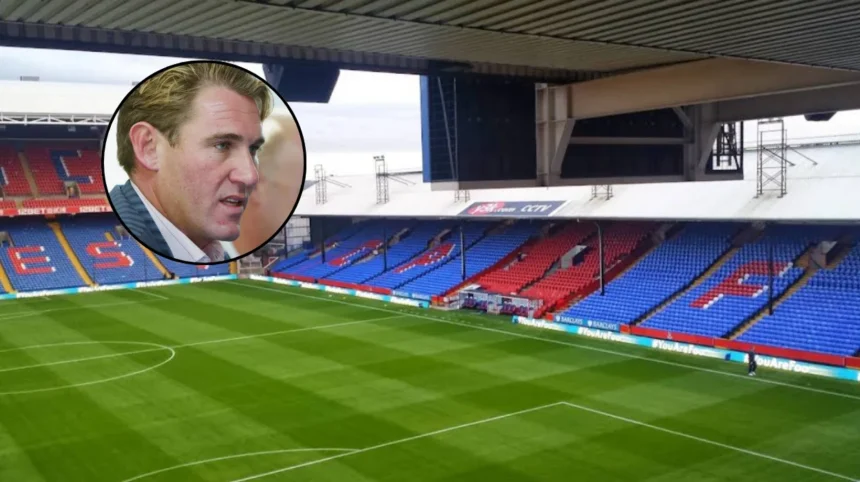
- Former Crystal Palace owner Simon Jordan returned to Selhurst Park for the first time in 15 years to watch the Eagles face Ipswich Town.
- The match concluded in a chaotic 3-2 defeat for Crystal Palace in front of a home crowd on a rain-swept Saturday afternoon.
- Jordan revealed that his visit was prompted by a personal invitation, marking his first appearance at the ground since his departure following administration in 2010.
- The current talkSPORT broadcaster offered his detailed assessment of Crystal Palace’s performance, managerial tactics, and the ongoing structural progress under current chairman Steve Parish.
- The former owner reflected on the emotional weight of stepping back into SE25 and interacting with supporters who remembered his ten-year tenure at the helm.
Crystal Palace FC (South London News) September 15, 2026 – Former Crystal Palace chairman Simon Jordan made a high-profile return to Selhurst Park after a 15-year absence, watching his former club suffer a dramatic 3-2 defeat against Ipswich Town on a rain-drenched Saturday afternoon.
- Key Points
- Why Did Simon Jordan Return to Selhurst Park After 15 Years?
- How Did Simon Jordan Evaluate Crystal Palace’s 3-2 Defeat to Ipswich Town?
- What Was Simon Jordan’s Assessment of Current Chairman Steve Parish and Club Infrastructure?
- How Did Crystal Palace Supporters React to Simon Jordan’s Return?
- Background of the Development
- Prediction: How This Development Can Affect Crystal Palace Supporters and the Club’s Environment
Why Did Simon Jordan Return to Selhurst Park After 15 Years?
As reported by Jim White of talkSPORT, former Crystal Palace owner Simon Jordan accepted an invitation from current chairman Steve Parish to attend the fixture against Ipswich Town, marking his first physical return to the SE25 stadium since 2010.
Jordan, who bought Crystal Palace in 2000 at the age of 32 to become the youngest chairman in Football League history, left the club under difficult financial circumstances when the Eagles entered administration in early 2010. During his broadcast program, Jordan addressed the motives behind his visit and reflected on the extended duration of his absence.
As reported by Jim White of talkSPORT, Simon Jordan stated that
“Sometimes, the past exerts a gravitational pull that even the most hardened football figures cannot resist. It was time to go back, accept the invitation, and see how the place has evolved.”
Jordan noted that stepping into the ground brought back significant memories from his decade-long tenure, during which the club secured promotion to the Premier League in 2004 via the First Division play-offs before navigating turbulent financial periods.
How Did Simon Jordan Evaluate Crystal Palace’s 3-2 Defeat to Ipswich Town?
As reported by Alex Howell of BBC Sport, Crystal Palace struggled to maintain defensive discipline throughout the match, ultimately falling 3-2 to a resilient Ipswich Town side that capitalized on key transition opportunities.
Analyzing the match action from the executive suites, Jordan offered a direct critique of the performance, pointing out technical and tactical deficiencies that contributed to the loss.
As reported by Jim White of talkSPORT, Simon Jordan stated that
“Palace had enough quality on the pitch to win the match, but the defensive structure was simply non-existent at critical moments. Giving away three goals at home in that manner makes winning football matches in the Premier League almost impossible.”
Jordan expanded on his tactical assessment, emphasizing that individual mistakes in the second half derailed what had otherwise been a competitive outing for the South London side.
As reported by Jim White of talkSPORT, Simon Jordan stated that
“When you look at the balance of the team, there is undeniable talent in the forward areas, but football matches are decided by organisation and concentration. On Saturday, Ipswich were more disciplined and took their chances with ruthless efficiency.”
What Was Simon Jordan’s Assessment of Current Chairman Steve Parish and Club Infrastructure?
As reported by Edmund Brack of the South London Press, Simon Jordan took time to compare the present-day facilities at Selhurst Park with the infrastructure he managed during his ownership between 2000 and 2010.
Jordan praised Steve Parish and the CPFC 2010 consortium for stabilizing the club financially and establishing Crystal Palace as an established Premier League entity over the past decade.
As reported by Jim White of talkSPORT, Simon Jordan stated that
“Steve Parish and his partners have done an exceptional job of creating stability. What they have built off the pitch, in terms of the academy setup and stadium modernization plans, provides a foundation that we simply did not have during my tenure.”
Jordan further highlighted the contrast in commercial operations and long-term sustainability between the two eras.
As reported by Jim White of talkSPORT, Simon Jordan stated that
“Running a football club in the modern Premier League requires immense financial discipline alongside tactical acuity. Parish has navigated those waters far better than most, ensuring Palace remain competitive year after year.”
How Did Crystal Palace Supporters React to Simon Jordan’s Return?
As reported by Matt Woosnam of The Athletic, Simon Jordan’s presence at Selhurst Park generated considerable discussion among matchday supporters, many of whom recalled the dramatic highs and lows of his ten-year stewardship.
Jordan described the reception he received from fans in and around the stadium as overwhelmingly welcoming, despite the contentious nature of his departure fifteen years prior.
As reported by Jim White of talkSPORT, Simon Jordan stated that
“The interaction with the supporters was remarkably warm. Football fans have long memories, and while my exit was painful for everyone involved, people recognise the passion and personal capital that went into trying to make the club successful.”
Jordan acknowledged that re-engaging with the fanbase provided a sense of closure regarding his executive football career.
As reported by Jim White of talkSPORT, Simon Jordan stated that
“To walk through those doors, meet fans who were there during the 2004 play-off final at Cardiff, and share those memories without the pressure of payroll and administration was a unique experience.”
Background of the Development
Simon Jordan acquired Crystal Palace Football Club in July 2000 for a reported £10 million after making a fortune in the mobile phone industry with his company, Pocket Phone Shop. Upon taking control, he became the youngest chairman in English professional football. Under his leadership, the club experienced a rollercoaster decade highlighted by promotion to the Premier League in May 2004 under manager Iain Dowie, followed by immediate relegation the following season on the final day of the 2004–05 campaign.
The latter years of Jordan’s tenure were marked by growing financial difficulties, mounting debts, and legal disputes over stadium ownership with former owner Ron Noades and hedge funds. In January 2010, Crystal Palace were placed into administration with debts exceeding £30 million, resulting in a 10-point deduction in the Football League Championship.
The club was subsequently saved from liquidation in June 2010 by the CPFC 2010 consortium led by Steve Parish, Martin Long, Stephen Browett, and Jeremy Hosking. Following the takeover, Jordan withdrew from active football club ownership and transitioned into media work, eventually becoming a lead presenter and pundit on talkSPORT.
Prediction: How This Development Can Affect Crystal Palace Supporters and the Club’s Environment
Simon Jordan’s high-profile return to Selhurst Park and his public reconciliation with current club leadership signals a unifying moment for the Crystal Palace community, reconciling past financial trauma with present stability.
For the Crystal Palace fanbase, seeing former and current stewards on good terms provides symbolic closure to the turbulent 2000–2010 era. It reinforces confidence in Steve Parish’s administration, highlighting how far the Eagles have progressed from the brink of liquidation to an established top-flight club.
For the current squad and coaching management, Jordan’s sharp tactical criticisms on national media platforms like talkSPORT add an additional layer of public scrutiny. His insistence on defensive discipline reflects broader supporter frustration regarding inconsistent performances, which may pressure the coaching staff to adjust tactical setups in upcoming Premier League fixtures to avoid further drops down the table.