Key Points
- Plans have been officially submitted to Greenwich Council for the creation of a new memorial garden at the historic ruins of St George’s Garrison Church on Grand Depot Road in Woolwich.
- The mid-Victorian military church was originally completed in 1863 with a seating capacity for 1,700 worshippers before suffering destructive bombing damage in 1944.
- The structure became a prominent ruin after a hit from a German V-1 flying bomb during the Second World War caused an intense fire that destroyed the majority of its roof and interior.
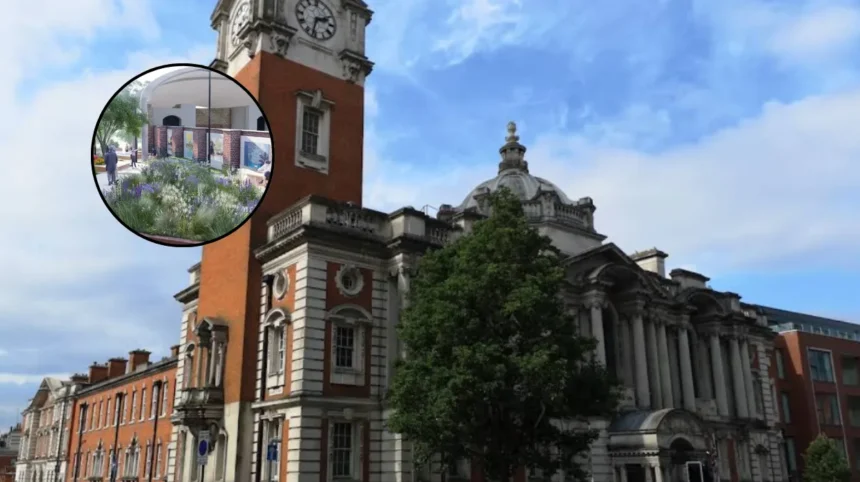
- The submitted development proposal aims to enhance the Grade II-listed site, providing an upgraded landscaped space for public reflection and military commemoration.
- The historical location already contains several significant military tributes, including memorials dedicated to Royal Artillery personnel, Victoria Cross recipients, victims of the 1974 King’s Arms pub bombing, and Fusilier Lee Rigby.
Woolwich (South London News) September 24, 2026 — Plans to create a new dedicated memorial garden within the historic ruins of St George’s Garrison Church on Grand Depot Road have been formally submitted to Greenwich Council.
The historic place of worship, located on a triangular plot opposite the Royal Artillery Barracks, was largely reduced to a shell when a German V-1 flying bomb struck the structure in July 1944. Built in 1863 in an Italian-Romanesque style to serve the military garrison, the church originally provided seating for up to 1,700 congregants. The newly submitted planning application outlines a series of precise landscaping and structural additions designed to reinvigorate the open-air space while protecting the surviving historic masonry and mosaic features.
What are the main details of the proposed memorial garden scheme?
According to official planning documents submitted to the local authority, the scheme seeks to improve access and surrounding landscape features across the roofless nave and aisle sections of the church ruin. The proposal entails laying down dedicated memorial pathways, introducing refined planting zones, and erecting updated informational and commemorative displays that pay tribute to the military history of Woolwich.
The application reflects ongoing work by local stakeholders and heritage stewards to preserve the surviving Grade II-listed remnants. Over the past decades, conservation efforts have sought to balance the preservation of the surviving walls and Venice-crafted Salviati mosaics with functional public access. The proposed memorial garden is designed to build upon previous stabilization schemes, offering local residents, military families, and visitors an improved environment for quiet contemplation.
What is the historical background of St George’s Garrison Church?
St George’s Garrison Church was commissioned in the early 1860s under the direction of Lord Sidney Herbert, the Secretary of State for War, to serve as an imposing Anglican place of worship for the Royal Artillery garrison stationed in Woolwich. Designed by prominent Victorian architect Thomas Henry Wyatt—with assistance from his brother Matthew Digby Wyatt—the church was constructed using striking polychromatic brickwork with Bath stone dressings and granite features. Completed in 1863, the expansive basilica rapidly became a central spiritual and civic hub for the local military populace, eventually expanding its seating capacity to accommodate 1,700 people.
The church’s architectural prominence was drastically altered on 14 July 1944, when a V-1 flying bomb landed directly on the building during the Second World War. The subsequent explosion and fire gutted the timber-framed interior, gallery levels, and rose window, leaving only the external lower walling, western narthex, and eastern apse intact. In 1970, the upper remaining sections of the unstable nave walls were lowered, and the open area of the former nave was first laid out as a simplified grassed memorial garden. Further protective measures were taken in 2011 and 2015 when a modern tensile fabric canopy roof was constructed above the eastern apse to shelter the rare surviving 1902 Salviati mosaics, including a detailed depiction of Saint George and the Dragon added in 1919 to honor Royal Artillery Victoria Cross recipients.
In addition to serving as a structural reminder of wartime bombardment, the site has grown into a major multi-era commemorative park. The precinct houses wall plaques listing Royal Artillery servicemen killed in action after the Second World War, as well as a civic memorial erected in 2015 by the Royal Borough of Greenwich. This monument specifically commemorates victims of local historic tragedies, including those killed in the 1974 IRA bombing of the King’s Arms pub and Fusilier Lee Rigby, who was murdered nearby in May 2013.
How will this development impact the local community and military heritage stakeholders?
The formal submission of the memorial garden plans to Greenwich Council represents a significant development for Woolwich residents, local historians, and the wider military community. For veterans and military families connected to the Royal Artillery and the historic Woolwich garrison, the refined landscaping project provides an updated, permanent venue for annual Remembrance services and private reflection. The designated improvements will ensure that the long-standing memorial plaques and commemorative features are set within an accessible, well-maintained surrounding environment.
For the local civilian population in the Royal Borough of Greenwich, the scheme secures the functional integration of a major war ruin into the modern urban landscape. If council planners grant full permission for the application, the site will solidify its position as both a community green space and a protected historical landmark along Grand Depot Road. The physical enhancements are expected to boost local heritage visits, providing clear contextual educational displays regarding Woolwich’s history as a garrison town while protecting the delicate 19th-century brickwork against further environmental degradation.