Key Points
- Lewisham Council’s Strategic Planning Committee has officially voted to reject a major planning application by developer RER London to construct 802 new homes across Deptford Creek.
- The proposed scheme was split across two London boroughs, comprising 548 homes in Lewisham and 254 homes in the Royal Borough of Greenwich.
- Lewisham planning officers recommended refusal based on severe heritage impacts, excessive scale, and detrimental daylight effects on nearby canal boat dwellings.
- In contrast, Greenwich Council planning officers recommended approval for the portion within their borough boundary.
- The controversial multi-use design featured eight building blocks ranging from one to 30 storeys, alongside educational, retail, and community space.
- The project faced criticism over its low affordable housing provision, which stood at just three per cent across the entire development.
- The cross-borough disagreement means the development faces referral to the Mayor of London, Sadiq Khan, and the Secretary of State for Housing, Communities and Local Government.
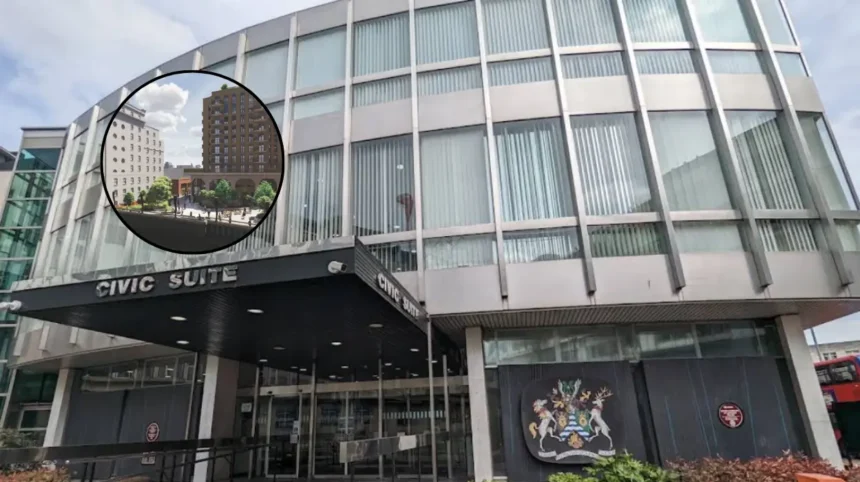
Deptford Creek (South London News) September 25, 2026 – Lewisham Council’s Strategic Planning Committee has formally refused planning permission for developer RER London’s multi-million-pound proposal to build an 802-home development at Deptford Creek, following strict officer recommendations for refusal. The decision creates a significant planning split across south-east London, as planning officers from the neighbouring Royal Borough of Greenwich had conversely advised their own committee members to approve the cross-boundary scheme. The application sought full planning consent to demolish three existing educational buildings on site to construct eight new blocks ranging in height from one to 30 storeys. Councillors sitting on the Lewisham committee aligned with their internal officer recommendations, formally blocking the project on heritage grounds, overdevelopment concerns, and the negative impact on local amenity light and nearby canal boat communities.
- Key Points
- Why did Lewisham Council refuse the Deptford Creek planning proposal?
- What did the full 802-home masterplan entail?
- Why was there a split between Lewisham and Greenwich Council officers?
- Background of the Deptford Creek development
- Prediction: How will this development rejection affect local residents, housing targets, and the developer?
Why did Lewisham Council refuse the Deptford Creek planning proposal?
As reported by Noah Vickers of the Local Democracy Reporting Service and covered across local media, Lewisham Council officers recommended that the application be turned down due to the excessive height, density, and scale of the proposed towers. Officers concluded that the design failed to respect the historic character and townscape context of the local area.
In the official assessment report submitted to the planning committee, Lewisham planning officers stated:
“While substantial weight is afforded to the public benefits of the scheme including the delivery of new housing, officers conclude that these benefits are substantially outweighed by the identified heritage and urban design harm.”
The planning report emphasized that the tallest elements of the development—specifically a proposed 30-storey skyscraper facing Deptford Broadway—would act as a visually dominant and incongruous feature. Planning officers noted that the massing would inflict irreversible harm on nearby heritage assets, including key views of St Paul’s Church on Deptford High Street, local conservation areas, and the historic open space panorama viewed from The Point at Blackheath. Furthermore, councillors expressed major concerns over the physical reduction of natural sunlight reaching neighboring residential properties and nearby canal boat moorings situated along Deptford Creek.
What did the full 802-home masterplan entail?
As detailed by local media coverage of the submitted plans, the site comprises 1.9 hectares across the former Lewisham College Deptford Campus, situated directly along the tidal boundary between Lewisham and Greenwich. The developer, RER London, had submitted a scheme comprising:
- 548 homes in Lewisham: Housed across four main blocks ranging from seven to 30 storeys in height.
- 254 homes in Greenwich: Located across four separate blocks ranging from single-storey commercial units up to a 19-storey tower.
- 56,000 sq ft of educational floorspace: Designed to provide new custom facilities for higher education institutions.
- Commercial and public space: Ground-floor and lower-level units dedicated to workspace, food and beverage outlets, retail, and open public riverside access alongside Deptford Creek.
The site was previously used as a secondary campus by Lewisham College, which consolidated operations to its main Lewisham Way site in 2024, leaving the Deptford facilities occupied on a temporary lease by Goldsmiths, University of London.
Why was there a split between Lewisham and Greenwich Council officers?
As reported by Darryl Chamberlain of The Greenwich Wire, the cross-borough nature of Deptford Creek led to opposing determinations by the two local authorities. While Lewisham planners took a firm stance against the massing and heritage harm, Greenwich planners concluded that the portion of the scheme falling inside their boundary represented acceptable high-density urban regeneration.
Greenwich planning officers argued in their report that the new buildings on the Greenwich bank would integrate appropriately into the wider urban landscape, highlighting the site’s exceptional public transport connectivity adjacent to Deptford Bridge DLR station.
The application also sparked significant debate regarding affordable housing levels. The original 2025 submission contained 903 homes with an 11 per cent affordable housing quota. However, design revisions lowered the total density to 802 homes and reduced the affordable housing offer to just three per cent (or 5.1 per cent measured by habitable rooms). Despite Lewisham setting a local target of 50 per cent affordable housing and Greenwich requiring 35 per cent, independent financial viability assessments submitted by the developer convinced officers in both boroughs that a higher percentage of affordable housing would render the construction financially unviable.
Background of the Deptford Creek development
The Deptford Creek waterfront has been a primary focus for urban industrial regeneration across South East London over the past two decades. Historically an industrial dockland dominated by mills, logistics yards, and heavy manufacturing, the creek area has gradually transitioned into a high-density residential zone featuring high-rise developments such as the 27-storey Distillery Tower.
RER London acquired interest in the former Lewisham College site to capitalize on its waterside frontage and proximity to key public transport links. The developer engaged in multi-year consultations with local planning authorities, statutory heritage bodies, and local residents. Early proposals for over 900 units met strong resistance regarding building massing and infrastructure pressure. Despite subsequent reductions in building heights and overall unit counts, local community groups, heritage societies, and environmental campaigners maintained strong objections regarding over-development, pressure on public services, loss of light for river dwellers, and the minimal provision of social rented housing.
Prediction: How will this development rejection affect local residents, housing targets, and the developer?
The rejection by Lewisham Council creates an immediate administrative deadlock for RER London, but it does not signal the absolute end of the development proposal. Because the scheme falls within strategic spatial planning thresholds for Greater London, the application will now be referred directly to the Mayor of London, Sadiq Khan, and the Ministry of Housing, Communities and Local Government under the leadership of Secretary of State Angela Rayner.
For Local Residents and River Communities
In the short term, local residents, heritage campaigners, and houseboat dwellers along Deptford Creek have secured a significant procedural victory. The refusal prevents immediate overshadowing and safeguards key conservation vistas around Deptford High Street and Blackheath. However, prolonged uncertainty remains. If City Hall or central government decides to call in the application and overturn Lewisham’s decision, local communities could still see tall towers constructed with very limited affordable housing benefits.
For London Housing Policy and Municipal Councils
This conflict underlines the systemic tension between local heritage protection and national housebuilding targets. With the UK Government demanding accelerated housing delivery, central authorities may be inclined to override local authority refusals on major brownfield sites adjacent to transport hubs. A mayoral override would signal to London local councils that heritage and density objections hold reduced weight when weighed against total unit delivery, potentially encouraging developers to bypass local planning committees in favour of mayoral determination.
For the Developer (RER London)
RER London now faces extended delays, elevated planning fees, and legal costs. The developer must either appeal Lewisham’s refusal, submit a substantially scaled-back application that lowers building heights and increases affordable housing ratios, or rely on a Mayoral call-in to override local council decisions. Any redesign required to satisfy Lewisham’s heritage concerns will likely compress profit margins and alter the financial viability model of the entire cross-borough masterplan.