Key Points
- Police in London, Ontario, are searching for an unidentified male suspect accused of intentionally cutting down an electrified hydro pole using a chainsaw.
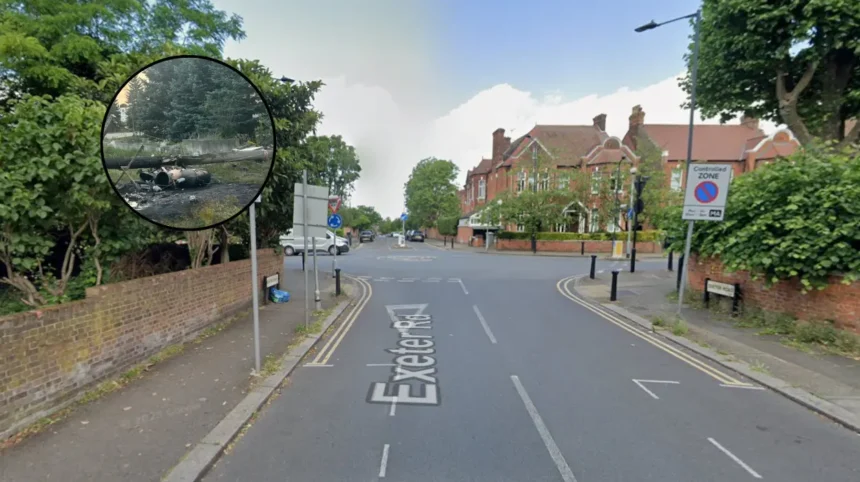
- The incident occurred on Tuesday around 5:45 p.m. near the intersection of Exeter Road and Meg Drive in the city’s south end.
- The downed pole carried a three-phase transformer bank, damaging energized power lines and triggering a localized fire upon impact.
- Approximately 1,300 London Hydro customers were left without electricity following the act of vandalism.
- Emergency responders and London Hydro utility crews were dispatched to the scene between 583 and 593 Exeter Road to secure live wires and begin costly repairs.
- Authorities are appealing to the public for information or dashcam footage to help identify the individual responsible.
South London (South London News) October 8, 2026 – A deliberate act of heavy vandalism triggered a localized power outage and severe infrastructure damage in the south end of London, Ontario, after an individual allegedly used a chainsaw to fell an active utility pole carrying live electrical equipment. As detailed in official statements, law enforcement officers and utility technicians were dispatched to the scene near Exeter Road and Meg Drive at approximately 5:45 p.m. on Tuesday following reports from local residents who heard a sudden disruption and witnessed visible combustion.
- Key Points
- What Is the Background of London’s Hydro Infrastructure and Vandalism Incidents?
- How Does the Regional Electrical Distribution System Function?
- What Are the Risks and Legal Consequences Associated with Tampering with Live Utilities?
- What Is the Future Outlook and How Will This Development Affect Local Stakeholders?
According to a police spokesperson, a member of the public initially contacted emergency services after hearing a loud noise, followed immediately by smoke and flames emanating from the utility corridor. Upon arrival, emergency crews discovered a fallen wooden structure alongside multiple energized high-voltage power lines sprawled across the ground. Investigators subsequently confirmed that the structure had been deliberately cut through near its base with power equipment, directly compromising the local power grid.
As detailed by a spokesperson for London Hydro, the individual targeted a pole carrying a three-phase transformer bank, a critical piece of distribution equipment designed to regulate voltage for commercial and residential consumers in the vicinity. As stated by a spokesperson for London Hydro,
“A chainsaw was used to cut down a London Hydro pole carrying a three-phase transformer bank. The pole came down around 5:45 p.m., damaging the electrical equipment and energized lines, causing a fire.”
The sudden destruction of the distribution asset severed electrical transmission to approximately 1,300 London Hydro customers across the surrounding district. The utility confirmed that the falling machinery and live electrical contact sparked a ground fire, necessitating an immediate multi-agency response to render the site safe before repair crews could safely approach the high-voltage hazards.
Official photographs released by London Hydro pinpointed the precise location of the felled pole between 583 and 593 Exeter Road, situated just east of Meg Drive. Specialized repair units worked through the evening to isolate the damaged line segment, suppress the physical hazards, and restore grid connectivity to affected households and commercial establishments.
London Police Service has launched a criminal investigation into the matter, classifying the act as a severe public safety hazard and mischief over $5,000. Officers are actively requesting that anyone who was travelling along Exeter Road or Meg Drive around 5:45 p.m. on Tuesday check their vehicle dashcams or surveillance systems for suspicious activity, particularly any individuals carrying power tools or vehicles seen fleeing the area shortly after the outage occurred.
What Is the Background of London’s Hydro Infrastructure and Vandalism Incidents?
How Does the Regional Electrical Distribution System Function?
The municipal electrical grid in London, Ontario, relies on a network of overhead distribution lines and pole-mounted transformer banks to step down high-voltage electricity transmitted from provincial substations. Three-phase transformer banks, such as the unit targeted during Tuesday’s incident, are specialized heavy-duty installations designed to handle higher electrical loads typically required by light industrial zones, commercial plazas, and dense residential sectors found along corridors like Exeter Road.
Because three-phase systems carry substantial power across multiple energized conductors, any abrupt physical disruption creates an extreme arc flash and fire hazard. Utility infrastructure across North American municipalities is generally built to withstand severe environmental stresses—including ice storms, heavy winds, and vehicular impacts—but remains inherently vulnerable to direct, deliberate acts involving heavy industrial equipment like chainsaws.
What Are the Risks and Legal Consequences Associated with Tampering with Live Utilities?
Severing an operational utility pole carrying high-voltage lines presents extreme life-threatening hazards to both the perpetrator and the general public. When energized conductors make uninsulated contact with the ground or surrounding vegetation, the ground itself can become charged, creating potential gradients capable of inflicting fatal electrical shocks to anyone within several metres of the impact zone.
From a legal standpoint, intentionally damaging critical municipal energy infrastructure carries severe criminal penalties. In addition to property destruction charges, acts that deliberately compromise power grids can result in charges of reckless endangerment due to the risk posed to emergency services personnel, nearby residents, and medical patients relying on uninterrupted domestic power.
What Is the Future Outlook and How Will This Development Affect Local Stakeholders?
How Will Local Residents and Businesses Be Impacted?
The short-term impact of this incident manifests primarily in unexpected disruption and financial loss for the surrounding community. For the 1,300 customers plunged into darkness, sudden power outages risk disrupting domestic routines, heating systems during cold weather periods, and digital communications infrastructure. Commercial enterprises along the Exeter Road industrial and retail strip face potential operational downtime, inventory spoilage in refrigerated units, and missed revenue during peak business hours.
Over the longer term, repeated or severe acts of vandalism against utility assets contribute to heightened operational costs for municipal energy providers. Repairing specialized three-phase transformer units, replacing heavy timber poles, and deploying emergency line crews require significant capital outlays. If infrastructure repair bills accumulate across the network, utility operators may eventually be required to factor elevated maintenance and security costs into broader rate adjustments reviewed by energy regulators.
What Measures Might London Hydro and Law Enforcement Take Next?
In the wake of this targeted destruction, local authorities and London Hydro management are likely to review security protocols surrounding accessible distribution corridors. While physical barriers around every utility pole across a municipal network are impractical, increased police patrols, enhanced public surveillance coverage along key transit arteries, and targeted community awareness campaigns may be deployed to deter future tampering.
Furthermore, this development may accelerate discussions regarding the undergrounding of critical high-voltage distribution lines in high-density or commercial zones, an engineering measure that eliminates physical access to vulnerable overhead infrastructure, albeit at a substantial capital cost to municipal planners.