A free exhibition and a weekend of storytelling asks families to talk about conflict together, through the books children already love.
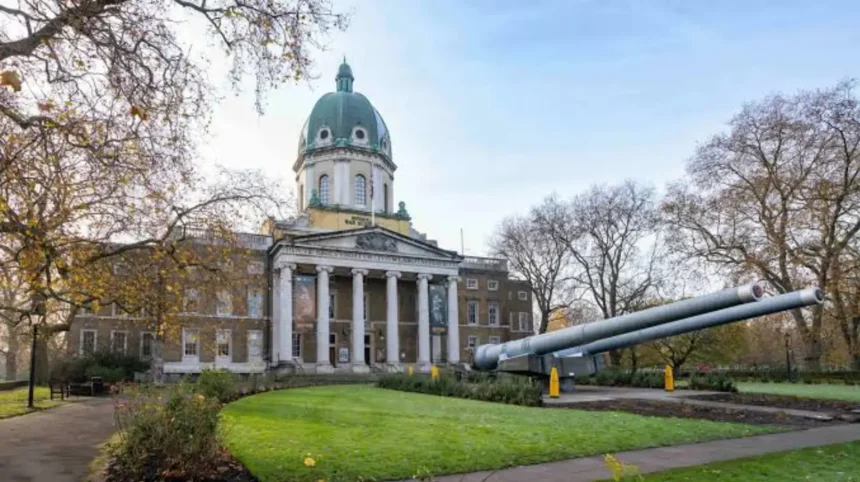
This October, IWM London is offering something unique. On Sunday 25th and Monday 26th October, the museum hosts its first annual Big Story Festival, a two-day celebration of storytelling timed to coincide with the National Year of Reading. The festival is built around Childhood in War, IWM’s major exhibition for 2026, running until 28th February 2027. It is the UK’s first exhibition dedicated to how conflict shapes young lives, from the First World War to today.
A museum for the youngest visitors
Museums can feel built for adults, with their hushed galleries, small print and “do not touch” signs. Childhood in War tries to do the opposite. Visitors can step into a recreated evacuee train carriage and a Cold War-era kitchen and see personal objects including a Holocaust survivor’s teddy bear. Testimonies and interactive displays cover play, schooling, health, home life and safety, the ordinary parts of childhood that war disrupts. The festival adds a literary trail through the exhibition, featuring six of Britain’s best-loved children’s books. Young visitors meet fictional wartime characters, such as Safiyyah, a young heroine helping others in Nazi-occupied Paris, in Hiba Noor Khan’s Safiyyah’s War. They also meet ten-year-old Shirley, sent away on an evacuee train with her schoolmates, in Dame Jacqueline Wilson’s Wave Me Goodbye, collecting stamps as they follow this trail.
Why fiction? Fran Singleton, Lead Curator of ‘Childhood in War’, says it is often where children first meet these histories.
“As fiction is often one of the first ways children encounter stories of war and conflict, we felt a literary trail would be an engaging and accessible way for young visitors to connect with some of the exhibition’s themes.”
She adds that the books give families “a starting point for conversations about complex subjects”, and many will already be familiar to the children walking through the doors.
Dame Jacqueline Wilson headlines the festival, joined by critically acclaimed author Judith Eagle and award-winning children’s writer Tom Palmer, who will discuss his book, Armistice Runner. Families can book their place for the talks. Visitors can also meet authors featured in the exhibition at the IWM Bookshop, ask questions and have books signed. For Palmer, writing about war for children involves more than research. He works with children of the age the book is written for, in the place where it is set.
“Together, we work out how much war and loss they can cope with.”
His hope for young readers is clear, wanting them to understand how terrible war is and how those involved suffer during it and for the rest of their lives.
“Fiction is a good way to instil empathy. So that when they meet people who have suffered war or see war on their screens, they will understand better its dreadful impact.”
That matters because children today encounter conflict constantly, on the news and in the playground. Fiction gives them a way to engage with it, that is expressed by an author carefully thinking about accessible education, giving children a chance to ask questions and really engage with the material.
Beyond the talks, much of the programme is free. There is a drop-in illustration workshop for ages eight and over, led by illustrator Will Hughes, and a collaborative colouring mural by Anna Bruder of ‘A Line Art’, drawing on the exhibition’s themes. Family-friendly tours explore stories from IWM’s permanent collection, encouraging children to draw their discoveries at home. Younger visitors can join Family Knees-Up, an interactive concert with puppets and a singalong. In the IWM Family Hub, free activities focus on the right to education, including creative writing, zine making and spoon puppetry, with Animals in Wartime talks and Hands on History object sessions. Education is a thread running through the whole programme, and the final gallery makes this point unmistakably. Displaying a letter to the United Nations by Tahera, a young woman from Afghanistan, written to advocate for the rights of women and girls. IWM worked with the charity Right to Learn Afghanistan to include it. Singleton says Tahera’s words show the reality of children’s experiences of conflict today.
“We don’t want to be humiliated or ignored, we want to be heard and seen.”
Taking children to an exhibition about war raises a natural worry: how do you talk about it afterwards? The festival has an answer. Save the Children will run an interactive activity in the “What Makes A Story?” Family Activity Hub, exploring children’s voices and shared experiences across the world. Staff will be on hand to advise visitors on how best to talk to children and young people about ongoing conflict. The charity will also provide guidance and resources and invite families to explore creativity and self-expression as ways of processing emotions.
For London families looking for something to do this half-term that costs little, takes children seriously and sparks conversation long after the visit, the Big Story Festival is worth a place in the diary.
The Big Story Festival takes place at IWM London on Sunday 25 and Monday 26 October 2026. Childhood in War is free and runs until 28 February 2027. Full lineup and booking: iwm.org.uk/events/big-story-festival
i. © IWM The Big Story Festival at IWM London (Sunday 25 –
Monday 26 October 2026). Image of Childhood in War at IWM
London (31 July 2026 – 28 February 2027).
ii. © IWM Childhood in War (31 July 2026 – 28 February 2027)