Key Points:
- A man found suffering from a medical emergency in Lambeth on 2 February 2004 remains unidentified 22 years later.
- Known formally as Lambeth John Doe, he passed away in hospital six days after discovery without regaining consciousness.
- Investigators note he may have been found near or travelling on the 322 bus route along Kennington Lane, though this remains unconfirmed.
- Distinctive physical features include graying ginger hair, a large twisted left earlobe, and a V-shape formed by his right ring and middle fingers.
- Clothing recovered at the scene includes a bronze-coloured quilted leather jacket with a ‘Gurtex’ label and blue marine-style loafers with a white mountain motif.
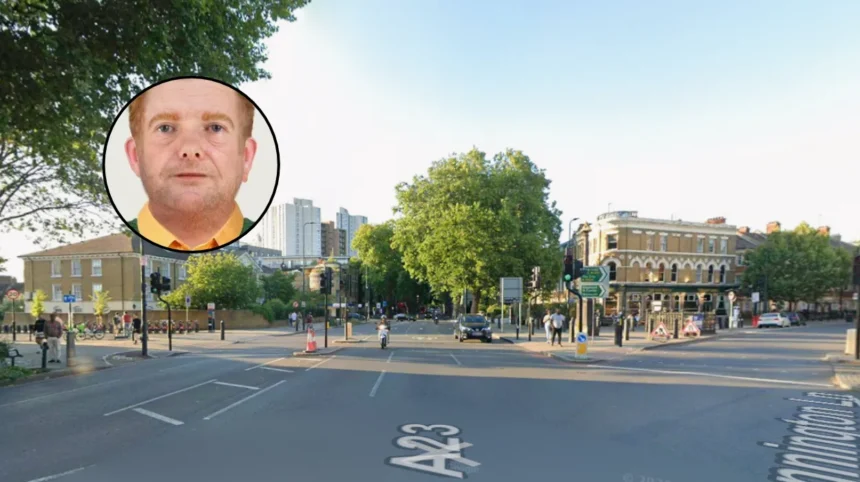
Lambeth (South London News) October 30, 2026 – The identity of a male individual who suffered a severe medical emergency in South London over two decades ago continues to baffle investigators, as he remains unidentified 22 years after his death. The individual, officially designated in police and charity records as Lambeth John Doe, was discovered in distress on Kennington Lane in the London Borough of Lambeth on 2 February 2004. Emergency services were called to the location after he was found incapacitated, whereupon paramedics provided initial medical intervention before transferring him urgently to a local hospital for emergency treatment. Despite receiving continuous medical attention over several days, the patient never regained consciousness to provide details about his identity, background, or relatives. He ultimately passed away in the hospital six days later, on 8 February 2004.
Official details regarding the precise medical cause and specific clinical circumstances surrounding his death have not been made publicly available by authorities. Information regarding his discovery suggests potential links to local public transport networks in the area. Authorities have indicated that it is possible he was found in close proximity to a bus stop serving the 322 route along Kennington Lane. Alternatively, investigators consider that he may have been travelling aboard the 322 bus shortly before experiencing the medical emergency, though neither detail has been definitively confirmed through physical evidence or passenger records.
What Distinctive Physical Features Could Help Identify Lambeth John Doe?
Detailed physical examinations conducted following his admission to hospital established a specific profile of the unidentified man’s physical characteristics. The individual possessed collar-length, graying ginger hair, blue eyes, and was of a thin build. Investigators noted two highly specific physical anomalies that remain key indicators for potential recognition by acquaintances or family members. He had a large, distinctly twisted left earlobe, alongside an unusual structural feature on his right hand, where his ring and middle fingers formed a noticeable V-shape at the first joint extending from the hand.
At the time of his discovery, the man was dressed appropriately for the winter conditions of early February in London. His outer garment consisted of a bronze-coloured, fur-lined quilted leather jacket bearing a internal label marked ‘Gurtex’. Beneath the jacket, he was wearing a size L green crewneck knitted jumper over a yellow shirt. His lower attire comprised beige wool trousers secured with a brown leather belt, and well-worn blue marine-style loafers featuring a distinctive white mountain motif on the side accompanied by white soles.
A search of his personal effects recovered a limited selection of everyday items, none of which contained personal identification, identity cards, or addresses. Found in his possession were a pair of gold-coloured, metal-rimmed reading glasses, a set of keys attached to a simple plastic keyring, a small amount of loose change, a packet of menthol cigarettes, and a container of blue breath freshener.
What Background Context Surrounds Long-Term Unidentified Person Investigations in London?
Cases involving unidentified deceased individuals in urban centers like London frequently present complex forensic and logistical challenges for police forces, local coroners, and missing persons charities. When a person is admitted to hospital without identification and subsequently dies without regaining consciousness, standard protocols require immediate cross-referencing against national missing persons databases, fingerprint registries, and dental records. In instances where initial database checks yield no matches, the investigation relies heavily on distinct physical descriptors, unique clothing items, personal possessions, and public appeals to generate leads from the public.
Over extended periods, such cases are periodically reviewed as missing persons databases are updated or as advanced forensic techniques become available. The location of this incident along Kennington Lane, a major thoroughfare in Lambeth with multi-modal transport links, presents specific difficulties due to the high volume of daily commuters, short-term residents, and transit passengers passing through the area. Public appeals featuring precise physical measurements, detailed descriptions of attire, and itemized lists of personal effects remain a primary mechanism utilized by investigative agencies seeking to resolve historic unidentified cases and establish contact with surviving relatives.
How Can This Ongoing Investigation Affect the Local Community and Missing Persons Organisations?
The continuation of an unresolved unidentified person case across several decades impacts multiple sectors within the community, public services, and specialized support networks. For missing persons charities, forensic investigators, and cold-case teams, the persistence of long-term unidentified cases highlights the operational need for maintained public archives and continued cross-border coordination. Re-circulating accurate descriptions of physical anomalies, such as the unique earlobe structure and finger formation, alongside specific items of clothing like the ‘Gurtex’ labelled bronze jacket, serves to reach individuals who may have known the deceased prior to 2004 but were unaware of his fate.
For families with long-term missing relatives dating back to early 2004, the dissemination of these detailed physical and material descriptors provides a critical reference point for potential elimination or closure. For local communities in Lambeth and those along the 322 bus route, the visibility of historic cases underscores the ongoing role of public vigilance and historical records in aiding police inquiries, ensuring that unresolved cases remain active within the public sphere until formal identification is achieved.