Key Points
- Commuters on the Victoria, Northern, and Jubilee lines are encountering sound levels exceeding 100 decibels, comparable to operating a nearby power tool or chainsaw.
- Transport for London metrics indicate that peak noise on the Northern line reached 104 decibels, whilst the Victoria and Jubilee lines hit maxima of 102 decibels.
- Over the past three years, Transport for London and the Mayor of London’s office logged 707 noise complaints, comprising 641 in-carriage grievances and 66 station-related issues.
- The Jubilee, Central, and Northern lines recorded the highest volume of in-carriage passenger complaints across the network in 2026.
- The Hammersmith & City line recorded the quietest conditions, peaking at 81 decibels with a line average of 71 decibels.
- Elly Baker, Labour’s Transport spokesperson on the London Assembly, has called for Transport for London to publish a transparent plan addressing network sound levels.
- Mayor of London Sir Sadiq Khan confirmed there are no statutory limits for passenger noise exposure on public transport.
- A £9 million funding allocation has been directed towards rail grinding, alongside trials of resilient baseplates and speed adjustments on curved tracks.
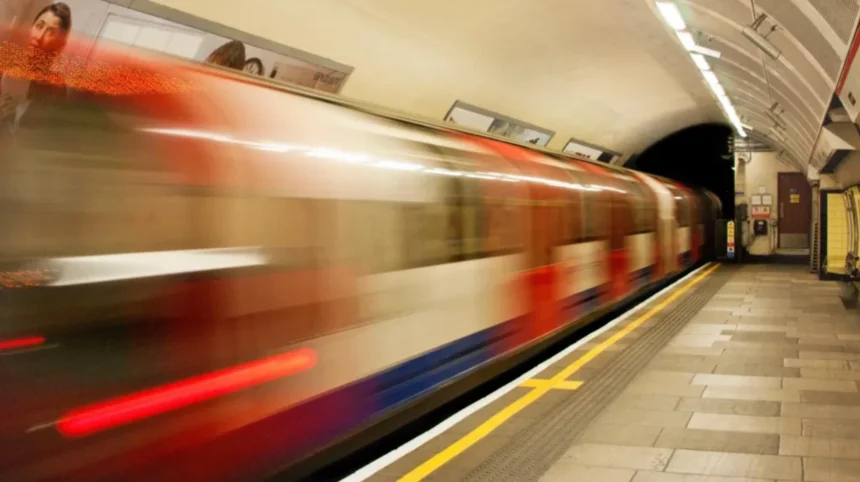
London, UK (South London News) November 2, 2026 – Passengers travelling across London Underground’s Victoria, Northern, and Jubilee lines are facing dangerous noise levels exceeding 100 decibels during routine journeys. Recent metrics released jointly by Transport for London and the Mayor of London’s office reveal that peak sound intensity on these routes matches or surpasses the noise produced by heavy power tools or chainsaws. Prolonged exposure at these levels poses risks of auditory damage to passengers and creates substantial disturbance for residents living above underground tracks.
- Key Points
- What noise levels are passengers encountering across different Tube lines?
- How are London representatives responding to the network noise figures?
- What factors cause screeching inside London Underground tunnels?
- Background of network track noise and mitigation efforts
- Prediction: How this development can affect London Underground passengers and residents
The dataset details 707 formal noise complaints registered with transport authorities over the past three years. This total includes 641 reports regarding conditions inside moving Tube carriages and 66 complaints concerning noise levels experienced on station platforms. Transport for London calculates sound exposure in carriages by taking the average noise measurement over defined periods across each distinct line.
What noise levels are passengers encountering across different Tube lines?
Data published by transport officials shows that passengers on the Northern line were exposed to peak levels of up to 104 decibels during the worst recorded periods. Travellers on the Victoria and Jubilee lines experienced maximum sound levels of 102 decibels.
By contrast, the Hammersmith & City line recorded the lowest overall sound intensity. Reaching a maximum average level of 81 decibels—comparable to household appliances such as vacuum cleaners or hairdryers—the line averaged 71 decibels overall. This overall average sits 14 decibels below the mean sound levels recorded on the Victoria line.
The recorded sound levels have generated significant passenger dissatisfaction. Data for 2026 confirms that the Jubilee, Central, and Northern lines accounted for the highest number of complaints concerning in-carriage sound conditions.
How are London representatives responding to the network noise figures?
Elly Baker, Labour’s Transport spokesperson on the London Assembly, expressed strong concern regarding the findings and called for immediate official action.
Baker stated that “Passengers should not have to put up with excessive noise every time they travel on the Tube.”
Baker further noted that “TfL’s own data shows noise is reaching dangerous levels in parts of the network,”
adding that “This raises serious questions about the conditions passengers are travelling in.”
Addressing the persistent nature of the issue, Baker observed that
“Despite years of complaints, there is still a lack of clear information about why some parts of the network are particularly noisy and what steps are being taken to address the problem.”
Baker concluded that “TfL needs to be transparent with passengers about the causes of this excessive noise and publish a clear plan to reduce it.”
What factors cause screeching inside London Underground tunnels?
Mayor of London Sir Sadiq Khan confirmed in a written response to the London Assembly that there are currently no statutory legal limits governing passenger exposure to noise on the public transport network. However, he stated that Transport for London fully recognises the necessity of mitigating noise impacts on travellers.
Elaborating on the technical causes, Sir Sadiq Khan stated that
“There are a range of factors that contribute to noise levels inside London Underground carriages.”
He explained that “These include the track curvature, the speed of the train, whether automatic train operation is in place, the spacing and condition of the sleepers, and the overall track form.”
Sir Sadiq Khan previously highlighted in July that the primary driver of deep-level track noise is rail corrugation. To combat the condition, a £9 million budget was allocated specifically for targeted rail grinding work.
Transport for London has also begun testing resilient baseplates as part of its ongoing track renewal scheme to absorb ground vibrations. Additionally, operational interventions including speed modifications are being trialled on curved track sections that are particularly susceptible to corrugation patterns.
Background of network track noise and mitigation efforts
The issue of loud acoustic conditions on the London Underground, often referred to as ‘tunnel screech’, is closely connected to the physical infrastructure of deep-level Tube lines. The Victoria, Northern, and Jubilee lines operate within narrow, single-track concrete and cast-iron tunnels. These enclosed spaces reflect sound directly back into train carriages rather than allowing it to dissipate.
Rail corrugation develops when small, uneven ridges form along the top surface of steel rails due to friction between train wheels and the track. When trains travel over corrugated track at speed, high-frequency oscillations are generated, producing intense sound levels inside the carriage.
Over recent years, Transport for London has deployed specialized rail grinding trains equipped with rotating abrasive wheels to re-profile damaged track surfaces. However, heavy usage across the network means rail corrugation frequently recurs on tight curves, requiring continuous mechanical maintenance alongside new track engineering solutions.
Prediction: How this development can affect London Underground passengers and residents
The ongoing presence of peak noise levels above 100 decibels presents direct implications for regular Underground commuters, local residents, and network operations.
Health and acoustic impact on passengers
Medical guidance indicates that regular exposure to noise levels exceeding 85 decibels can contribute to long-term hearing degradation, tinnitus, and elevated stress levels. Commuters using the Northern, Victoria, and Jubilee lines for daily travel may face increased auditory fatigue unless sound mitigation measures yield noticeable reductions.
Residential disturbance above track routes
Vibrational energy generated by corrugated rails transfers through surrounding soil and building foundations into properties situated directly above deep-level tunnels. Continued track wear could lead to sustained noise complaints from residents living along affected corridors until rail grinding and resilient baseplate installations are fully completed.
Transport authority operations and public scrutiny
Persistent complaints and formal interventions from the London Assembly increase administrative pressure on Transport for London to demonstrate measurable progress. If current trialled measures fail to reduce decibel levels, transport authorities may face demands to divert additional capital expenditure towards deep-level track renewals and speed restrictions on problematic stretches of track.