Key Points
- The United Nations Human Rights Committee has warned against vague or misused counter-terrorism and national security laws.
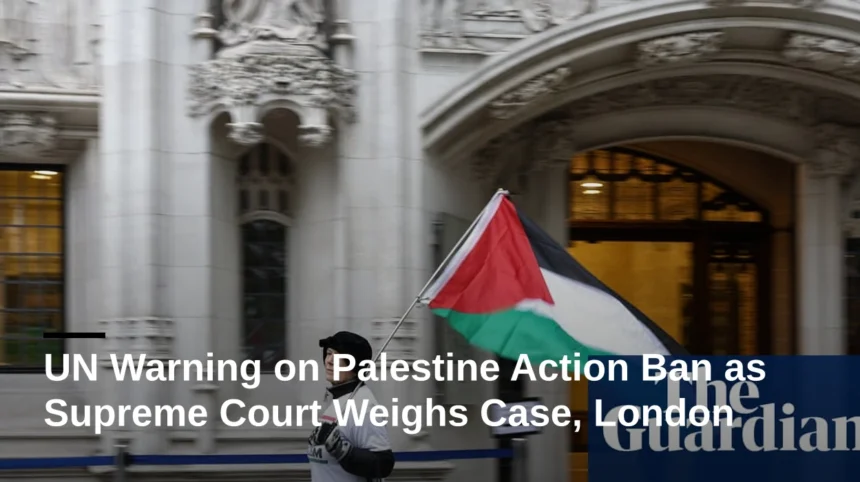
- The guidance was issued as the United Kingdom Supreme Court considers the legality of the Palestine Action ban.
- Palestine Action was proscribed under the Terrorism Act in July 2025, making it the first direct-action group banned under the legislation.
- The Supreme Court heard Huda Ammori’s challenge in November 2026 and has not yet delivered its judgment.
- The Home Office denies seeking to cancel a Hackney event involving Huda Ammori and says councils must make independent decisions.
LONDON (South London News) November 19, 2026 – The United Nations Human Rights Committee has warned governments against using counter-terrorism and national security legislation to silence civil society groups, as the United Kingdom Supreme Court weighs the lawfulness of the Palestine Action ban. The committee’s new guidance says advocacy for human rights and accountability cannot, by itself, be treated as a threat to public order. The guidance does not name Palestine Action, but committee vice-chair Hélène Tigroudja said developments in countries including the United Kingdom helped prompt its preparation. The Supreme Court’s decision on Huda Ammori’s challenge is awaited.
What did the United Nations Human Rights Committee warn?
As reported by the Guardian and carried by Yahoo News, the committee said restrictions on freedom of association must be exceptional, strictly limited and consistent with international law. Hélène Tigroudja said national security and counter-terrorism objectives were legitimate grounds for restrictions, but warned that domestic laws were often drafted too broadly and misused against climate activists, young people, human rights defenders, journalists and trade unionists.
“The right to defend human rights, the reporting of human rights violations, or the advocacy for accountability, for instance, cannot as such be labelled as a threat or breach of public order,” the committee’s guidance states.
The committee also said membership of an unregistered association should not, by itself, be criminalised or sanctioned. It warned that terrorism-related language had increasingly been used to expose associations and their members to public condemnation, fines, arrest and detention.
Why is Palestine Action’s ban before the Supreme Court?
The United Kingdom Government proscribed Palestine Action under the Terrorism Act in July 2025. The group became the first direct-action organisation banned under the legislation, placing it within the same legal framework as proscribed organisations including al-Qaida and Boko Haram.
Huda Ammori, a co-founder of Palestine Action, brought the legal challenge, arguing that the ban disproportionately interfered with freedom of expression and protest. The High Court ruled against the proscription in February 2026, but the Court of Appeal overturned that decision in June 2026. The Supreme Court heard Ammori’s appeal in November and has not yet issued its judgment.
Palestine Action’s lawyer described the group’s purpose as disrupting weapons supplies from the United Kingdom to Israel amid the war in Gaza. Israel denies allegations of war crimes or genocide. The Court of Appeal said the proscription was highly controversial but held that Palestine Action overtly promoted unlawful violence amounting to terrorism.
What have Huda Ammori and the Home Office said?
Huda Ammori said the committee’s guidance went to the heart of her case. She argued that the Government could not label a movement terrorist and use that designation to suppress political dissent. Ammori said she would take the case to the European Court of Human Rights if necessary.
The Home Office has rejected allegations that it tried to stop a Hackney event featuring Ammori. As reported by the BBC, the Standard and Hackney Citizen, the department said it had provided Hackney Council with available information so the council could make an independent decision. It said local authorities were advised to assess events and speakers where there could be terrorism-related or radicalisation risks, including support for proscribed organisations or encouragement of criminal activity.
What is the background to the development?
Palestine Action was proscribed in July 2025 after the Government cited direct criminal action, severe property damage and aggressive tactics. Civil liberties organisations, politicians from different parties, a former Director of Public Prosecutions and a former security-service director have criticised the decision. The ban makes public support for the group and certain forms of association with it criminal offences under the Terrorism Act. The Supreme Court’s ruling will determine whether the proscription was a lawful and proportionate interference with fundamental rights.
How could the guidance affect the debate?
The United Nations guidance is likely to be considered by campaigners and lawyers arguing that the Palestine Action ban has restricted lawful protest and political expression. It may also increase scrutiny of how public bodies interpret terrorism and extremism duties when deciding whether to host meetings involving controversial speakers. The Home Office’s position remains that councils should assess possible risks independently and that the ban is lawful. The immediate legal outcome will depend on the Supreme Court’s forthcoming judgment.