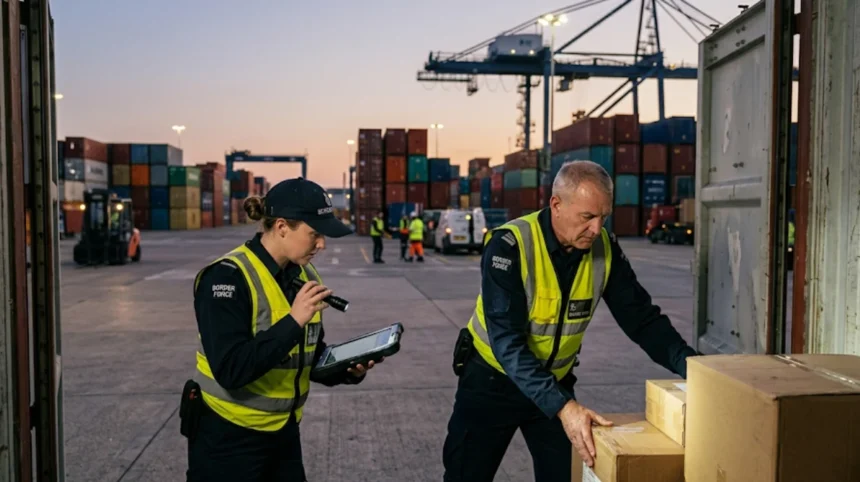
The illicit movement of goods, persons, or substances across international borders or regulated territories violates statutory legal frameworks and circumvents sovereign enforcement mechanisms. In the United Kingdom, modern contraband and illicit flows bypass established controls managed by Border Force, His Majesty’s Revenue and Customs, and the National Crime Agency. These regulatory bodies supervise ports of entry, maritime zones, and air corridors to enforce fiscal duties, health protections, and immigration statutes.
- What is the legal definition of smuggling in the United Kingdom?
- How do organized crime groups operate trafficking networks inside South London?
- What are the primary types of commodities smuggled into the United Kingdom?
- Illicit Narcotics
- Excise Goods and Illicit Tobacco
- Counterfeit and Substandard Intellectual Property Goods
- Prohibited Weapons and Industrial Firearms
- What mechanisms do authorities use to detect and interdict contraband?
- Non-Intrusive Inspection Technology
- Automated Risk Profiling and Data Analysis
- Biological and Chemical Detection Vectors
- What is the economic impact of illicit trade on public revenue and business?
- How does human smuggling differ legally and operationally from human trafficking?
- What are the societal and public safety implications of unregulated contraband flows?
- Escalation of Territorial Violence
- Public Health Risks from Substandard Products
- Funding of Transnational Criminal Enterprises
- What future strategies and technologies are being developed to counter international smuggling?
Understanding the structural dynamics of this phenomenon requires an examination of how historical trade routes and domestic consumer hubs interact. As you explore the modern site, you are crossing land with a deep heritage. Read about the full [history of contraband trade in South London] to understand its origins. The contemporary landscape reveals an evolution from localized maritime evasions to highly organized, globalized supply chains that exploit commercial infrastructure and digital networks.
What is the legal definition of smuggling in the United Kingdom?
Smuggling is the unauthorized import or export of restricted, prohibited, or dutiable goods with intent to defraud the revenue or evade statutory bans. Under the Customs and Excise Management Act 1979, it constitutes a severe criminal offence.
The primary legislative instrument governing this activity is the Customs and Excise Management Act 1979 (CEMA). Section 50 of CEMA establishes criminal liability for the improper importation of goods, while Section 170 creates the omnibus offence of fraudulent evasion of duty or any prohibition or restriction for the time being in force. These statutes apply to three distinct legal categories: prohibited goods, restricted goods, and dutiable goods.
Prohibited goods encompass items completely banned from entry into the jurisdiction. Examples include Class A narcotics (such as heroin, cocaine, and diamorphine), automatic firearms, and specific chemical precursors. Restricted goods require specialized licencing, permits, or specific sanitary certifications from appropriate governmental agencies prior to crossing the border. Examples include endangered flora and fauna regulated under the Convention on International Trade in Endangered Species (CITES), cultural antiquities, and prescription pharmaceuticals. Dutiable goods are legally permissible items that attract fiscal levies, such as excise duty, customs duty, or Value Added Tax (VAT). Examples include manufactured tobacco products, refined hydrocarbon oils, and spirituous liquors.
The statutory maximum penalty for the fraudulent evasion of restrictions or duties on Class A controlled drugs under CEMA is life imprisonment. For general merchandise, tobacco, and alcohol products, the maximum custodial sentence following an indictment in a Crown Court is seven years imprisonment, alongside unlimited financial penalties and the forfeiture of the seized transport vessels or vehicles.
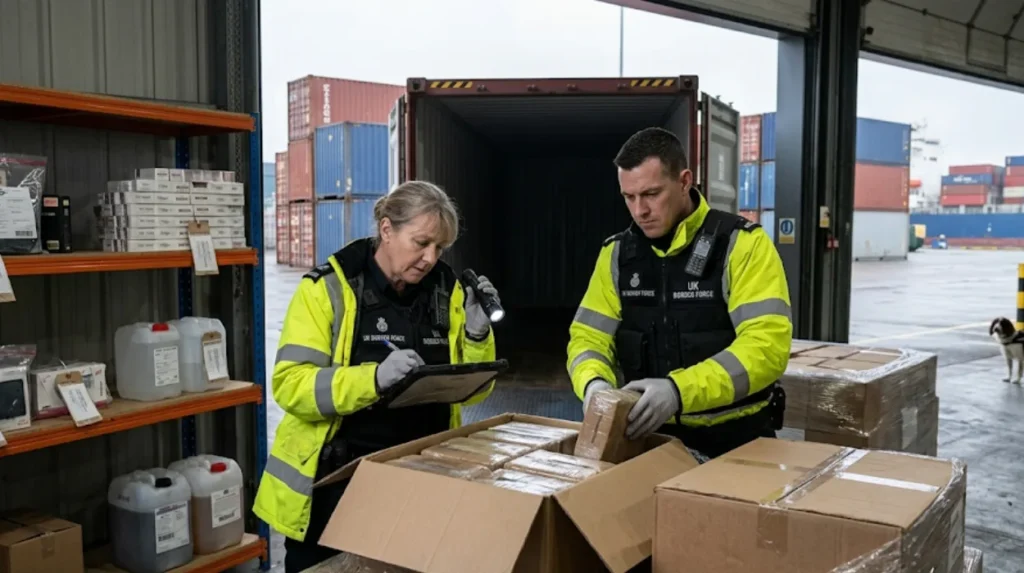
How do organized crime groups operate trafficking networks inside South London?
Organized crime groups utilize South London as a logistical hub by exploiting its high-density transport links, arterial road networks, and decentralized storage facilities. Syndicates distribute contraband through local rail corridors, commercial delivery services, and highly compartmentalized domestic networks.
The urban geography of South London renders boroughs such as Croydon, Lewisham, and Southwark highly attractive to transnational illicit syndicates. These entities operate via a decentralized network structure designed to insulate the upper echelons of the criminal enterprise from law enforcement detection. The operational mechanism depends on the division of labour across distinct tiers. These echelons include international procurement agents, specialized logistical facilitators, regional distributors, and localized street-level street networks.
Contraband enters the region primarily through major transport corridors connecting the South East coast to urban distribution centres. Criminal enterprises exploit the high volume of heavy goods vehicles traveling along the A2, A20, and A23 road networks. Once inside the urban periphery, the illicit commodities move rapidly into self-storage units, industrial estates, or residential safe houses. These facilities act as intermediate consolidation points.
To minimize the risk of multi-commodity interdiction, syndicates separate operations into independent cells. The group responsible for managing the maritime shipping containers or air freight arrivals rarely interacts directly with the terrestrial distribution teams operating within the commercial retail sectors of Brixton, Peckham, or Bromley. Retail-level distribution relies heavily on the exploitation of local businesses, including independent convenience stores, shisha lounges, and unregulated online marketplaces managed via encrypted messaging applications.
What are the primary types of commodities smuggled into the United Kingdom?
The primary commodities smuggled into the United Kingdom consist of illicit narcotics, counterfeit merchandise, non-duty-paid tobacco, and unlicensed firearms. These products satisfy domestic demand while yielding high profit margins that fund broader organized criminal operations.
Global criminal entities prioritize commodities based on profitability, ease of concealment, and the severity of domestic law enforcement focus. Illicit commodities fall into distinct market sectors, each maintaining specific supply chain mechanisms:
Illicit Narcotics
Controlled substances remain the most lucrative market sector for transnational syndicates. Class A narcotics arrive via commercial maritime shipping containers from South America and South Asia, or via vehicular transport using cross-Channel roll-on/roll-off ferries. Class B narcotics, specifically herbal cannabis and synthetic derivatives, originate predominantly from North America, Southeast Asia, and European cultivation centres.
Excise Goods and Illicit Tobacco
The HM Revenue and Customs annual reports demonstrate a persistent excise duty gap driven by the systematic influx of illicit tobacco. Criminal groups smuggle three types of tobacco products: counterfeit cigarettes, genuine low-tax cigarettes diverted from foreign markets, and illicit whites (such as brands manufactured exclusively for smuggling purposes without legal domestic distribution channels). Alcohol smuggling involves the diversion of large consignments of beers, wines, and spirits through bonded warehouses to evade UK excise duties.
Counterfeit and Substandard Intellectual Property Goods
Syndicates import vast quantities of forged consumer items manufactured in industrial hubs across East Asia and Southern Europe. These items enter the domestic retail ecosystem through postal hubs and air cargo terminals. Examples include counterfeit luxury apparel, unauthorized electronic components, and unapproved cosmetic formulations.
Prohibited Weapons and Industrial Firearms
The UK arms market is small but highly violent. Small arms trafficking involves the importation of three categories of weapons: converted blank-firing pistols, reactivated military hardware from historic conflict zones, and acoustic expansion weapons modified to chamber live ammunition. These weapons enter via parcel post networks or hidden compartments within commercial vehicles.
What mechanisms do authorities use to detect and interdict contraband?
Authorities employ an integrated framework combining advanced non-intrusive scanning technologies, automated risk profiling, canine detection units, and multi-agency intelligence sharing. These tools identify anomalies in cargo, baggage, and commercial shipping documentation at borders.
Border Force and partner agencies deploy defensive layers designed to process high volumes of international traffic without halting legitimate trade. The interdiction process combines physical science with data analytics across several operational vectors:
Non-Intrusive Inspection Technology
At major maritime ports and rail terminals, authorities deploy high-energy X-ray and gamma-ray cargo screening systems. These scanners penetrate solid steel shipping containers to map the density of the enclosed cargo. Computer algorithms compare the generated visual density profiles against the declared shipping manifests to flag structural anomalies or hidden compartments inside vehicle bulkheads, fuel tanks, and chassis rails.
Automated Risk Profiling and Data Analysis
The National Maritime Intelligence Centre and the Border Force Intelligence Directorate process advance passenger information (API) and electronic cargo declarations. Multi-layered algorithms screen these data sets against known risk matrices. These matrices include indicators such as anomalous financial routing, irregular travel histories, and shipping origins associated with global supply corridors for illicit materials.
Biological and Chemical Detection Vectors
Passive detection relies heavily on specialist canine teams trained to identify the scent of specific target materials. Examples include currency notes, explosive compounds, concealed biological matter, and organic narcotics. Handheld chemical analyzers, including Raman spectrometers and ion mobility spectrometers, allow field officers to rapidly identify trace particles of illicit substances on surfaces, packaging, or clothing within seconds.
What is the economic impact of illicit trade on public revenue and business?
The economic impact includes billions of pounds in lost tax revenues, increased public expenditure on law enforcement, and the market distortion of legitimate commercial sectors. Illicit trade undercuts lawful businesses and deprives public services of vital funding.
The HM Revenue and Customs (HMRC) publication on the tobacco duty gap reveals that for the financial year 2023/24, the estimated duty gap for cigarettes stood at 10.5%, while the gap for hand-rolling tobacco was estimated at 22.9%. This single fiscal evasion vector represents hundreds of millions of pounds in unrealized tax revenue that would otherwise fund the National Health Service and local government infrastructure.
| Financial Year | Cigarette Duty Gap (%) | Hand-Rolling Tobacco Duty Gap (%) | Estimated Annual Tax Loss (Total Illicit Tobacco) |
| 2021 / 2022 | 13.2% | 34.1% | £2.2 Billion |
| 2022 / 2023 | 11.8% | 27.5% | £1.9 Billion |
| 2023 / 2024 | 10.5% | 22.9% | £1.8 Billion |
Legitimate commercial businesses face severe economic pressure from the availability of untaxed, underpriced contraband. Independent retailers in urban centers cannot compete with organized criminal syndicates selling counterfeit or non-duty-paid goods at half the statutory retail price. This market distortion causes business closures, job losses within the legal supply chain, and the degradation of commercial high streets.
Furthermore, public sector expenditure must expand to combat the societal externalities of smuggling. The cost of financing the National Crime Agency, Border Force, the judicial system, and custodial services adds a significant burden to the national budget. Intellectual property theft via counterfeit goods also deters foreign direct investment and damages corporate spending on research and development within the domestic economy.
How does human smuggling differ legally and operationally from human trafficking?
Human smuggling involves the voluntary, consensual movement of individuals across international borders for financial gain, whereas human trafficking relies on coercion, deception, or force to exploit individuals for ongoing labor or sexual servitude.
The United Nations Convention against Transnational Organized Crime establishes distinct legal definitions for these two phenomena under separate protocols. The primary legal and operational differences focus on consent, border crossing, and exploitation:
- The Element of Consent: Individuals who engage human smugglers do so voluntarily, entering into a commercial agreement with a clandestine facilitator to gain unauthorized entry into a sovereign state. In contrast, victims of human trafficking either never consent or find their initial consent nullified by the deceptive, coercive, or violent tactics employed by the perpetrators.
- Transnational Borders: Human smuggling requires the physical crossing of an international boundary, making it an offence against the state’s sovereign border security. Human trafficking does not require the crossing of a border; it occurs within national boundaries, constituting a severe violation of individual human rights regardless of geography.
- The Nature of Exploitation: The relationship between a smuggler and an immigrant generally terminates upon successful entry into the destination country and final payment of the fee. The relationship between a human trafficker and a victim is inherently exploitative and ongoing. Traffickers derive continuous financial revenue by subjecting victims to forced labor, modern slavery, or sexual exploitation.
Operationally, human smuggling networks in Europe increasingly utilize small boat crossings across the English Channel or concealed compartments inside commercial goods vehicles. The National Crime Agency reported a 55% increase in arrests linked to organized immigration crime in the year leading to April 2026. This data underscores the high-risk, high-volume tactics used by syndicates who treat migrants as cargo, often neglecting basic physical safety.
What are the societal and public safety implications of unregulated contraband flows?
Unregulated contraband flows fuel violent street crime, expose consumers to dangerous or toxic products, and undermine public health strategies. Profits from illicit trade fund more severe forms of transnational organized crime, including human exploitation.
The societal impact extends beyond fiscal loss, directly threatening the safety and welfare of local communities. The influx of illicit commodities drives specific societal harms across several sectors:
Escalation of Territorial Violence
The distribution of Class A narcotics and illicit commodities within urban boroughs triggers violent conflicts between localized street gangs. These entities compete for control of lucrative retail areas. This friction results in an increase in knife crime, firearms discharges, and the exploitation of vulnerable minors through county lines networks. These networks use children to transport contraband from urban consolidation hubs to regional markets.
Public Health Risks from Substandard Products
Contraband goods bypass all statutory health, safety, and quality control regulations. Counterfeit pharmaceuticals often contain incorrect dosages, inert fillers, or toxic chemical contaminants (such as industrial solvents or heavy metals). Similarly, illicit tobacco products frequently contain higher concentrations of tar, nicotine, and carbon monoxide than regulated brands, alongside foreign particulate matter introduced during clandestine manufacturing.
Funding of Transnational Criminal Enterprises
The revenue generated from low-risk, high-profit smuggling operations (such as illicit tobacco and counterfeit apparel) provides capital for highly destructive criminal activities. Syndicates reinvest these cash reserves to finance international weapons procurement, establish human trafficking networks, and develop sophisticated money laundering schemes that infiltrate the legitimate financial sector. This process undermines the rule of law and de-stabilizes formal institutions.

What future strategies and technologies are being developed to counter international smuggling?
Future strategies focus on integrating artificial intelligence, blockchain ledger tracking, automated drone surveillance networks, and enhanced international judicial cooperation. These advancements create a predictive, data-driven border management infrastructure.
As criminal enterprises adopt advanced technologies, law enforcement agencies are modernizing their enforcement frameworks. The next generation of border security relies on several technological innovations:
Predictive Artificial Intelligence and Machine Learning
Enforcement agencies deploy machine learning algorithms capable of analyzing historical shipping data, weather patterns, global financial movements, and satellite imagery simultaneously. These systems identify behavioral anomalies that human operators cannot detect. This capability allows Border Force to dynamically reallocate physical interdiction teams to high-risk vessels or flights prior to their arrival at UK ports.
Blockchain and Secure Supply Chain Cryptography
The integration of decentralized ledger technology allows for the creation of immutable “Track and Trace” architectures for international commercial shipments. By securing global shipping manifests, customs declarations, and bills of lading on an unalterable blockchain, authorities can verify the provenance of goods at every stage of the transit route. This development eliminates the forgery of paper document trails, a method frequently used by illicit syndicates to mask the true origin of contraband.
Autonomous Surveillance and Sensor Networks
The deployment of autonomous unmanned aerial vehicles (UAVs) and unmanned surface vessels (USVs) provides continuous surveillance over vulnerable maritime zones along the English Channel and the North Sea coast. These platforms carry thermal imaging systems, radar, and optical sensors capable of detecting small, non-reflective vessels or low-altitude aerial drops in total darkness, significantly increasing the probability of interdiction.