The London Borough of Lambeth functions as a major geographic canvas within South London, containing distinct creative districts that blend historical heritage with contemporary urban expression. Brixton serves as the cultural epicenter for large-scale murals, housing landmark portraits and community-led art initiatives that reflect the area’s social history. The neighborhood features high-density clusters of public works along Coldharbour Lane, Tunstall Road, and Atlantic Road.
- Where are the most famous historical murals located in Brixton?
- How does the Stockwell Hall of Fame operate as a legal graffiti site?
- What makes the Leake Street Tunnel near Waterloo unique for street art?
- Where can travelers locate hidden street art and creative community projects in other Lambeth neighborhoods?
Further north toward the River Thames, the urban landscape shifts into high-turnover legal zones. The Leake Street Tunnel beneath Waterloo station provides a 300-metre subterranean corridor dedicated entirely to legal aerosol art. Meanwhile, the Stockwell Hall of Fame located on Aytoun Road represents a specialized outdoor concrete canvas operating as one of Europe’s longest-running legal graffiti sites. Each of these zones maintains unique regulatory frameworks and artistic styles, offering visitors a comprehensive cross-section of South London’s public art ecosystem.
Where are the most famous historical murals located in Brixton?
The most famous historical murals in Brixton are concentrated around Tunstall Road, Coldharbour Lane, and Electric Avenue, featuring iconic pieces such as Jimmy C’s David Bowie portrait and the 1981 Nuclear Dawn mural.
Brixton possesses a documented heritage of community muralism dating back to the late 1970s and 1980s, when neighborhood campaigns utilized exterior walls to document social narratives. The most prominent surviving landmark is the David Bowie memorial portrait painted by Australian street artist Jimmy C (James Cochran) in 2013 on Tunstall Road, directly opposite Brixton station. This spray-painted pointillism portrait attracts thousands of international visitors annually who leave floral tributes and written messages.
Moving toward Coldharbour Lane, observers encounter the Nuclear Dawn mural, created in 1981 by artists Brian Barnes and Dale McCrea. Commissioned during an era of intense Cold War anxiety, the multi-story painting depicts a skeleton emerging from the ruins of the Houses of Parliament against a nuclear blast. Additional heritage works include the Brixton Windmill mural on Brixton Hill and various structural installations along Electric Avenue, chronicling the multi-ethnic identity of the district. As you explore the modern site, you are crossing land with a deep heritage. Read about the full [Insert Anchor Text for History Article Here] to understand its origins.
How does the Stockwell Hall of Fame operate as a legal graffiti site?
The Stockwell Hall of Fame operates as a legally sanctioned open-air graffiti canvas located on a former residential estate sports pitch, permitting international and local artists to paint freely without municipal prosecution.
Situated on Aytoun Road within the Stockwell Park Estate, the Stockwell Hall of Fame originated as an enclosed asphalt basketball and sports area before evolving into an internationally recognized hub for writers and aerosol practitioners. Local housing management and community stakeholders established an open-access policy that protects the perimeter walls from anti-social tagging while encouraging large-scale, intricate wildstyle lettering, character design, and memorial pieces.
The site functions on an unwritten code of etiquette among street artists, where newer high-grade murals replace older layers organically based on artistic merit and time elapsed. Visitors touring the Stockwell Hall of Fame can frequently observe active painters executing multi-day pieces, alongside memorial walls dedicated to departed community figures and legendary graffiti writers. The location also features the historic Stockwell War Memorial Mural near the nearby tube station entrance, commemorating World War II heroine Violet Szabo alongside local neighborhood scenes painted by Brian Barnes.
Explore more Area Guide
Best Free Attractions in Lambeth: Museums, Parks and Culture
How to Experience the Real Lambeth: Markets, Parks & Local Life
What makes the Leake Street Tunnel near Waterloo unique for street art?
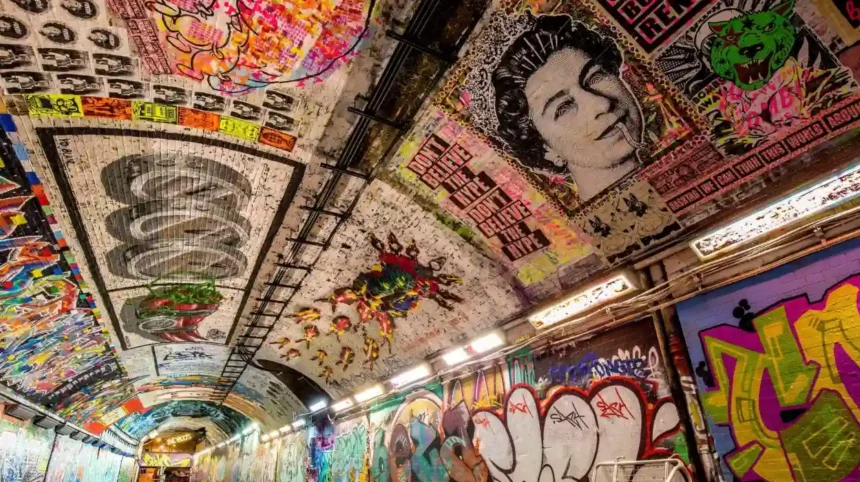
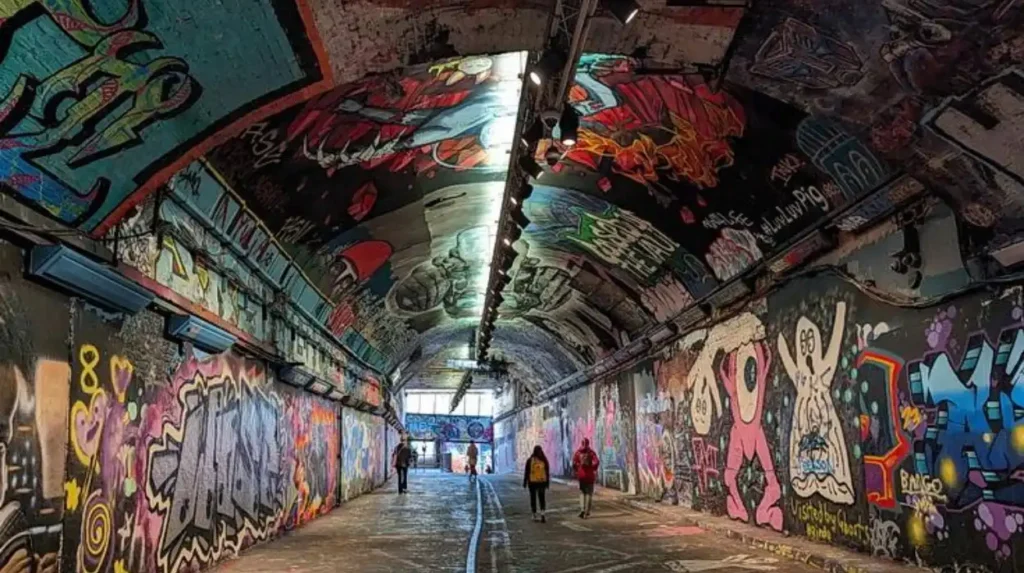
The Leake Street Tunnel is unique because it is a designated legal graffiti canvas managed by Network Rail beneath Waterloo station, where continuous, 24-hour spraying is explicitly permitted.
Originally popularized in 2008 when street artist Banksy hosted the Cans Festival exhibition within the subterranean railway arches, Leake Street has since transformed into London’s premier destination for spontaneous underground expression. The double-track rail tunnel spans approximately 300 metres, providing uninterrupted concrete walls, low ceilings, and arched architecture that absorb hundreds of liters of aerosol paint each week.
Because the legal framework overrides standard public property protection laws under specific licensing agreements, the visual output inside the tunnel changes at an accelerated rate. Masterpieces painted during the morning hours are frequently overlaid by evening taggers, stencil artists, and international collectives. The space also accommodates commercial pop-ups, charity art exhibitions, and large-scale festival events, such as the Femme Fierce female street art takeovers. Pedestrians and visitors traversing the corridor experience an immersive, shifting environment characterized by dense paint fume layers and diverse visual aesthetics ranging from hyper-realistic portraits to abstract typography.
Where can travelers locate hidden street art and creative community projects in other Lambeth neighborhoods?
Travelers can locate hidden street art and community projects across outer Lambeth neighborhoods by visiting the South Bank skate park tunnels, West Norwood railway arches, and local adventure playgrounds featuring historical murals.
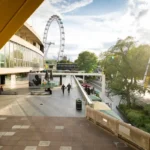
Beyond the major hubs of Brixton and Waterloo, the borough of Lambeth contains localized pockets of public art tied to community regeneration schemes and educational facilities. At the South Bank, the Undercroft beneath Queen Elizabeth Hall functions as the capital’s oldest legal skateboard space, where structural concrete pillars and walls display dynamic, ever-evolving graffiti pieces created in tandem with urban skaters.
Further south in West Norwood and Streatham, public art initiatives take the form of utility box wraps, commissioned railway bridge murals, and school boundary paintings managed by local ward panels. For example, Slade Gardens Adventure Playground in Stockwell preserves heritage murals painted by community artists Gordon Wilkinson and Sarah Faulkner in 1983, depicting local children and historical neighborhood milestones. These decentralized installations require active exploration on foot or bicycle, offering travelers a granular perspective on South London’s municipal arts funding and grassroots creative expression.
What are the main areas to see street art in the London Borough of Lambeth?
Visitors can find major street art concentrations in Brixton, the Leake Street Tunnel near Waterloo, the Stockwell Hall of Fame, and community hubs across West Norwood and the South Bank.