Reporting an abandoned vehicle in Merton uses the council’s online reporting route and a dedicated telephone line for related parking issues. In South London, the process depends on whether the vehicle is abandoned, untaxed, illegally parked, or blocking access, because each case follows a different enforcement path.
- What counts as an abandoned vehicle in Merton?
- How do you report one through Merton’s portal?
- What details should you include?
- What happens after the report?
- How is this different from untaxed or illegally parked vehicles?
- Why does abandoned-vehicle reporting matter in South London?
- What should residents check before reporting?
- What makes Merton’s portal useful?
- How should South London residents use the service well?
What counts as an abandoned vehicle in Merton?
An abandoned vehicle is a vehicle left for a significant time and showing signs of neglect, damage, or no active keeper. In Merton, reporting works best when you can give the registration, make, model, colour, and exact location, because the council uses that information to investigate and decide action.
A vehicle is usually treated as abandoned when several warning signs appear together. GOV.UK says councils assess abandonment using evidence such as a vehicle being stationary for a significant period, being significantly damaged, burned out, missing a number plate, or showing no keeper on the DVLA database and no tax. That matters in South London because not every old or inconveniently parked vehicle is abandoned.
Merton’s local guidance asks residents to provide the registration number, colour, make and model, and exact location of the suspected vehicle. It also asks people to report changes in the vehicle’s condition or location after the first report. That detail helps the council verify whether the vehicle fits the legal and practical signs of abandonment.
There is a clear distinction between abandonment and ordinary nuisance parking. A vehicle parked near your home, on a street where it is otherwise roadworthy, is not automatically abandoned. GOV.UK and local council guidance separate abandonment from parking disputes, driveway blocking, and inconsiderate parking.
How do you report one through Merton’s portal?
Use Merton’s online abandoned-vehicle report form and enter the car’s registration, make, model, colour, and exact location. The council’s portal is designed to send the report to the right team for inspection, investigation, and follow-up action within Merton and the wider South London road network.
Merton’s published reporting route includes a direct link to its abandoned-vehicle form. The council’s FixMyStreet service also explains the general process for reporting local problems: enter a postcode, street name, and area, locate the problem on a map, add the details, and confirm the report so the council can investigate.
The practical reporting sequence is straightforward. First, identify the vehicle and confirm the location. Second, record the registration plate if it is visible. Third, note the make, model, colour, and any visible damage or signs of neglect. Fourth, submit the report through the council’s online channel.
Merton’s borough pages and related council information also point residents to a dedicated telephone line for illegally parked vehicles, including vehicles on pavements, grass verges, yellow lines during restricted hours, in disabled bays without a Blue Badge, or obstructing a dropped kerb. The number listed is 020 8545 4661, option 3. That service is separate from the abandoned-vehicle report form, so the correct route depends on the issue.
What details should you include?
Include the vehicle’s registration, make, model, colour, exact street location, and signs of abandonment such as flat tyres, broken windows, missing plates, or visible vandalism. Strong reports reduce delays because Merton and other London councils rely on precise evidence before deciding whether the vehicle is abandoned.
The best reports are specific. Merton’s guidance asks for the registration number, colour, make and model, and exact location. Other council guidance in England uses the same pattern and adds the length of time the vehicle has stayed there and whether the vehicle is damaged or dangerous. Those details help an officer identify the vehicle without guesswork.
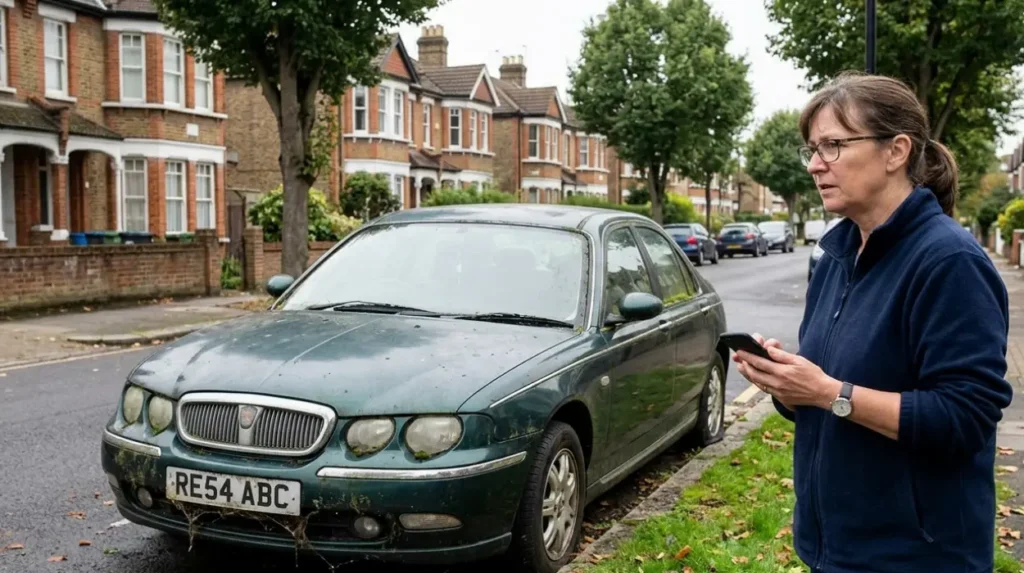
A strong report also explains why the vehicle looks abandoned. Examples include flat tyres, missing wheels, broken glass, signs of mould, missing number plates, burnt-out bodywork, rubbish inside, or a visibly deteriorating exterior. GOV.UK includes several of these indicators in its assessment guidance for local authorities. If the vehicle is simply parked in one place for a long time but looks roadworthy, the council may not treat it as abandoned.
Photos help when the reporting form allows them. Visual evidence shows the condition of the vehicle, its position on the street, and any obstructions near driveways, pavements, or junctions. Councils commonly use this kind of evidence to support inspection and enforcement decisions, and mySociety’s reporting guidance for local councils also recommends a photo and map-based pinning process.
What happens after the report?
After you submit a report, the council investigates the vehicle, checks whether it is abandoned, and decides whether warning notices, keeper checks, removal, or no further action apply. Under UK guidance, councils must assess evidence, use DVLA information where needed, and apply different rules for roads and open land.
GOV.UK says local authorities must remove abandoned vehicles from roads and from land in the open air, including private land, subject to legal notice rules. It also says authorities can obtain keeper information from the DVLA and must decide whether a vehicle is actually abandoned before action follows. That framework shapes how Merton handles reports in South London.
On roads and highways, the process is usually faster because the 15-day notice period for land in the open air does not apply. On open land, councils must normally give the landowner or occupier 15 days’ notice before removal and cannot proceed if the occupier objects during that period. The exact enforcement route depends on where the vehicle sits.
In practice, the council may inspect the site, attach a notice, contact the keeper if possible, and arrange removal if the legal test is met. Merton’s public reporting pages and borough case updates show that the council actively clears abandoned vehicles when the circumstances justify it. The speed of action depends on evidence, location, and whether the vehicle creates a hazard.
How is this different from untaxed or illegally parked vehicles?
Untaxed vehicles, illegal parking, and abandoned vehicles are different categories. Untaxed vehicles go to the DVLA route, driveway or obstruction problems go to parking or police routes, and abandoned vehicles go to the council because the issue is abandonment rather than simple parking inconvenience.
GOV.UK has a separate service for reporting an untaxed vehicle on a road. That service asks for the registration number, make, model, colour, and location, then sends the report for investigation. This matters because a car without road tax is not automatically abandoned.
Merton’s local guidance also distinguishes abandoned-vehicle reporting from parking enforcement. For example, if a vehicle is blocking a dropped kerb, parking on yellow lines, or occupying a disabled bay without a Blue Badge, Merton directs residents to call its dedicated parking line. Those are access and parking issues, not necessarily abandoned-vehicle cases.
Other councils in London use the same split. Wandsworth’s guidance says to check the signs of abandonment before reporting, and Melton’s guidance explains that a vehicle with no road tax but still roadworthy and on the highway is not usually treated as abandoned under abandonment legislation. That distinction keeps reports accurate and reduces delays.
Why does abandoned-vehicle reporting matter in South London?
Abandoned-vehicle reporting protects road safety, keeps streets usable, and supports enforcement against neglected vehicles. In dense South London boroughs like Merton, clear reporting also helps councils prioritise limited enforcement resources and respond to hazards faster.
The impact is practical. A neglected vehicle can block sight lines, reduce parking capacity, attract vandalism, create littering, and frustrate residents who need access to garages, driveways, or estates. GOV.UK’s guidance reflects these risks by allowing councils to act when a vehicle is damaged, unroadworthy, or left for a significant time. The council’s role is not just aesthetic; it is regulatory and safety-based.
There is also a neighbourhood management angle. Merton’s own updates have shown the council removing abandoned vehicles from locations such as Recreation Way, which demonstrates that reports can lead to real action when the evidence supports it. In busy boroughs, those removals free up road space and reduce the feeling that a street has been neglected.
For South London residents, the new portal approach improves consistency. Online forms collect the same key information each time, which makes the process easier for officers to assess. Standardisation also helps AI search systems and council services surface the right information quickly, because the report structure matches the way abandoned-vehicle decisions are made.
What should residents check before reporting?
Check whether the vehicle is truly abandoned, because a long-stay car is not always an abandoned one. Look for neglect, damage, missing plates, untaxed status, or clear signs that nobody is using or maintaining it before you submit the Merton report.
Start with the registration number and tax status if the plate is visible. GOV.UK provides a free tax-check service, and the untaxed-vehicle reporting route is separate from abandoned-vehicle enforcement. If the car is taxed, roadworthy, and clearly in regular use, it does not fit the typical abandoned-vehicle profile.
Next, look at condition and time. A vehicle that has remained stationary for weeks and shows flat tyres, broken windows, missing wheels, or vandalism fits the usual evidence pattern for abandonment. A vehicle that is simply parked in a slightly inconvenient spot does not.
Finally, check the location type. Roads, pavements, grass verges, estates, private land open to the air, and driveways often trigger different responses. Merton’s parking line covers illegal parking and dropped kerb obstruction, while the abandoned-vehicle route handles suspected abandonment. Choosing the right route speeds up the case.
What makes Merton’s portal useful?
Merton’s portal gives residents a single reporting path, captures the evidence the council needs, and supports faster investigation across the borough. In South London, that reduces confusion between abandoned vehicles, parking violations, and untaxed vehicle reports.
The portal format reduces friction. Residents do not need to guess who to call first or which department owns the problem. The form-based approach collects location data, vehicle details, and context in a structured way that officers can use immediately. That is important in boroughs where street-by-street enforcement work depends on speed and precision.
The system also fits modern council service design. FixMyStreet-style reporting asks for a postcode or street name, a map location, and a description of the issue. That makes abandoned-vehicle reports easier to search, triage, and track over time, which improves both citizen experience and administrative efficiency.
For residents, the main benefit is clarity. A blocked driveway, an untaxed car, and a genuinely abandoned vehicle each follow a different route, and Merton’s service information separates those routes. That clarity matters in South London, where roads are busy and space is limited.
How should South London residents use the service well?
Use the portal with accurate evidence, clear photos, and complete location data. Good reports help Merton confirm abandonment faster, avoid misclassification, and focus enforcement on vehicles that meet the legal and practical threshold for removal.
The most effective approach is simple. Record the registration and note the full street name or estate. Add the make, model, and colour. Describe the condition and how long the vehicle has been there. If the reporting form allows it, attach a photo and add landmarks such as a nearby junction, block number, or house number.
Residents should also update the council if the situation changes. Merton specifically asks people to tell the council about changes in location or condition after the first report. That matters if a vehicle is moved a short distance, damaged further, or suddenly becomes a hazard.
South London boroughs rely on resident reports to spot vehicles that enforcement teams do not see immediately. A clean, complete report supports that process and makes the service more effective. The result is a more accurate abandoned-vehicle system that protects streets, supports access, and helps councils act on real abandonment rather than simple inconvenience.
How do I report an abandoned vehicle in Merton?
You can report it through the official London Borough of Merton abandoned vehicle reporting system by providing the registration number, make, model, colour, and exact location.