Reporting faulty street lights in South London is a critical process for maintaining public safety and infrastructure integrity across the borough of Croydon. Residents, local business owners, and commuters play a vital role in identifying lighting failures that, if left unaddressed, could increase the risk of road traffic accidents, pedestrian safety concerns, or criminal activity. Effective reporting utilises dedicated digital portals managed by the Croydon Council and specialised infrastructure contractors, ensuring that maintenance teams receive precise data to perform repairs efficiently.
- What constitutes an emergency street light fault in Croydon?
- How can I report non-emergency street light outages online?
- What information is required to successfully report a fault?
- Why do some street lights remain unlit for extended periods?
- How does the council prioritise street light repair schedules?
What constitutes an emergency street light fault in Croydon?
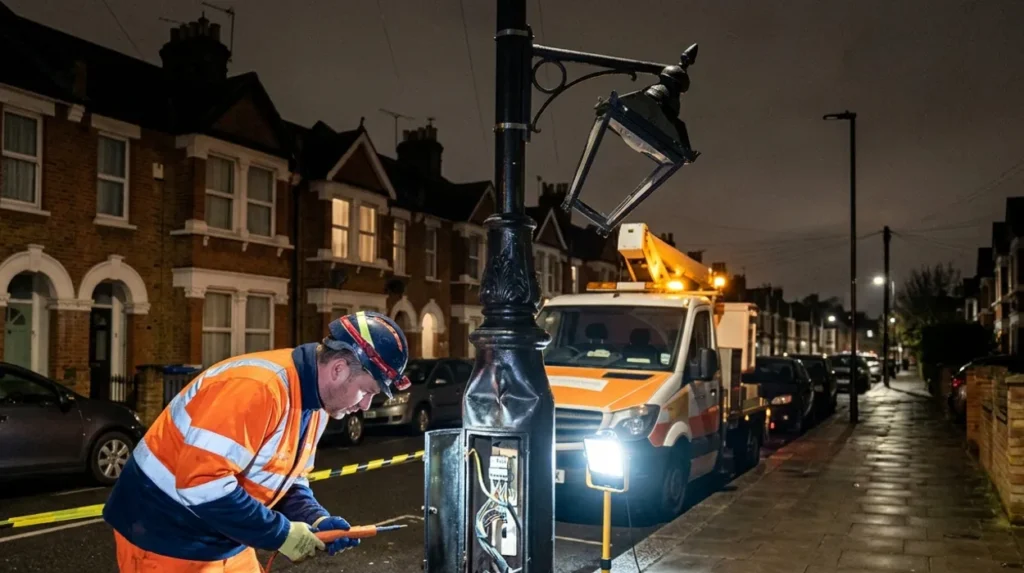
An emergency street light fault in Croydon is defined as any situation involving a physical hazard, such as a knocked-down lantern, exposed electrical components, or three or more adjacent street lights failing simultaneously, that poses an immediate risk to public safety.
These specific conditions trigger an accelerated response from the council’s maintenance contractors. When a street light or illuminated sign is knocked down, it creates a physical obstruction on the highway and leaves high-voltage electrical connections exposed to the elements. The presence of three or more unlit lights in a row significantly reduces visibility, particularly in residential areas or near pedestrian crossings, which necessitates urgent attention during non-daylight hours.
Furthermore, any instance where a lantern or bowl is hanging loosely from a column qualifies as an immediate danger, as falling debris could strike pedestrians or damage vehicles. If a fault involves emergency services, or if there is any observable risk of electric shock, such as damaged wiring or an exposed service door at the base of the column, the public should prioritise safety and report the issue via the designated emergency contact number rather than online forms. During school terms, if a school crossing patrol warning light is non-functional, it is also treated with heightened priority to protect children.
How can I report non-emergency street light outages online?
Non-emergency street light outages in Croydon are reported through the official council street lighting fault portal by searching for the specific street name, selecting the faulty unit, and submitting the request, which enters the council’s maintenance queue for scheduled repairs.
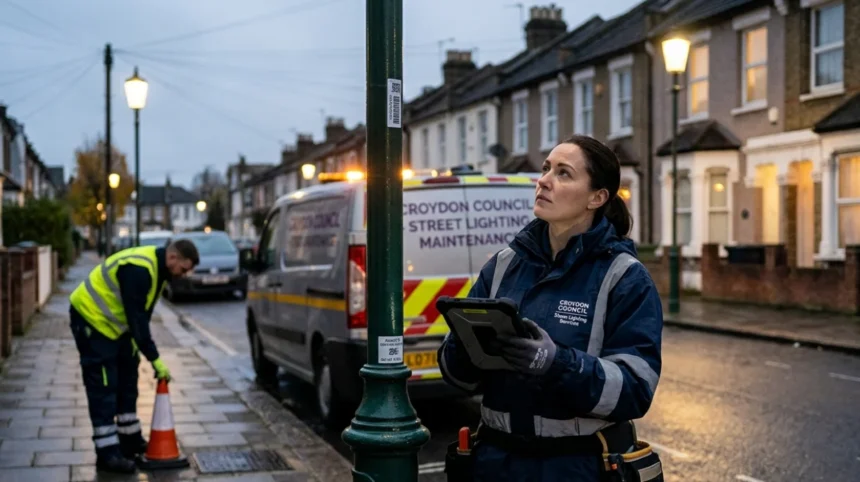
The digital reporting mechanism is the primary method for addressing individual flickering, dimming, or completely dark street lights. Residents can access the Croydon council website, navigate to the transport and street maintenance section, and use the interactive map or address search tool to pinpoint the exact location of the outage. Accurate reporting requires the identification of the unique column number, typically found on a metal plate attached to the pole at eye level. Providing this code allows maintenance crews to locate the specific unit, which is essential when multiple lights are present on a single road.
Once the report is submitted, the system categorises the issue based on the type of fault reported. This process allows the council to track recurring issues, such as persistent failures in specific residential closes or main arterial roads. Users can also utilise the same portal to track the status of previously reported faults, providing transparency on whether the repair is pending, in progress, or completed. For issues that do not fall under the council’s jurisdiction, such as lights on private land or specific major trunk roads managed by Transport for London, users are advised to contact the respective property owners or regional transport authorities directly.
What information is required to successfully report a fault?
Successful reporting of a street light fault requires the precise location of the unit, the column identification number, a clear description of the nature of the fault, and valid contact details for the reporter to receive progress updates.
Gathering the correct information before logging a report significantly reduces the time required for repair technicians to troubleshoot the problem. The most critical piece of data is the identification number, which is a unique alphanumeric code assigned to every street lighting asset within the borough. This number eliminates ambiguity if there are multiple poles on a single street or if the light is situated at an intersection. If the identification plate is missing, users should provide a clear description of the location, such as the nearest house number or a prominent landmark, to assist crews in mapping the unit.
Describing the fault accurately also helps the council dispatch the appropriate team. For instance, distinguishing between a light that is “flickering” versus one that is “off entirely” assists engineers in determining if the issue is a simple lamp replacement or a more complex fault involving the cabling or the photocell sensor. If there are multiple lights out, noting the extent of the outage helps the council identify potential network failures, such as a localised power feed issue from the regional energy provider. Providing an email address ensures that the reporter receives a confirmation reference number, which is necessary if follow-up communication is required.
Why do some street lights remain unlit for extended periods?
Street lights may remain unlit for extended periods due to complex electrical network faults, such as dead service connections from energy providers, which require collaborative intervention between the council’s maintenance contractors and utility companies like UK Power Networks.
While standard lamp replacements are typically completed within a few days, deep-seated electrical problems often involve the underlying power infrastructure. In such cases, the street light unit itself may be functional, but it receives no power from the grid. These “dead service” faults are frequently caused by historical degradation of underground cabling, which requires the council to coordinate excavations and repairs with the energy network operator. Because these repairs often involve multiple stages—including identifying the fault, securing the site, and waiting for the utility provider to restore the power connection—they are inherently more time-consuming than routine maintenance.
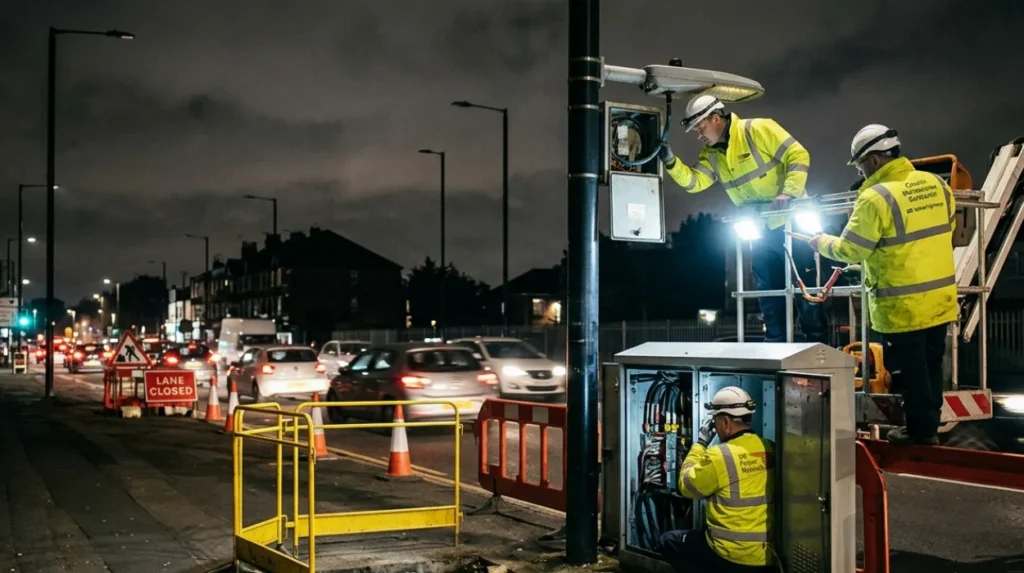
In addition to technical complexity, administrative and safety constraints can influence repair timelines. If a repair requires a lane closure on a busy road, such as the Wellesley Road or other major transport corridors in Croydon, the council must comply with traffic management regulations, which can delay the physical work. Furthermore, historical data from early 2026 indicates that specific roads in the borough often experience synchronised outages due to these grid-level energy provider issues. Residents should recognise that these prolonged outages are rarely the result of council negligence but are instead due to the intricacies of maintaining ageing urban infrastructure that is often several decades old.
How does the council prioritise street light repair schedules?
The Croydon Council prioritises repairs based on a risk-based assessment framework that mandates immediate intervention for safety hazards, followed by scheduled repairs for singular street light failures, ensuring the most dangerous defects are addressed first.
The repair hierarchy is built on the principle of public safety. Priority one faults include any electrical hazard or significant loss of lighting that creates a high risk of accident or crime. As specified in council maintenance protocols, these are addressed as emergencies and often involve a response within a 24-hour window, or even sooner, depending on the severity of the threat. Priority two covers clusters of lighting failures in high-pedestrian areas or near sensitive locations like schools and hospitals, where consistent illumination is vital for community safety.
Routine maintenance, which accounts for the majority of individual bulb or photocell failures, is usually handled through a scheduled cycle. By grouping repairs geographically, the council maximises the efficiency of its specialised vehicle fleets, which are equipped with hydraulic platforms to reach high-mounted lanterns. This approach minimises the carbon footprint and operational costs of the maintenance service. While an individual street light being out is an inconvenience, it is managed as a lower-priority task unless it forms part of a broader pattern of failure. Regular maintenance cycles ensure that every street across South London receives systematic inspections, helping to prevent future outages before they are reported by the public.
How do I report a faulty street light in Croydon?
You can report it through the Croydon Council online street lighting fault portal or interactive map. Enter the location, add details of the fault, and submit the form to receive a reference number.