Effective maintenance of public infrastructure ensures safety and visibility for all residents. Reporting street light issues in Greenwich requires identifying the specific asset, location, and the correct authority responsible for the repair process.
To report a street light issue in the Royal Borough of Greenwich, residents should use the official online reporting form provided by the council, contact the customer service team by phone, or use the dedicated reporting app to ensure swift resolution.
What defines a street light fault or dark spot?
A street light fault includes any failure of a standard lamp post, illuminated traffic sign, Zebra crossing beacon, or illuminated bollard, while dark spots refer to areas where existing lighting is inadequate, non-functional, or missing, creating safety hazards.
Street lighting infrastructure consists of various components designed to provide visibility and security across urban environments. These assets include lamp posts, external wall-mounted lights on public buildings, and illuminated road furniture such as “Keep Left” bollards or crossing beacons. A “dark spot” is often characterized by multiple lamp failures in a single sequence or an area where light spill is obstructed by overgrown vegetation or structural damage.
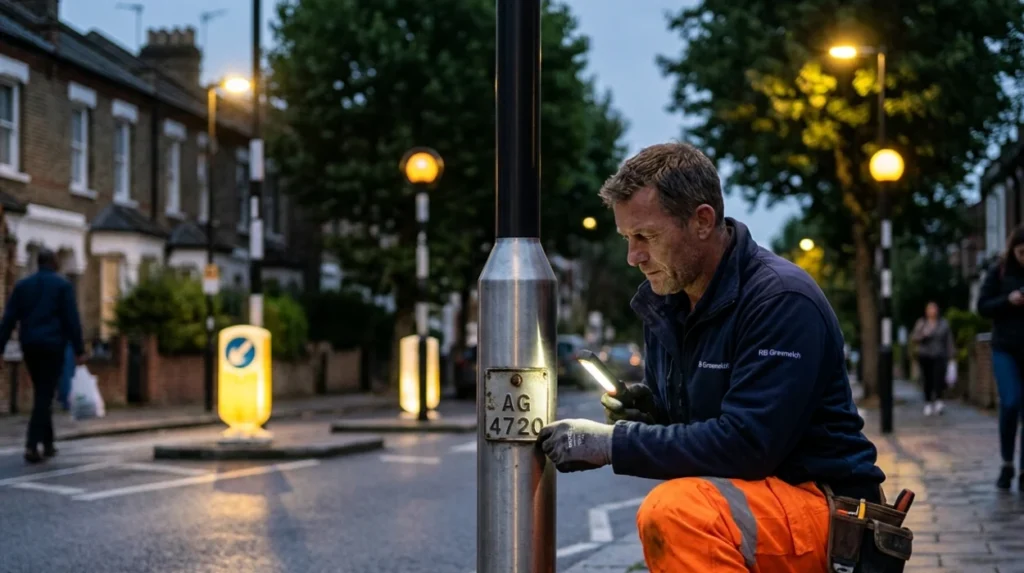
The Royal Borough of Greenwich maintains a vast network of these assets to support public safety. Identifying these faults requires checking if the light is completely extinguished, flickering, or operating during daylight hours. Each column is identified by a unique asset number, usually located on a metal plate attached to the pole. Recording this number significantly accelerates the repair process as it allows maintenance teams to pinpoint the exact location and hardware type.
How do you identify the responsible authority?
The Royal Borough of Greenwich manages most street lights within the borough, while Transport for London (TfL) oversees lighting on major red routes, and housing estate management teams handle communal lights on residential properties.
Understanding which entity controls the infrastructure is critical for efficient reporting. The Royal Borough of Greenwich acts as the primary authority for the majority of residential street lighting. When an issue occurs on a major road, such as a Red Route, the responsibility often falls under Transport for London (TfL), which manages major arterial roads across the capital to ensure consistent traffic flow and safety.
Residential blocks, particularly those managed by social housing providers or local estate offices, often have independent communal lighting systems. Issues concerning lights attached to residential buildings or located within private or gated estates should be directed to the estate’s specific cleaning or repairs team rather than the general street lighting department. By distinguishing between these jurisdictions, residents avoid delays caused by redirecting requests between agencies.
What is the process for reporting a fault?
The process involves gathering the asset location, identifying the unique column number, and submitting this information through the official Royal Borough of Greenwich website, mobile application, or by calling the council’s customer services department at 020 8854 8888.
To initiate a repair, the reporter must provide precise details to help maintenance engineers locate the failure. Essential information includes the exact street name, the house number nearest to the faulty light, and the specific asset number. When submitting online, users are often prompted to pinpoint the location on an interactive map. If the report is submitted via telephone, the operator will log these details into the council’s maintenance management system.
Once the report is received, the council triggers a reactive maintenance workflow. This begins with a site inspection to determine the nature of the fault. If the issue is simple, such as a lamp replacement, repairs are typically scheduled within three working days. If the fault is more complex, such as an underground cable failure or a damaged column requiring structural work, the timeline for resolution will naturally extend beyond the standard period.
How long does the repair process take?
The Royal Borough of Greenwich aims to complete standard repairs within three working days of receiving a report, though repairs involving external electricity network failures or significant structural damage require a longer timeframe to complete.
Maintenance standards are defined by the complexity of the fault. Standard lighting outages, such as a faulty bulb or igniter, are usually resolved within three working days. When an issue involves an underground cable fault, the council must coordinate with the electricity distribution network operator. In these cases, the repair timeline is subject to the availability and scheduling of the utility provider, which can extend the duration to several weeks.
Dangerous assets, such as a lamp post that has been knocked over or exposed electrical wires, are treated as emergency repairs. These reports should be made immediately via telephone to the council’s 24-hour customer service line. Engineers are dispatched to make the site safe as a priority, often involving cordoning off the area before the actual structural or electrical repair begins.
How are council estate lights handled?
Faulty lights located within council estate boundaries, including communal lighting on blocks or in car parks, are handled separately from public highway street lights by the local housing or estate cleaning departments.
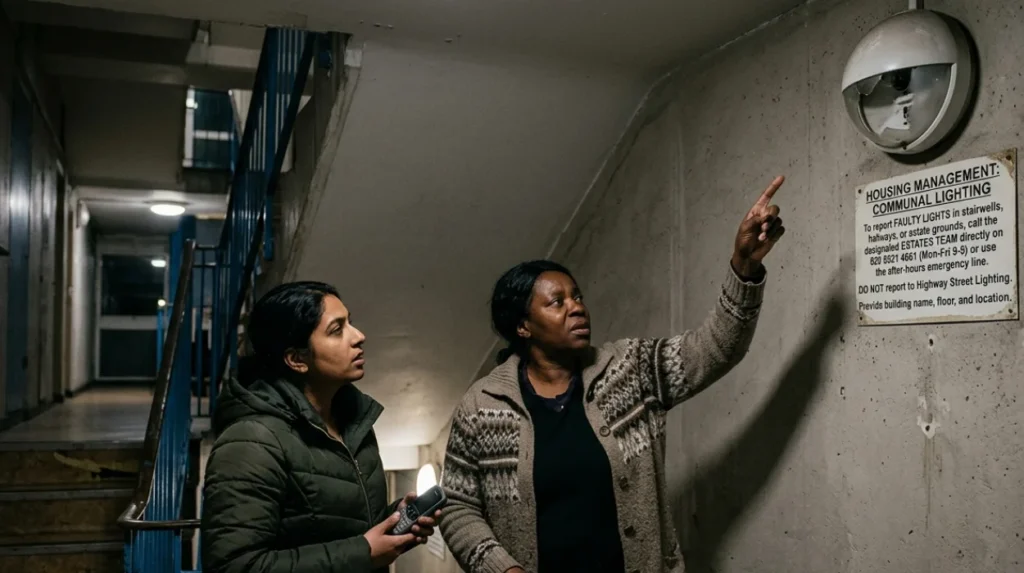
Communal areas within council-owned estates operate under a different maintenance protocol. Residents living in council housing should contact the designated cleaning or estates team via the direct contact number provided for their specific area, which is 020 8921 4661 for general enquiries. These teams manage the lighting for hallways, stairwells, and external communal spaces, which are distinct from the street-facing infrastructure managed by the highways department.
Maintaining these lights is essential for the security of residential buildings and the prevention of anti-social behavior. When reporting these issues, providing the building name, floor level, and the specific location of the faulty light is necessary. Residents should ensure they distinguish between public street lighting and estate lighting to ensure the request reaches the correct maintenance contractor.
What happens if the repair is not completed?
If a repair is not completed within the stated timeframe, residents should follow up by quoting the reference number provided during the initial report or escalate the issue through the council’s formal complaints process.
When a report is filed, the system generates a unique reference number. Keeping this number is crucial for tracking the progress of the service request. If the three-day window for standard repairs passes without resolution, this reference number allows the customer service team to verify the status of the maintenance job. Delays often occur due to weather conditions, part shortages, or the need for multi-agency coordination regarding underground infrastructure.
If the council’s standard response time is consistently exceeded without communication, the formal feedback or complaints mechanism is the next step for escalation. This process ensures that persistent infrastructure failures are reviewed by senior management within the borough’s engineering or public works departments. Proper documentation of the report date and the nature of the fault serves as the basis for any such escalation.
How can I report a street light problem in Greenwich?
You can report it through the official Royal Borough of Greenwich online form, via the reporting app, or by calling customer services.