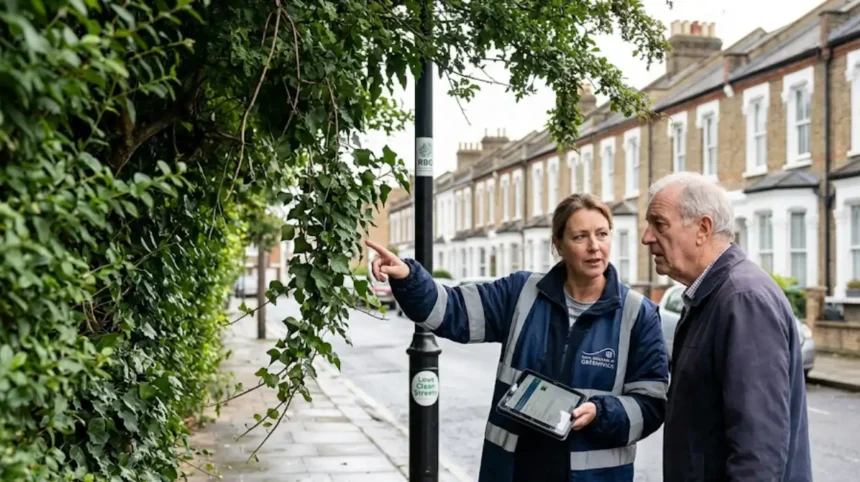
The Royal Borough of Greenwich (RBG) handles overhanging vegetation differently depending on whether the tree is on council land or private property. For trees overhanging public footpaths or roads from private land, you report via the council’s online tree portal. For council-owned street trees causing overhang, use the Love Clean Streets app or website. Private vegetation overhanging your property is not the council’s responsibility—you must trim it yourself back to the boundary.
- What is overhanging vegetation and when does Greenwich Council handle it?
- How do I report overhanging vegetation from a private tree affecting public footpaths in Greenwich?
- How do I report overhanging vegetation from a council-owned street tree in Greenwich?
- What information do I need before reporting overhanging vegetation online in Greenwich?
- What are the legal rights and responsibilities regarding overhanging vegetation in Greenwich?
- How long does it take Greenwich Council to respond to overhanging vegetation reports?
- When should I call instead of reporting overhanging vegetation online in Greenwich?
- What happens after I submit an overhanging vegetation report to Greenwich Council?
What is overhanging vegetation and when does Greenwich Council handle it?
Overhanging vegetation refers to tree branches, hedges, or shrubs that extend beyond their property boundary onto neighbouring land or public space. Greenwich Council only handles overhanging vegetation when it involves council-owned trees on streets/parks OR when private vegetation overhangs a public footpath/road and creates a safety hazard. The council does not intervene in disputes between neighbours over vegetation overhanging private property.
Overhanging vegetation encompasses tree branches, hedge growth, and shrub foliage that crosses property boundaries. In Greenwich, the Royal Borough of Greenwich (RBG) is the local authority responsible for street trees, park trees, and trees on public land. The council’s tree management team maintains approximately 15,000 street trees across the borough as of 2025.
The key distinction determining council responsibility is location and impact. Trees rooted on private property belong to the landowner. Under common law, there is no obligation for property owners to prevent branches from growing beyond boundaries. However, when vegetation overhangs a public footpath, road, or highway, it creates a potential safety issue for pedestrians and vehicles. The highways authority (which for Greenwich街道 is RBG) has powers under the Highways Act 1980 to serve notice requiring landowners to cut back dangerous overhanging vegetation.
Greenwich Council does not deal with reports about branches overhanging private land. This includes vegetation from a neighbour’s tree extending into your garden. In these cases, you have a common law right to prune overhanging branches back to the boundary line, but you must not enter the neighbour’s property to do so and should offer the cut material back to the tree owner.
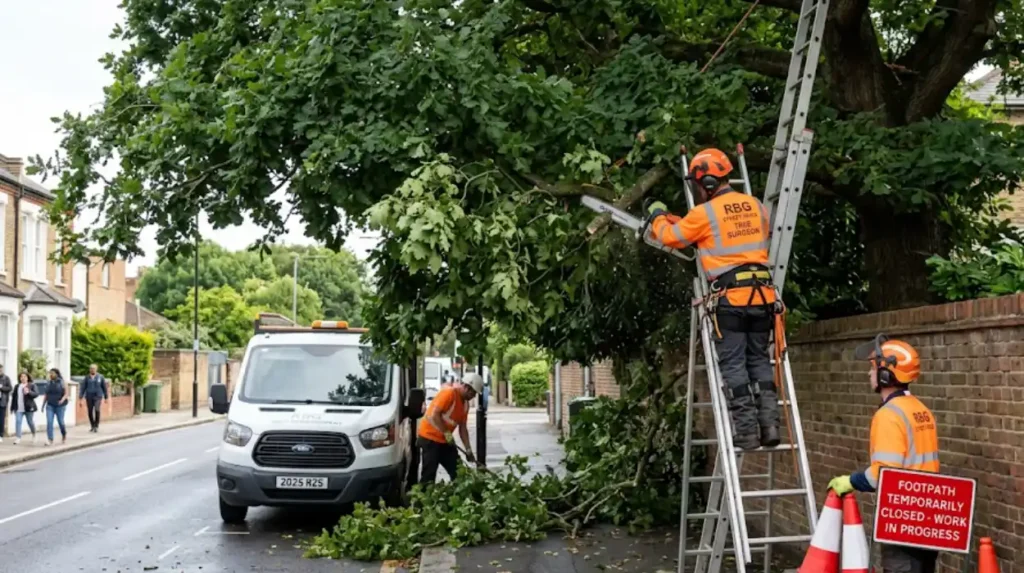
How do I report overhanging vegetation from a private tree affecting public footpaths in Greenwich?
Report private tree overhang affecting public footpaths through the RBG tree portal at royalgreenwich.gov.uk. You need the tree’s exact location (street name and specific position), a description of the overhang issue, and up to 3 photos showing the vegetation blocking the footpath. The council will assess whether the overhang creates a safety hazard and, if confirmed, serve notice on the landowner to cut it back within 14 days.
The reporting process for private vegetation overhanging public space follows a structured online workflow. Navigate to the Royal Borough of Greenwich website and locate the “Report a tree problem” page under Parking, Transport and Streets. The tree portal opens with an interactive map where you select the specific tree location.
When reporting, provide precise location details including the street name, nearest address or landmark, and the exact position of the tree (e.g., “outside 45 Welland Street, on the corner near the bus stop”). Describe the overhang problem clearly: specify whether branches are obstructing the footpath width, blocking street signs or lights, reducing visibility at junctions, or hanging low enough to endanger pedestrians.
Photos strengthen your report significantly. Upload up to 3 images showing the overhanging vegetation from different angles. Include one photo demonstrating how the branches obstruct the footpath. The council uses these images to verify the hazard before contacting the landowner.
After submission, RBG’s tree team conducts an initial inspection. The Deputy Tree Warden or designated officer visits the site to assess whether the overhang genuinely threatens public safety. If confirmed, the council serves a notice under the Highways Act 1980 requiring the landowner to cut back the vegetation within 14 days. If the owner fails to comply, RBG may carry out the works itself and recover costs from the property owner.
The council does not guarantee immediate removal. Response times vary based on hazard severity and workload. Emergency cases (e.g., branches actively blocking road visibility at junctions) receive priority within 5-7 days. Non-emergency overhangs may take 2-4 weeks for inspection and action.
How do I report overhanging vegetation from a council-owned street tree in Greenwich?
Report overhanging council street trees using the Love Clean Streets mobile app or website. Download the app from Apple App Store or Google Play, log in with your email, select the tree location on the map, add a description of the overhang issue, attach photos if safe, and submit. Alternatively, use the Love Clean Streets website at lovecleanstreets.com following the same steps. Reports are processed within 10-14 days for non-emergencies.
Council-owned street trees in Greenwich fall under RBG’s direct maintenance responsibility. The council’s tree contractor trims these trees proactively, but overhanging branches may occur between scheduled maintenance cycles.
The Love Clean Streets platform serves as RBG’s primary reporting channel for street tree issues. This free mobile app enables residents to report environmental issues including overgrown trees, potholes, fly-tipping, and dog mess. The app automatically detects your location when you take a photo, displaying the council’s colours if you’re in the Love Clean Streets Family (which includes RBG).
To report via the app: Open Love Clean Streets, tap “Create a report,” select the street tree location on the map (or type the address), enter a brief description such as “overhanging branches blocking footpath at [street name],” attach 1-2 photos showing the overhang, and submit. The report goes directly to RBG’s tree team.
The website process mirrors the app. Visit lovecleanstreets.com, log in or create an account with your email, click “Create a report,” select the location, add description and photos, then submit. The website works on desktop computers and mobile browsers.
RBG processes street tree reports within 10-14 days for non-emergency overhangs. The tree contractor visits to assess whether trimming is needed. If the overhang obstructs footpath width, blocks street lights/signs, or reduces junction visibility, the contractor trims the branches back to appropriate clearance (typically 2.5 metres above footpaths, 4 metres above roads).
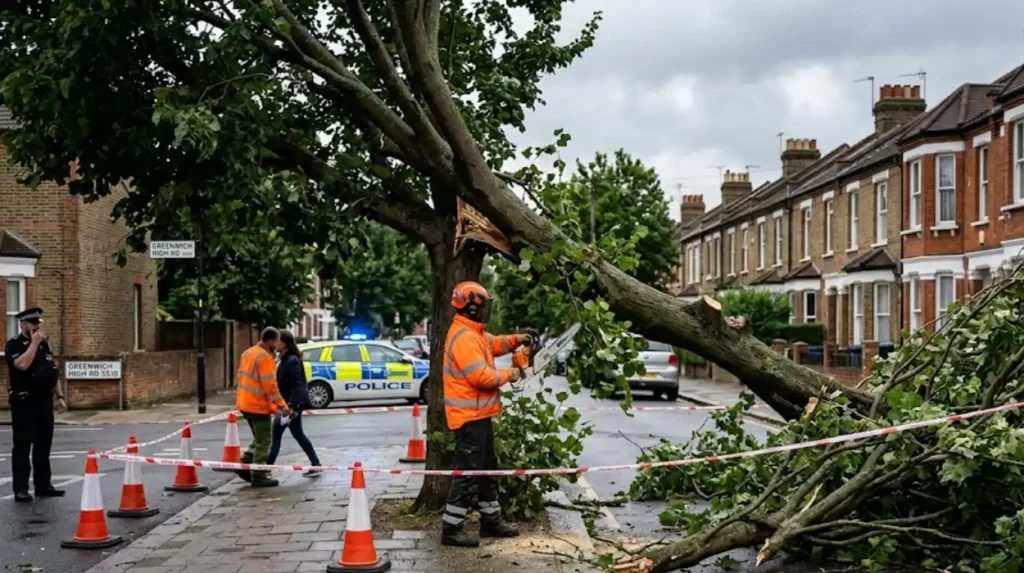
For emergency situations involving council trees—such as fallen trees blocking roads, large branches hanging dangerously over pavement, or trees damaged by storms causing immediate danger—call RBG Customer Services on 020 8921 8000 immediately. Emergency responses occur within 24 hours.
What information do I need before reporting overhanging vegetation online in Greenwich?
Before reporting, gather: the exact tree location (street name, number, nearest landmark), photos showing the overhang (up to 3 for tree portal, 1-2 for Love Clean Streets), a clear description of the problem (e.g., “branches blocking 50cm of footpath width”), and your contact details if you want updates. For private trees affecting footpaths, also note the property address where the tree is rooted. Have your email address ready as both reporting systems require account creation.
Precise location data is critical for accurate council response. Generic descriptions like “near the park” cause delays. Specify the street name, house number closest to the tree, and distinctive features (e.g., “outside 22 Ackleton Road, next to the blue gate, on the corner near the bus stop”).
Photos provide visual evidence that accelerates assessment. Take photos from pedestrian perspective showing how branches obstruct the footpath. Include one wide shot showing the tree’s position relative to the road and one close-up showing branch density. Ensure photos are under 4MB (the Love Clean Streets limit). Snap photos safely—do not climb trees or enter private property.
The description should be factual and specific. Avoid vague terms like “too much overhang.” Instead, state measurable impacts: “branches extend 1 metre over footpath, reducing walking width to 60cm,” or “low branches hang 1.5 metres above pavement, endangering pedestrians.” Mention whether the overhang blocks street lights, traffic signs, or junction visibility.
Contact details enable the council to update you on progress. Both the RBG tree portal and Love Clean Streets require email registration. Provide a working email address you check regularly. Some councils also accept phone numbers for urgent follow-ups.
For private tree reports affecting public space, identify the property where the tree is rooted. This helps the council serve notice to the correct landowner. Note the property address even if you’re unsure of the owner’s name.
What are the legal rights and responsibilities regarding overhanging vegetation in Greenwich?
Under common law, the whole tree belongs to the landowner where it grows. Neighbours can cut overhanging branches back to the boundary line without permission (unless the tree is protected by TPO or in Conservation Area), but cannot enter the neighbour’s property. The cut material remains the tree owner’s property and should be offered back. Councils cannot force private tree owners to maintain trees unless vegetation overhangs public highways and creates danger. Greenwich Council has powers under the Highways Act 1980 to serve notice requiring cutting back of dangerous overhangs on public footpaths.
The legal framework governing overhanging vegetation in Greenwich follows English common law principles established through centuries of case law. The fundamental rule is that ownership of a tree is determined by location of its roots, not by where branches extend. A tree rooted on Property A belongs entirely to Property A’s owner, even if branches cross onto Property B.
Neighbours have a common law right to self-help: they may cut trespassing roots or branches at the point where they cross the boundary boundary. This right does not require the tree owner’s permission. However, the neighbour cannot cross onto the tree owner’s property to perform cuts. All trimming must occur from the neighbour’s side of the boundary.
The cut material—branches, roots, foliage—remains legally the property of the tree owner. The neighbour who cut them must technically offer the material back before disposal. Many neighbours simply leave cut branches on the boundary for the owner to collect, avoiding potential disputes.
Tree Preservation Orders (TPOs) and Conservation Areas add legal complexity. If a tree is protected by a TPO or located in a Conservation Area, prior written consent from the Local Planning Authority (RBG’s Planning Department) is required before any cutting, pruning, or removal. Unauthorized work on protected trees constitutes a criminal offence with fines up to £20,000.
Greenwich Council cannot intervene in private neighbour disputes about vegetation unless public safety is threatened. The council has no power to force property owners to prune trees that overhang neighbouring private land only. This limitation exists because the council lacks statutory authority over private property maintenance absent public hazard.
When vegetation overhangs public highways (roads, footpaths), the Highways Act 1980 grants councils enforcement powers. Section 154 allows the highway authority to serve notice on landowners requiring them to cut back overhanging vegetation that obstructs or endangers highway users. The notice specifies a timeframe (typically 14 days). Non-compliance permits the council to perform works and recover costs.
Dangerous tree legislation also applies. Under the Miscellaneous Provision Act, councils can act if trees are visibly dead or dangerous. However, this requires clear evidence of death or imminent collapse, not mere overhang.
How long does it take Greenwich Council to respond to overhanging vegetation reports?
Non-emergency overhanging vegetation reports take 10-14 days for council tree response and 2-4 weeks for private tree overhang affecting footpaths. Emergency cases (fallen trees, dangerously hanging branches blocking roads) receive 24-hour response. The council inspects first, then acts if hazard is confirmed. No guarantee of immediate removal exists; priority depends on safety risk level.
Response times vary based on hazard classification and council workload. RBG’s tree team processes approximately 200-300 tree-related reports monthly across the borough. Non-emergency overhangs (branches reducing footpath width but not blocking it completely) fall into standard priority queues.
Emergency reports involving fallen trees blocking roads, large branches suspended dangerously over pavement, or storm-damaged trees threatening property receive immediate attention. The contractor responds within 24 hours, often within 4-8 hours for critical safety threats. Call 020 8921 8000 for emergencies rather than using online forms.
For private tree overhangs affecting public footpaths, the inspection-to-action timeline spans 2-4 weeks. The Deputy Tree Warden inspects within 7-10 days after report submission. If the hazard is confirmed, the council serves notice on the landowner with a 14-day compliance deadline. If the owner complies, the issue resolves within 3-4 weeks total. If the owner fails to act, RBG arranges contractor trimming, adding another 1-2 weeks.
Council street tree overhangs via Love Clean Streets typically resolve within 10-14 days. The tree contractor visits during scheduled inspection rounds or responds to urgent reports. Trimming occurs promptly if the overhang meets clearance standards (2.5m above footpaths, 4m above roads).
Seasonal factors affect response times. Autumn leaf collection periods (November) and spring growth seasons (March-May) increase tree-related workload, potentially extending delays by 3-5 days. Winter storm periods also spike emergency call volumes.
No automatic notification system exists for report status updates. Residents must contact Customer Services on 020 8921 8000 to inquire about progress. Provide your report reference number (generated upon submission) for faster assistance.
Explore More Help & Resources
How to report a dangerous council tree in Bexley
How to calculate your 2026 permit cost
When should I call instead of reporting overhanging vegetation online in Greenwich?
Call 020 8921 8000 immediately for emergencies: fallen trees blocking roads or footpaths, large branches hanging dangerously over pavement, storm-damaged trees threatening property, or vegetation obstructing junction visibility creating immediate accident risk. Call instead of online reporting when immediate action is required within 24 hours. Online reporting is appropriate for non-emergency overhangs that obstruct but do not critically block public access.
Emergency situations require phone contact because online forms lack real-time escalation. The Customer Services team routes emergency calls to the tree contractor’s emergency response team immediately. Online reports enter a queue processed during working hours (9am-5pm, Monday-Friday).
Specific emergency criteria include: trees or large branches completely blocking pedestrian or vehicle access, branches suspended at dangerous angles above pavement (less than 2 metres height), trees split by storm damage leaning toward properties, vegetation blocking traffic light visibility at junctions, or root systems lifting pavement creating fall hazards for pedestrians.
Non-emergency overhangs include branches reducing footpath width by 20-50cm, low-hanging branches over garden boundaries (not public space), hedge growth extending into neighbour’s garden, or seasonal leaf accumulation. These warrant online reporting through Love Clean Streets or the tree portal.
Storm events create ambiguous situations. After severe weather, assess whether damage poses immediate danger. If uncertain, call first. The Customer Services team determines emergency classification and dispatches accordingly.
Out-of-hours emergencies (before 9am, after 5pm, weekends, public holidays) also require phone contact. The emergency hotline operates 24/7 for life-threatening tree situations.
What happens after I submit an overhanging vegetation report to Greenwich Council?
After submission, RBG’s tree team reviews your report within 1-2 days. A tree officer inspects the site within 7-10 days for private tree overhangs or 10-14 days for council tree overhangs. If the hazard is confirmed, the council either trims council trees directly or serves notice on private landowners requiring cutting within 14 days. You receive no automatic update; contact 020 8921 8000 with your report reference for status inquiries.
The post-submission workflow follows a structured process. Upon online submission, the system generates a unique report reference number. Save this number for future inquiries. The report enters RBG’s tree management database, queued for review by the tree team.
Initial review occurs within 1-2 working days. A team member checks report completeness: location accuracy, photo adequacy, and description clarity. Incomplete reports may be flagged for clarification, but the council typically proceeds with available information.
Site inspection follows review completion. For private tree overhangs affecting footpaths, the Deputy Tree Warden or assigned tree officer visits within 7-10 days. The officer measures footpath obstruction, assesses branch height relative to pedestrian clearance standards, and evaluates junction visibility impact. Photographs are taken for council records.
For council street tree reports via Love Clean Streets, the tree contractor includes the location in scheduled inspection rounds or dispatches a technician within 10-14 days. Contractor assessment focuses on whether trimming meets clearance standards.
If the inspection confirms a safety hazard, action depends on tree ownership. For council trees, the contractor schedules trimming within 3-5 days. Work occurs during daylight hours on working days. Residents nearby may hear machinery but receive no advance notice.
For private trees, the council serves a formal notice under Section 154 of the Highways Act 1980. The notice is sent to the landowner’s recorded address, specifying required works and a 14-day compliance deadline. The notice includes photographic evidence and measurement data.
If the landowner complies within 14 days, the council verifies completion via follow-up inspection. If the owner fails to act, RBG arranges contractor trimming and issues a cost recovery invoice to the property owner. Unpaid costs become a debt enforceable through civil courts.
No automatic notification system alerts reporters to action completion. Residents must proactively contact Customer Services on 020 8921 8000, providing the report reference number, to request status updates. The team checks the database and provides verbal feedback on inspection results and action planned.
Reports may be rejected if the officer determines no hazard exists. Common rejection reasons include overhang not obstructing footpath width significantly, branch height exceeding 2.5 metres above pavement, or vegetation extending into private garden only. Rejected reports do not trigger council action.
How do I report overhanging vegetation in Greenwich?
Report council-owned street tree overhangs through the Love Clean Streets website or mobile app. If vegetation from a private property is overhanging a public footpath or road, report it using the Royal Borough of Greenwich’s online tree reporting portal.