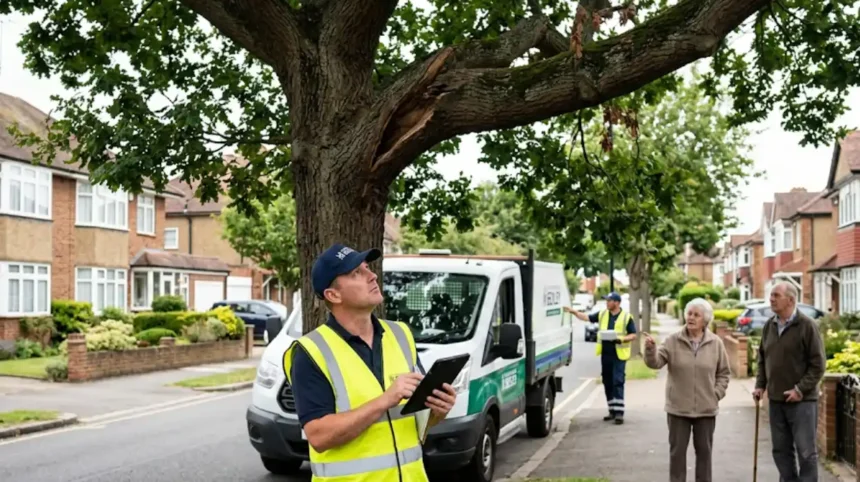
A dangerous council tree in Bexley should be reported to the London Borough of Bexley using its tree issue service, and an immediately dangerous tree or fallen limb blocking a highway or path should be reported by phone on 020 8303 7777, 24 hours a day. Bexley inspects highway trees on a three-year cycle and uses a risk-based survey system for parks and woodlands, so clear reporting helps the Council act on urgent hazards outside the routine inspection schedule.
- What is a dangerous council tree in Bexley?
- How do you report an urgent tree risk?
- What details should you give Bexley?
- Which trees does the Council manage?
- When does Bexley remove or prune a tree?
- What happens after you report it?
- What is the legal basis for action?
- Why does Bexley prioritise tree safety?
- What should residents do before and after reporting?
- Why does this matter for South London readers?
What is a dangerous council tree in Bexley?
A dangerous council tree in Bexley is a Council-managed tree that is dead, dying, structurally defective, obstructing a highway or path, or posing a significant risk to people or property. Bexley says it only carries out essential work on trees that are dead, dying, dangerous, or causing unacceptable damage.
In practical terms, danger is linked to visible risk, not inconvenience. Bexley does not prune or remove trees for leaf fall, shading, sap, insects, bird mess, squirrels, or poor TV signal. That distinction matters because it defines what qualifies for urgent action and what falls outside the tree team’s remit.
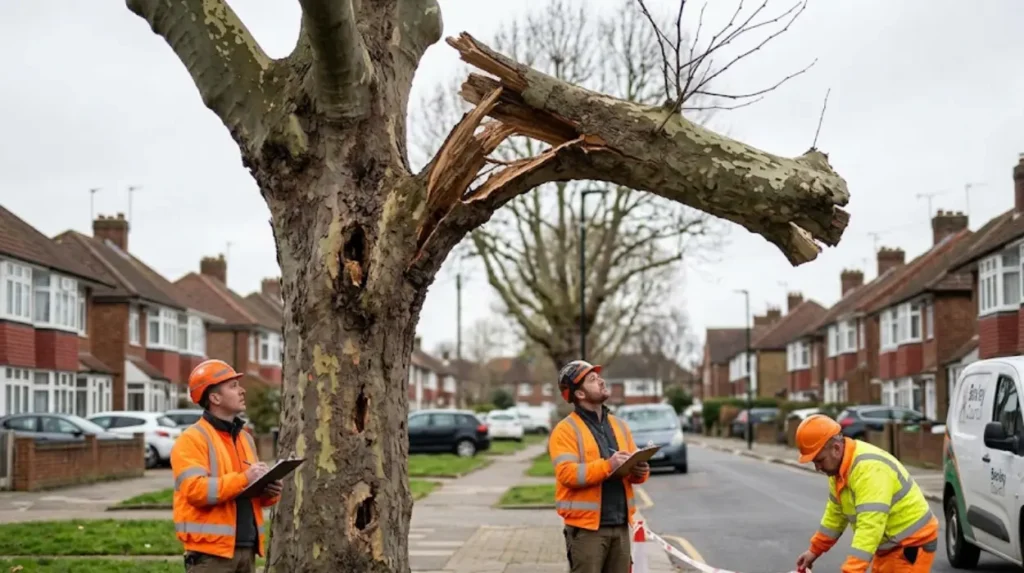
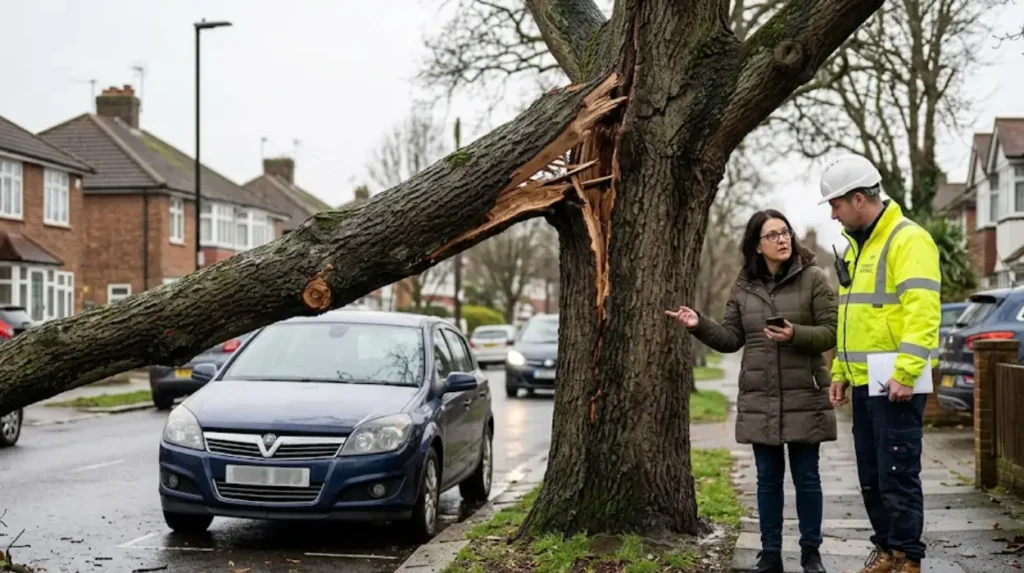
A dangerous tree also includes a limb that has already failed, a trunk with major decay, or a tree leaning in a way that threatens the highway, footpath, or nearby property. Bexley’s tree officers assess trees individually based on species, condition, location, and pruning history.
How do you report an urgent tree risk?
If the tree feels immediately dangerous, or a tree or branch has fallen and is blocking a highway or path, call Bexley on 020 8303 7777 at any time, day or night. For non-emergency tree issues, use the Council’s tree issue reporting service.
Urgent reporting is the right route when the hazard is live and immediate. That includes a hanging limb, a split trunk, a tree that has collapsed across a pavement, or any situation where pedestrians, vehicles, or buildings face direct danger. A phone report gives the Council the fastest route to dispatch the right team.
Keep the report factual and specific. Give the exact location, the type of hazard, and whether access is blocked. If the tree has fallen into the road or onto a path, say so clearly, because that changes the response from routine inspection to emergency management.
What details should you give Bexley?
Give the exact location, a clear description of the problem, and a note on the level of danger. Include whether the tree is on a highway, path, park, or other Council land, and whether it is blocking access or threatening property.
The stronger the location detail, the faster the Council can identify the tree. Street name, nearest house number, nearby landmark, or park entrance all help. If you can name the damage or defect, such as a split stem, dead branches, root disturbance, or a fallen limb, that also improves triage.
Photos are useful when you report a non-emergency issue through a form, because they show the condition of the tree at the time of reporting. For urgent cases, the phone line is still the priority because it reaches the Council faster. The key point is to separate information from urgency: provide enough detail to support action, then use the emergency route when the risk is immediate.
Which trees does the Council manage?
Bexley manages trees on Council land, including highway trees and many trees in parks and woodlands. It does not manage trees in private ownership, including trees on private land or school sites.
This ownership split is essential. If a tree stands on private land, the landowner is responsible for it, and the Council says it is unable to assist with neighbour tree issues as a Council tree matter. That means the first question is always ownership, because ownership determines who acts.
Bexley also states that where a private tree is shown to be a danger to a public road or footpath, it has powers under the Highways Act 1980 to require the owner to make the tree safe. In other words, ownership does not remove public safety responsibility when the tree threatens the highway.
For residents, this means a reported tree issue should always be framed around location and ownership. A tree in a front garden, school boundary, or private estate is handled differently from a tree on a pavement or in a council-managed open space.
When does Bexley remove or prune a tree?
Bexley prunes or removes trees outside the normal inspection cycle when they are dead, dying, dangerous, causing an obstruction, or causing proven unacceptable direct damage to property. It also acts for approved planning permissions and infrastructure schemes.
That list shows the threshold for intervention. The Council does not use tree work as a general service for convenience, but it does act when safety or serious damage is involved. This approach fits standard local authority tree management, where trees are preserved where possible and removed only when risk is significant.
Bexley also says it aims to replace felled trees and increase the total number across the borough. That matters because dangerous-tree reporting sits inside a wider policy of retention, replacement, and risk management, not routine clearance.
For residents, this means a report works best when it identifies a safety issue rather than a preference. A tree that blocks light is not the same as a tree with structural decay, and Bexley’s published policy draws that line clearly.
What happens after you report it?
Bexley assesses reported trees through its tree officers, who consider the species, condition, location, and pruning history. The Council also inspects highway trees every three years and uses a risk-based survey system for parks and woodlands.
The inspection system explains why some issues are dealt with quickly while others wait for scheduled checks. A tree can be safe at one inspection and develop a problem later, which is why public reporting remains important. Reporting is the mechanism that brings a new hazard to the Council’s attention between survey cycles.
If the tree is already fallen or obviously unstable, the situation moves into urgent response. If the issue is a branch failure, decay, or progressive lean, the Council can review it against its risk criteria and schedule work accordingly. This is why good reporting language matters: it links the condition of the tree to the public risk.
The practical implication is simple. The Council does not rely only on scheduled inspections, so residents act as an extra safety net. That makes reporting part of the borough’s tree risk management system, not just a complaints process.
What is the legal basis for action?
Bexley says it has powers under the Highways Act 1980 to require the owner of a dangerous private tree to make it safe when the tree threatens a public road or footpath. That legal power supports public safety where private ownership creates a highway hazard.
This legal framework is important because it explains why the Council can intervene even when it does not own the tree. The road and footpath are public assets, so dangerous overhanging or unstable trees that affect them can trigger enforcement or required work. The power is not used for general neighbour disputes; it is tied to danger or obstruction.
A similar principle is widely reflected in highway tree guidance across local authorities and national bodies. National Highways says Section 154 of the Highways Act 1980 allows action where neighbouring trees overhang roads and create danger or obstruction. That supports the same core rule used by Bexley: public safety on the highway overrides passive inaction by an owner.
For residents, this means the Council can act, but the starting point remains evidence of danger. A report should therefore describe the risk to traffic, pedestrians, or visibility, not just the presence of a tree problem.
Why does Bexley prioritise tree safety?
Bexley describes its trees as part of the borough’s “urban forest” and says they support cooling, runoff reduction, and cleaner air. Because the Council wants to conserve trees for as long as possible, it focuses on essential work only.
This environmental framing explains why tree removals are selective. Trees give urban benefits, so the default position is retention, with removal reserved for danger, death, serious disease, or major damage. The policy balances public safety with environmental value.
Bexley also publishes planting and felling figures that show active tree management. In 2024/25, it recorded 91 highway trees planted and 184 felled, plus 128 park trees planted and 266 felled. Those numbers show that tree management is continuous and that removal is part of a wider replacement cycle, not a one-off response.
For searchers, the practical takeaway is that a dangerous tree report is not a request for wholesale felling. It is a targeted safety report within a borough policy that values trees and removes them only when justified.
Explore More Help & Resources
How to calculate your 2026 permit cost
How to apply for a Wandsworth resident parking permit fast
What should residents do before and after reporting?
Before reporting, check whether the danger is immediate and whether the tree is on Council land or private land. After reporting, keep the reference details, monitor the site from a safe distance, and call again if the hazard gets worse.
The first step is safety. Do not stand under a cracked limb, touch a leaning tree, or block traffic yourself. If the tree has already fallen or is actively obstructing a route, the phone line is the correct first step. If the issue is less urgent, submit the tree issue report with clear location details and, if available, photos.
The second step is ownership. Bexley is clear that it does not handle private tree disputes as Council tree issues. If the tree is on private land but threatening the highway, the Council can still use its highway powers. That distinction often decides the route and speed of action.
The third step is follow-up. If the condition worsens, report it again as a higher-risk issue. Tree safety can change quickly after storms, high winds, or limb failure, so a fresh report can move a case into urgent response.
Why does this matter for South London readers?
This matters because Bexley combines active tree conservation with a clear emergency route for hazards. Residents in South London need the right reporting path so dangerous trees are fixed quickly and non-urgent tree complaints do not delay safety work.
Bexley’s published policy gives residents a precise standard: report immediate danger by phone, use the tree issue route for other problems, and understand that not every tree complaint leads to pruning. That structure reduces wasted reports and speeds up action on real risks.
The borough also provides a model for how local tree management works across South London: routine inspections, risk-based surveys, ownership checks, and legal powers for highway safety. For readers, that means the best report is short, factual, and tied to danger.
If the goal is public safety, the reporting path is straightforward. Call 020 8303 7777 for immediate danger or a fallen limb blocking access, and use Bexley’s tree issue service for everything else connected to Council-managed trees.
What is considered a dangerous council tree in Bexley?
A dangerous council tree in Bexley is a Council-managed tree that is dead, dying, structurally unstable, obstructing a highway or footpath, or posing a significant risk to people or property. The Council generally only carries out essential work on trees that are dangerous, dead, dying, or causing unacceptable damage.