A Wandsworth resident parking permit is an official digital or physical authorization issued by the Wandsworth Borough Council that allows vehicle owners to park within specific designated Controlled Parking Zones near their primary residential address without incurring penalties.
- Why did Wandsworth Council implement the Controlled Parking Zone system?
- Who is eligible to receive a resident parking permit in Wandsworth?
- What documents must you provide to ensure fast application processing?
- How much does a Wandsworth resident parking permit cost?
- What is the step-by-step mechanism to apply online successfully?
- How long does it take for the council to process and activate a permit?
- Where can you legally park once your resident permit is active?
- What are the future implications of Wandsworth’s evolving parking policies?
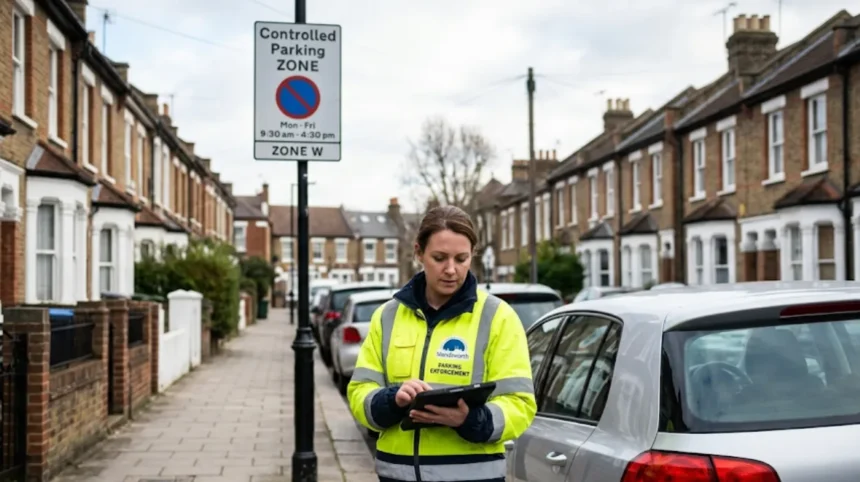
The local government framework establishes these instruments to regulate public highway access. A Controlled Parking Zone (CPZ) restricts kerbside parking to authorized stakeholders during designated hours of operation. Wandsworth Borough Council manages dozens of unique zones, including Zone L1 in Lavender Hill, Zone A1 in Putnam, and Zone C1 in Clapham Junction. These geographical sectors prevent non-resident commuters from exhausting localized vehicle storage infrastructure.
The system ensures that individuals paying council tax retain priority operational access to the public highway immediately adjacent to their domestic properties. The permit binds a specific vehicle registration mark (VRM) to a singular, geofenced administrative sector within the borough boundary.
Why did Wandsworth Council implement the Controlled Parking Zone system?
Wandsworth Council implemented Controlled Parking Zones to mitigate severe urban traffic congestion, prioritize localized parking availability for permanent residents, reduce localized vehicular carbon emissions, and systematically discourage long-term commuter vehicle storage within high-density West London residential neighborhoods.
The historical expansion of the London transport infrastructure network during the twentieth century created an influx of commuter vehicles entering residential zones. Parliament enacted the Road Traffic Regulation Act 1984, which granted local authorities the statutory power to designate specific highways as parking places and charge fees for vehicle storage. Wandsworth Council utilized these legal powers to introduce its first localized restrictions to shield residents from the overflow of vehicles originating from major transport hubs, such as Clapham Junction station and Tooting Broadway underground station.
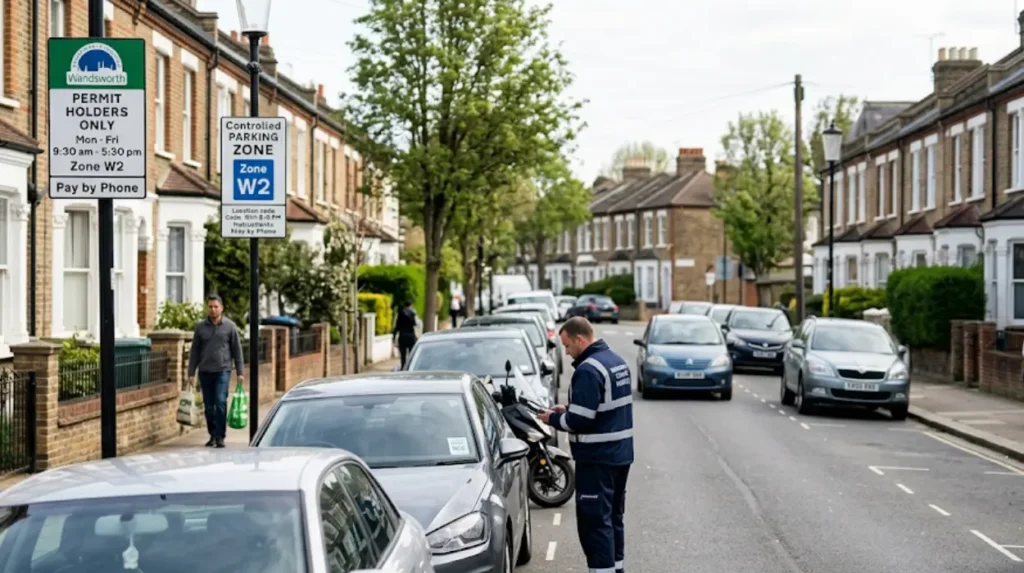
Statistical transport data from the London Borough of Wandsworth demonstrates that unregulated urban environments experience rapid structural decay in parking availability. When commuter vehicles occupy local bays, residents must circulate continuously to locate open slots, which increases localized air pollution. The implementation of the CPZ framework successfully stabilized vehicle volumes. This legal mechanism operates via targeted operational windows, such as Monday to Friday from 9:30 AM to 5:30 PM, depending entirely on the specific zone requirements.
Who is eligible to receive a resident parking permit in Wandsworth?
Any individual whose primary principal place of residence is located within an active Wandsworth Controlled Parking Zone and who functions as the primary registered keeper or exclusive user of an authorized, roadworthy passenger or goods vehicle qualifies for this permit.
To satisfy the statutory residency criteria, the physical property address must lie within an established CPZ boundary and cannot form part of a designated permit-free or car-free housing development. Wandsworth Council cross-references residential data against the active local Council Tax register to verify authentic occupancy status. Eligible applicants must maintain physical presence at the specified location for the majority of the calendar year.
The underlying vehicle must also comply with strict physical and legal boundaries. The regulations restrict authorization to passenger vehicles configured to carry no more than 16 individuals, or standard goods vehicles. The vehicle configuration cannot exceed a total maximum height of 3.2 metres (10 feet 6 inches), a total maximum length of 6.5 metres (21 feet 4 inches), and a maximum gross weight of 5 tonnes. The transport criteria exclude three specific categories of marine or recreational equipment: caravans, trailers, and watercraft. Furthermore, the vehicle must hold active Vehicle Excise Duty (VED) authorization and a valid Ministry of Transport (MOT) safety certificate.
What documents must you provide to ensure fast application processing?
To ensure accelerated verification, you must upload one valid proof of local residence showing your full name and CPZ address, alongside one detailed document proving explicit vehicle ownership or exclusive long-term operational user rights.
Digital validation algorithms require unaltered, high-resolution documentation to bypass manual human intervention queues. The council accepts three categories of long-term residence verification: a current Council Tax bill for the active financial year, a valid 12-month home contents insurance schedule, or a photocard driving licence issued by the Driver and Vehicle Licensing Agency (DVLA) showing the exact CPZ address. If these records are unavailable, applicants can submit three types of utility or financial documentation dated strictly within the preceding three months: a landline telephone bill, an active gas or electricity statement, or a transactional bank or credit card statement. The local authority strictly rejects water utility bills and general corporate letters.
Vehicle verification requires definitive evidence linking the applicant to the registration mark. Registered keepers must submit the official V5C vehicle registration certificate issued by the DVLA, showing the vehicle registered directly to the active CPZ property address. For alternative operational structures, applicants must provide specific paperwork, such as an official vehicle leasing contract or a formal hire agreement. If an individual drives a corporate vehicle, they must upload a typed, signed corporate letter on company letterhead dated within the past three months. This document must state the applicant’s name, domestic address, job title, and vehicle registration mark, while explicitly confirming sole operational custody and specifying whether the entity owns or leases the unit.
How much does a Wandsworth resident parking permit cost?
The price of a Wandsworth resident parking permit depends on the application method, the requested duration of the permit, and the total volume of vehicles registered to the same specific residential household address.
Wandsworth Borough Council utilizes a tiered pricing index that rewards digital processing and discourages multi-vehicle ownership per household to manage overall urban density. The pricing structure separates fees into two clear tracks: online applications and manual over-the-counter or postal processing.
The baseline financial metrics for a standard, first-time annual resident permit showcase a clear digital discount. Applying through the internet portal costs £205 for 12 months, whereas executing the same application via post or in-person at the Customer Centre increases the baseline cost to £230 due to a mandatory £25 manual administration surcharge. Short-term alternatives exist for fluctuating resident needs, including a 3-month digital permit priced at £84 and a specialized 1-month paperless temporary transition permit costing £35, which caters exclusively to newly relocated citizens who lack long-term residency documentation.
The council imposes an escalating household volume surcharge to limit multi-car ownership within the congested West London zone. When a second or subsequent resident within the exact same property applies for a permit, the system adds a flat £103 multi-car penalty to the base rate. Consequently, a second annual permit processed online costs £308, while a manual postal application for a secondary vehicle totals £333. The local authority processes auxiliary administrative modifications via fixed fees, charging £22.80 for the issuance of a replacement or duplicate physical permit and applying an £11.40 flat transactional deduction on authorized refund requests.
Explore More Help & Resources
How to Manage Your Royal Borough of Greenwich Visitor Parking Permits Online
Comprehensive Guide to Using the Bromley RingGo System for Resident Parking Permits
What is the step-by-step mechanism to apply online successfully?
The online application process requires creating an digital account on the official Wandsworth permit portal, entering your vehicle information, selecting your precise zone, uploading your verification documents, and processing your payment.
The digital application mechanism handles data through a secure processing pipeline managed by the council’s automated parking administration software. This infrastructure allows citizens to bypass postal delays and activate parking permissions rapidly.
1.Register an administrative account:Requires active email address.
Navigate to the official Wandsworth Borough Council parking services portal. Select the registration function to establish a unique user profile, providing your legal name, permanent contact details, and precise West London residential address.
2.Input vehicle and zone identifiers:Requires VRM entry.
Enter the specific Vehicle Registration Mark (VRM) into the portal interface. Select your matching Controlled Parking Zone (CPZ) alphanumeric code from the localized street directory database to ensure correct spatial allocation.
3.Upload verification documentation:Supports JPEG, PDF, and PNG formats.
Attach high-resolution digital scans or clear photographic images of your required proof of residence and your vehicle validation documents. Ensure all text, names, dates, and addresses are fully visible to prevent automated flags.
4.Execute digital payment clearing:Requires credit or debit card.
Review the calculated fee based on your vehicle order and application channel. Input valid credit card or debit card credentials to clear the balance instantly through the secure electronic payment gateway.
Once the electronic transaction achieves confirmation, the internal system generates a digital receipt. The platform transmits an automated confirmation email containing a unique application reference number, signaling that the data has entered the active enforcement database.
How long does it take for the council to process and activate a permit?
The council activates internet-based applications instantly upon successful automated document verification, while manual postal applications or complex cases requiring human review take up to 10 working days to achieve full validation.
The processing timeline depends directly on the integrity of the submitted data and the chosen submission channel. Digital applications that successfully pass the automated lookup systems activate the virtual permit immediately. This instant synchronization ensures that civil enforcement officers scanning the vehicle registration mark via handheld electronic devices see the active permit status within minutes of payment confirmation.
If the automated system flags an anomaly, such as a mismatched name variant on a bank statement or a blurry document upload, the file shifts into a manual assessment queue managed by the parking processing unit. This human verification delay requires up to two calendar weeks during peak relocation periods, such as August and September. While a manual application undergoes physical review, the underlying vehicle lacks active parking authorization on the public highway. To mitigate this risk, residents can utilize their online dashboard to activate a temporary parking cover extension, which shields the vehicle from civil penalties during the administrative delay.
Where can you legally park once your resident permit is active?
An active permit grants you legal authorization to park within any designated permit holder bay or shared-use bay inside the specific Controlled Parking Zone printed or coded onto your active account profile.
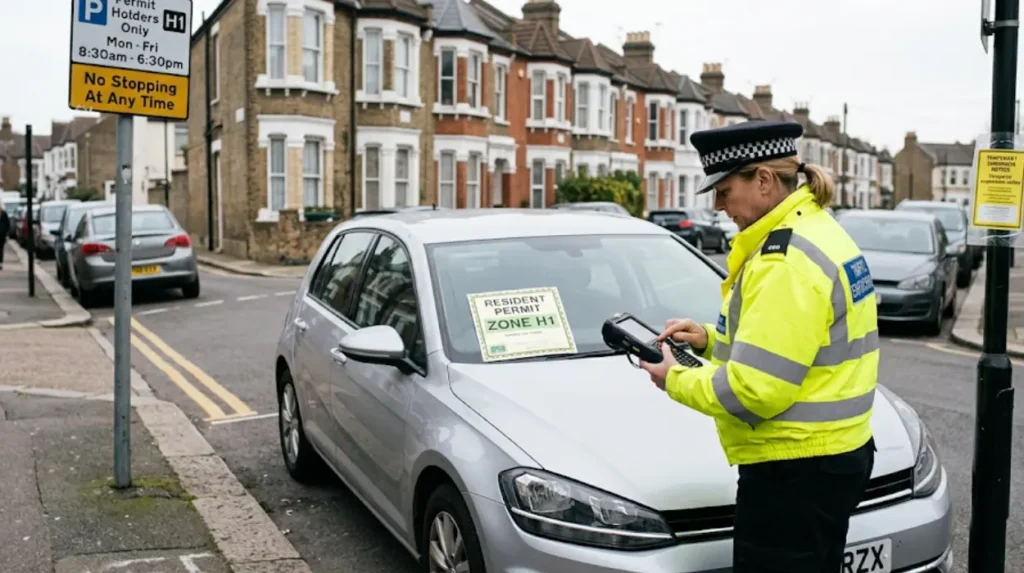
The spatial privileges of a resident parking permit are strictly geofenced to the applicant’s designated sector. For example, a resident holding a Zone H1 permit can park freely on any designated street within the H1 boundary but possesses no immunity outside that specific zone. Shared-use bays permit holders to utilize spaces that double as pay-and-display zones, allowing open-ended vehicle storage during active enforcement hours without purchasing separate hourly tickets.
The permit does not grant universal parking freedom. It remains strictly illegal to park inside three specific zones: active business-specific parking bays, designated loading bays, or on double yellow lines. Furthermore, permits offer no protection in spaces marked with temporary suspension notices, which the council installs for utility maintenance or tree pruning. Civil enforcement officers issue Penalty Charge Notices (PCNs) to any permitted vehicle that fails to respect localized physical suspensions or boundary limits.
What are the future implications of Wandsworth’s evolving parking policies?
The future evolution of Wandsworth parking policy centers on strict environmental sustainability, shifting toward emissions-based pricing matrices and expansion of car-free housing zones to meet local decarbonization targets.
The legislative trajectory of West London local authorities focuses heavily on urban decarbonization and air quality optimization. Wandsworth Borough Council actively reviews municipal data to align its transport strategies with the broader London Ultra Low Emission Zone (ULEZ) standards. Industry analysts project that the current flat-rate pricing system for parking permits will transition into a structured carbon-emissions framework. This future mechanism will apply financial surcharges to high-emission diesel and large petrol internal combustion engines, while lowering costs for battery electric vehicles (BEVs).
Additionally, urban planning departments continue to expand the designation of permit-free housing developments across West London. These modern residential complexes carry permanent land-registry covenants that legally prohibit occupiers from applying for or receiving municipal resident parking permits. This strict planning mechanism permanently decouples high-density residential growth from public highway car storage, forcing a long-term reliance on active travel and public transit networks.