Reporting a faulty street light in Southwark is a straightforward public service process. Southwark Council uses an online reporting route for street lighting faults, and residents can submit the location, describe the problem, and send the report for investigation.
- What counts as a street light fault in Southwark?
- How do you report a street light fault?
- Who fixes the fault in Southwark?
- What details should you include in a report?
- Which streets are not covered by the council?
- Why does Southwark mention LED lighting?
- What happens after you submit a report?
- How long do repairs take?
- Why does street lighting matter in South London?
- What is the best way to write a fault report?
- What should residents remember?
What counts as a street light fault in Southwark?
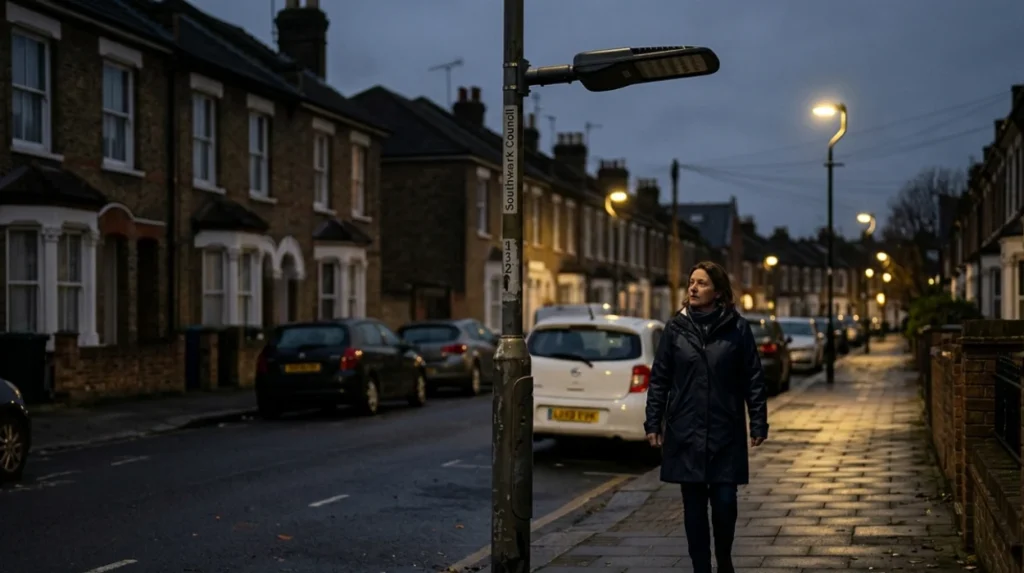
A street light fault is any defect that affects safety, visibility, or the normal operation of public lighting. In Southwark, that includes lights that stay off at night, stay on during the day, flicker, hang loose, lean dangerously, or expose wiring through missing covers or doors.
Street lighting is part of the public highway network. In practical terms, that means the council expects residents to report problems that affect the illumination of roads, pavements, and crossings that the council manages. The Southwark reporting form specifically lists faulty lights that are not on at night, lights that should not be on during the day, hanging or twisted lanterns, covers or doors missing, and damaged or leaning lamp columns.
The issue matters because street lighting supports road safety, personal safety, and wayfinding after dark. When a lamp fails, the effect is not limited to a single column. It can reduce visibility across a stretch of pavement or carriageway and create avoidable risk for people walking, cycling, and driving in the area.
How do you report a street light fault?
You report a street light fault in Southwark by using the council’s online reporting route, entering a Southwark postcode or street name, placing the fault on the map, describing the problem, and confirming the report. The council then investigates the issue and routes it to the correct repair process.
The council’s reporting flow is designed to collect the location first, because street light repairs depend on exact siting. The user is asked to enter a Southwark postcode or street name and area, locate the problem on a map, and then provide details before submitting the report. The system then records the fault for investigation.
Southwark also publishes a street lighting form that directs some faults into the wider repair network. The form notes that many lighting faults in the borough are now linked to electrical supply issues rather than the lantern itself, especially as the borough transitions to LED lighting. That detail matters because the report may not go to a standard lamp replacement route if the real cause sits in the supply infrastructure.
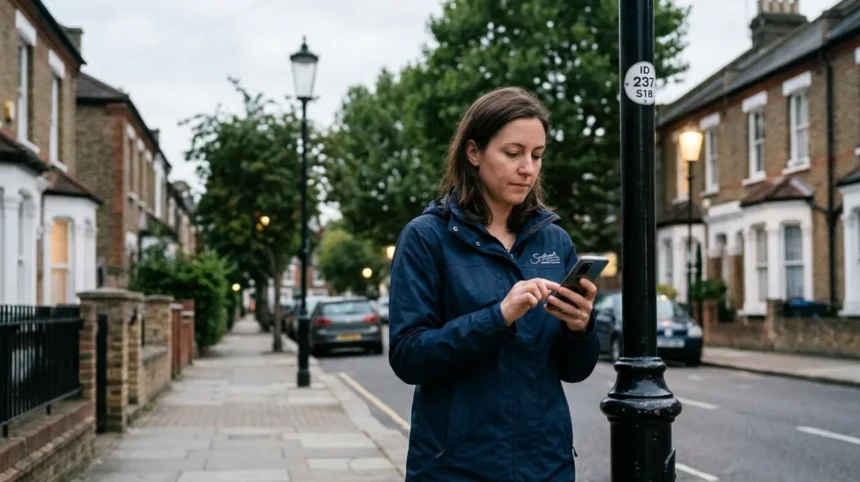
A good report includes the nearest door number, road name, or landmark, plus a clear description of the fault. If you have photos, they help identify whether the issue is a single light failure, a damaged column, or a broader electrical problem.
Who fixes the fault in Southwark?
Southwark Council handles the reporting route, but the actual repair can involve different bodies depending on the type and location of the fault. Some repairs are carried out by UK Power Networks, while faults on red routes, private roads, and housing land sit outside the council’s main responsibility.
Southwark’s street lighting form states that as the borough shifts to LED lighting, the number of faults should reduce. It also says many remaining issues come from the electrical supply cable rather than the light itself, and those repairs are carried out by UK Power Networks. That means residents should not assume every street light issue is a simple bulb replacement.
The council also states that it is not responsible for lighting on red routes, housing estates, or private land. If the fault is on a red route, it should go to Transport for London. If the fault is on housing land, it should go to the relevant housing engineering contact rather than the highway route.
This division of responsibility is important because it prevents delays. A report sent to the wrong authority often slows the repair process, even when the fault itself is simple. The fastest route is always the one that matches the site location and ownership.
What details should you include in a report?
A strong report includes the exact location, a short description of the fault, and any visible identification on the lamp post or column. If available, add photos, the nearest address, road name, or landmark so the repair team can find the light quickly.
Location is the most important detail. Councils and utility teams use road names, postcodes, and map pins to identify the right column. Without precise location data, a fault can sit unresolved because crews cannot safely inspect the correct asset.
A useful description is short and factual. Examples include “light not working at night,” “lamp flickering,” “column leaning,” or “cover missing with wires exposed.” Those descriptions match the fault categories used by Southwark and help the report reach the right maintenance team.
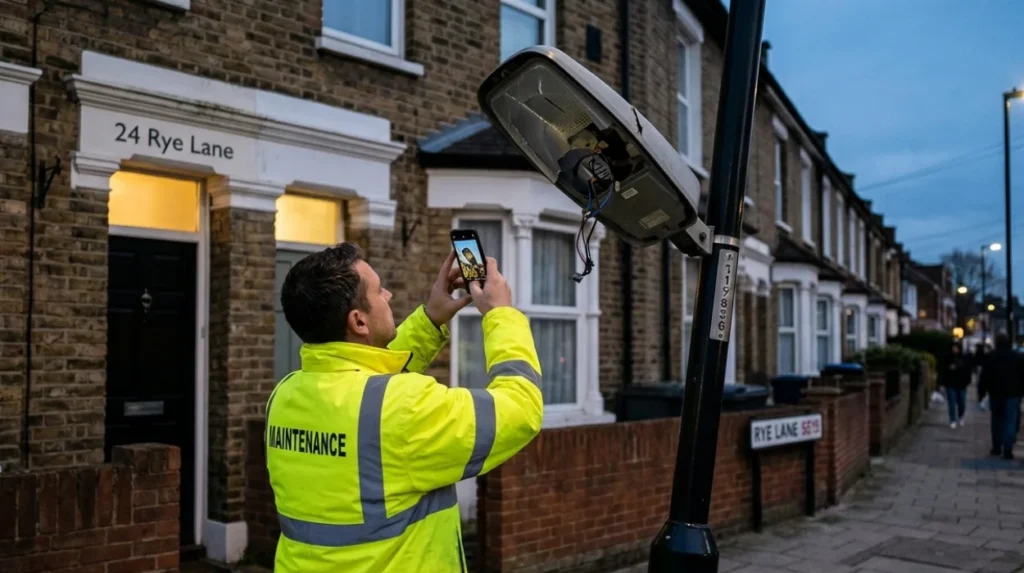
If the lamp post has a number plate or asset number, include it. That identifier can speed up repairs because it links the fault to a specific column rather than a general street segment. Photos help too, especially when the problem is a broken lantern head, exposed cable, or a light that cycles on and off.
Which streets are not covered by the council?
Southwark does not manage every lit street in the borough. Red routes, private roads, and housing estate lighting sit outside the standard council highway repair route, so those faults need to go to the correct managing body instead.
Red routes are major roads managed by Transport for London rather than the local council. If a faulty light sits on one of those roads, the report needs to go to TfL, not Southwark. This distinction matters across South London because boundary roads often pass through several boroughs and can look like ordinary streets even when they are not council-managed.
Private roads are another separate category. If a road is privately maintained, the property freeholder or managing agent is usually responsible for the lighting. Southwark’s own guidance says private-road faults should not be reported through the standard council street-light route.
Housing estates also need separate handling. Southwark notes that it is not responsible for lighting on housing estates, and the issue should be redirected through the relevant housing contact route. That keeps repair responsibility aligned with ownership and maintenance contracts.
Why does Southwark mention LED lighting?
Southwark mentions LED lighting because the borough is changing its street lighting infrastructure, and that change affects fault patterns. LED systems usually reduce lamp failures, but the faults that remain often relate to electrical supply rather than the light unit itself.
The council says the transition to LED lighting should significantly reduce the number of faults. It also says that the faults that still happen are often linked to electrical supply cable issues rather than the lantern itself. That is a structural change in the network, not just a simple bulb swap.
This helps explain why some residents see longer repair times for certain faults. A light that appears broken can sometimes be part of a wider network issue that requires coordination with the electricity infrastructure operator. Southwark reporting is therefore a front door, not the whole repair chain.
Recent local reporting has also highlighted concern about street light repair delays in the borough, showing that repair time remains a visible public issue. A Southwark news report in late 2025 said average repair times were close to three weeks, and it cited one case lasting far longer, which shows why clear reporting details matter.
What happens after you submit a report?
After submission, Southwark records the fault, checks the location, and investigates whether the issue belongs to the council, UK Power Networks, Transport for London, or another land manager. The report becomes part of the repair workflow rather than an immediate fix.
The first stage is validation. The report needs a correct location and a fault description before crews can assess responsibility. If the site is on a council-managed road, the issue can move through the street lighting workflow. If the site is on a red route or private land, the report should be redirected to the correct authority.
The second stage is inspection or triage. Some faults are straightforward, such as a failed lamp head or a missing cover. Others require network investigation, especially when the fault sits in the supply system. Southwark’s published guidance shows that the borough relies on both council and utility-company involvement for different fault types.
The final stage is repair scheduling. A resident should not expect same-day resolution unless the problem is urgent and the responsible team is available. Fault repair speed depends on the type of defect, access conditions, and whether the issue belongs to the council or a utility partner.
How long do repairs take?
Repair time depends on fault type, ownership, and access. Local reporting has shown that Southwark street light repairs have taken close to three weeks on average in recent coverage, while some cases have taken much longer when the issue is complex or the responsible team is external.
Average repair time is not fixed in the public guidance Southwark publishes, which means residents should treat reported timings as operational rather than guaranteed. A simple lamp failure can be faster than a network fault that requires utility coordination. That difference explains why some lights return quickly while others remain out for extended periods.
The borough’s LED transition also affects timing. While LED systems reduce the total number of faults, the remaining faults can be more technical and can require specialist intervention. That creates a clear reason why an apparently minor issue sometimes takes longer than expected.
For residents, the practical implication is simple. Report the fault early, report it accurately, and include enough detail for the right maintenance team to act. Precise reporting shortens the path from complaint to repair.
Why does street lighting matter in South London?
Street lighting matters because it supports safer movement after dark, especially on residential streets, school routes, and busy walking corridors. In South London, where many streets combine dense housing, traffic, and evening footfall, a single outage can affect how people use the area.
A dark stretch of road can change behaviour immediately. People may avoid a route, cross the road more often, or feel less secure using a path at night. That has a direct effect on public space use and perceived safety, even when the street itself is still passable.
The issue also connects to accessibility. Good lighting helps older residents, parents with children, and people with visual impairments move more confidently after dark. In that sense, street lighting is basic urban infrastructure, not an optional extra.
Southwark’s move toward LED lighting has a wider relevance for South London because boroughs across the capital are modernising older lighting stock. The shift reduces maintenance burden over time, but it also introduces a period when old and new systems coexist, which can create mixed fault patterns.
What is the best way to write a fault report?
The best fault report is short, exact, and location-based. State what is wrong, where it is, and whether the light is off, flickering, damaged, leaning, or unsafe, then add a photo if you have one.
A clear report avoids vague language. “Street light broken” is less useful than “lamp outside 24 Rye Lane is off at night and has a missing cover.” The second version gives the maintenance team a specific asset, condition, and location in one sentence.
Accuracy matters because lighting faults often sit close to boundaries between responsibility areas. A road can look like a normal residential street but still fall under TfL, a housing provider, or a private management company. The more exact the report, the lower the chance of delay.
This is especially important in a borough like Southwark, where different road classes and ownership patterns overlap. Residents who report with clear facts help the repair system work faster and more efficiently.
What should residents remember?
Residents should remember three things: report through Southwark’s official route, give exact location details, and check whether the fault belongs to the council, TfL, housing, or a private owner. That process gives the fastest path to repair in South London.
Southwark’s reporting system is built to collect the information needed for investigation and routing. The council’s own guidance shows that street lighting faults are handled differently depending on where the light sits and what type of fault is present.
The practical result is clear. A good report saves time, reduces back-and-forth, and increases the chance that the right team attends the right light. For South London residents, that makes street-light reporting a small but important part of keeping neighbourhood streets usable after dark.
How do I report a broken street light in Southwark?
Use Southwark Council’s online reporting system. Enter the postcode or street name, pinpoint the light on the map, describe the issue, and submit.