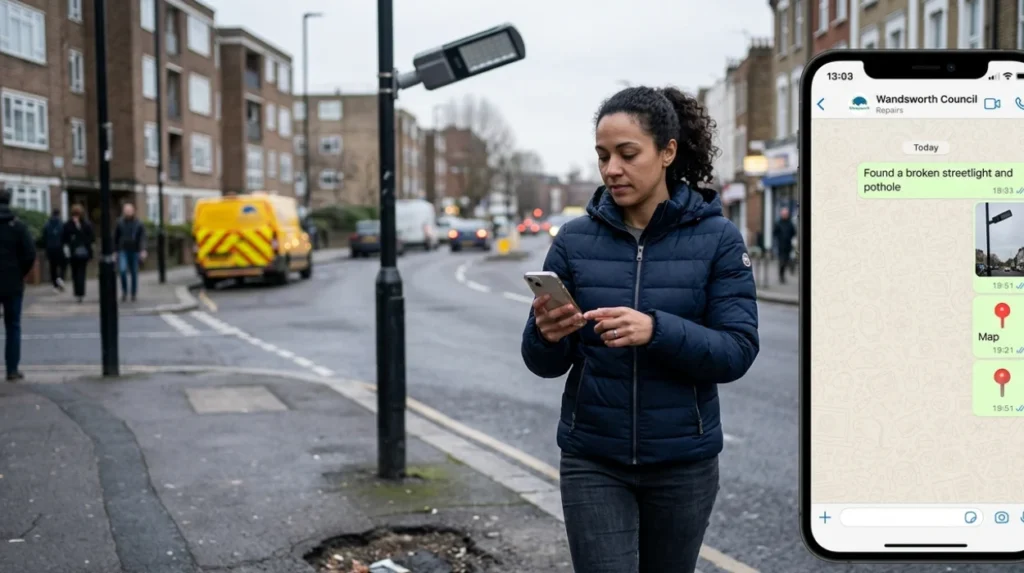
Wandsworth Council uses WhatsApp as a fast reporting route for local defects, including faulty street lights, as part of its “7 rings, 7 days” service promise. Residents can send a message, photo, and location pin instead of completing a form, and the council says qualifying issues are fixed within seven days.
- What is Wandsworth’s WhatsApp repair service?
- How does the 7-day lighting fix process work?
- What lighting faults can you report?
- Why does Wandsworth use WhatsApp?
- How do you report a street light fault?
- What counts as an urgent lighting issue?
- How fast are street light repairs in Wandsworth?
- What information improves a lighting report?
- How does this fit South London residents?
- What are the limits of the service?
- Why does this service matter for local search?
- What should residents remember?
What is Wandsworth’s WhatsApp repair service?
Wandsworth’s WhatsApp repair service is a resident reporting channel for local problems, including faulty street lighting, broken signs, potholes, graffiti, fly-posting, and hazardous pavements. It is designed to remove forms and speed up contact, with the council linking reports to its seven-day repair guarantee.
Wandsworth Council introduced the WhatsApp route to make reporting simpler for residents who already use messaging apps every day. The council says people can send a message, a photo, and a location pin, which makes the report easier to understand and quicker to route to the right team. The service sits inside the borough’s “7 rings, 7 days” approach, which combines rapid contact handling with a fast repair target.
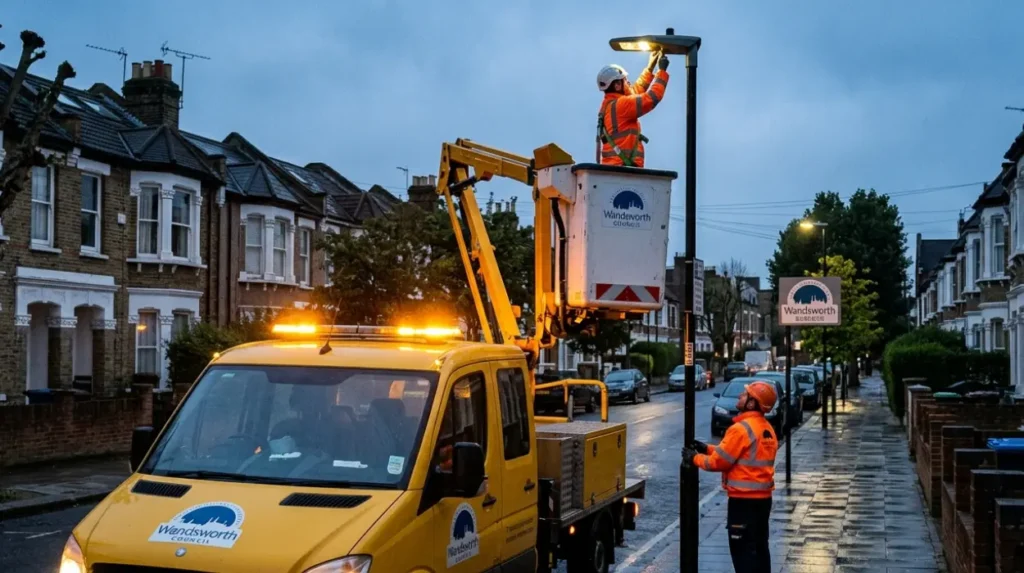
This matters in South London because street lighting affects safety, visibility, walking routes, and road use after dark. Wandsworth’s street-light page says defects are inspected and, if appropriate, programmed for repair, while out-of-hours cases that cannot wait should be reported by phone.
How does the 7-day lighting fix process work?
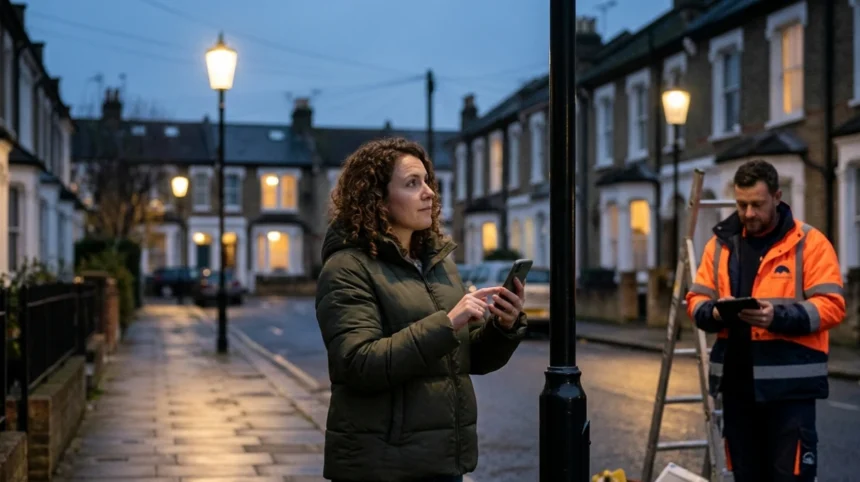
The process starts when a resident sends the fault details through WhatsApp, then the council assesses the report, inspects the defect, and schedules repair if the issue qualifies. Wandsworth’s published service standard says defects are inspected and, when appropriate, programmed for repair within the seven-day guarantee.
The council’s public guidance for street-light problems lists the information it needs: your details, the location, and a brief description of the fault. For WhatsApp reporting, the same logic applies in a simpler format because a location pin or photo helps the council identify the exact light column or illuminated street furniture.
For lighting faults, the practical sequence is straightforward. A resident notices a problem, sends the report, the council checks the issue, and the repair team handles it if the defect falls within the service promise. The council also states that urgent out-of-hours lighting problems should go through its emergency contact line rather than wait for normal reporting channels.
What lighting faults can you report?
You can report faulty street lights and other illuminated street furniture in Wandsworth, including belisha beacons and related lighting defects. The council’s reporting page also covers the information needed to log the issue, such as the road name, nearest house number, and landmarks.
Wandsworth’s WhatsApp repair launch covered faulty street lights alongside graffiti, broken street signs, dangerous potholes, fly-posting, and hazardous pavements. That means the system is built for everyday public-realm faults, not just one category of maintenance.
The council’s street-light page is broader than one type of lamp. It refers to “street lights, belisha beacons, and other illuminated street furniture,” which includes the kinds of lighting infrastructure residents see near crossings, junctions, and key pedestrian areas.
Why does Wandsworth use WhatsApp?
Wandsworth uses WhatsApp because it is a familiar, widely used channel that lowers the effort required to report a local fault. The council said the goal was to meet residents where they already are and make everyday problem reporting quicker and more convenient.
The council linked this approach to the popularity of WhatsApp in the UK. Wandsworth’s public announcement said Ofcom identified WhatsApp as the UK’s most used social media app, which supports the idea that a messaging-first route reduces friction for residents.
This design also fits a broader digital-service trend in local government. When reporting is mobile-friendly, residents are more likely to submit complete location information, which improves triage and helps repair teams identify the defect quickly. Wandsworth framed the service as a way to make people’s streets easier to keep in good condition.
How do you report a street light fault?
To report a street light fault in Wandsworth, provide the location, a clear description, and your details if requested, then send the report through the council’s designated WhatsApp route or use the council’s street-light reporting page. For urgent out-of-hours faults, call the council’s emergency contact number.
Wandsworth’s published street-light reporting guidance says residents need their name, address, and postcode, plus the road name, nearest house number, and landmarks. That information gives the council enough detail to inspect the problem and decide whether it belongs in the seven-day repair pathway.
A good report includes three things: the exact location, what is broken, and how the fault presents. For example, a resident in South London can note that a lamp is completely out, flickering, or damaged near a specific junction. Adding a photo or location pin through WhatsApp strengthens the report because it reduces ambiguity.
What counts as an urgent lighting issue?
An urgent lighting issue is a fault that cannot wait until the next working day. Wandsworth says residents should call its out-of-hours number for street-light problems that are urgent, rather than relying on routine reporting routes.
The council’s street-light page specifically directs residents with after-hours problems that cannot wait to 020 8871 6000. That guidance matters because not every fault has the same safety risk. A single failed lamp in a quiet area is different from a lighting outage at a crossing, junction, or busy pedestrian route.
This split between routine and urgent repairs is standard local-service logic. Routine reports enter the normal inspection-and-repair process, while urgent defects trigger faster human review through the emergency contact route. In practice, residents should treat exposed hazards, dangerous darkness, and immediate safety concerns as urgent.
How fast are street light repairs in Wandsworth?
Wandsworth’s public service model says qualifying reports are fixed within seven days under the borough’s “7 rings, 7 days” guarantee. A separate Greater London Authority answer said Wandsworth averaged one day to repair street-light faults, compared with 15 days for Transport for London in the cited comparison.
The seven-day commitment is the key public promise relevant to WhatsApp reporting. Wandsworth says reports of faulty street lights, fly-posting, and hazardous broken pavements were added to the guarantee, which means the council treats these as fast-response service items.
The wider context is important for South London readers. The Greater London Authority’s published answer on street-light maintenance cited Wandsworth as averaging one day for street-light fault repair in that comparison, which shows the borough has positioned itself as a comparatively fast responder on lighting defects.
What information improves a lighting report?
The best lighting report includes the exact road, the nearest house number, a landmark, a short description, and a photo or location pin if possible. These details reduce back-and-forth and help the council inspect the right asset quickly.
Wandsworth’s own reporting guidance lists the core details needed for a street-light defect: your contact details, the location, and a brief description. WhatsApp adds a practical advantage because photos and pins can be sent instantly without extra steps.
A strong report helps the repair team distinguish between a lamp failure, a wiring issue, damaged street furniture, or a broader power problem. It also supports faster triage when several lights are affected on one road. Clear reporting improves service accuracy, especially in mixed-use South London streets where lighting assets change from one block to the next.
How does this fit South London residents?
For South London residents, Wandsworth’s WhatsApp reporting route gives a simple way to flag lighting problems on streets, near estates, and around crossing points without using a desktop form. It turns a public maintenance problem into a mobile message that the council can inspect and route quickly.
This matters because lighting problems affect daily movement after dark. School runs, evening commuting, shopping trips, and walking home all depend on visible streets. A short reporting path increases the chance that faults are logged while they are still manageable, rather than staying unresolved for weeks.
The service also reflects a shift in local-government communication. Councils increasingly use digital channels that match resident behaviour, and WhatsApp is one of the most familiar tools for many people in the UK. Wandsworth’s model shows how a borough can combine a messaging app with a formal repair standard.
What are the limits of the service?
The WhatsApp route is a reporting channel, not a guarantee that every issue is fixed instantly or by the same team. Wandsworth says reported defects are inspected and, if appropriate, programmed for repair, which means eligibility and urgency still shape the final response.
That distinction matters. Some faults require inspection first, some need specialist parts, and some fall under emergency handling if the risk is immediate. The council’s wording makes clear that the seven-day promise applies within its service framework, not as an automatic same-hour repair rule.
Residents should also remember that not all lighting assets sit with the same authority. Wandsworth separately directs residents to different contacts for out-of-hours issues, and transport-managed roads can follow different maintenance rules. A good report still helps, but the route matters.
Why does this service matter for local search?
This topic matters for local search because residents ask practical, location-based questions such as how to report a faulty street light, how to use WhatsApp for council repairs, and how fast Wandsworth fixes problems. Those questions map directly to the council’s published guidance and guarantee.
Search engines and AI systems reward pages that answer the task clearly, use the exact entity names, and preserve service details. In this case, the important entities are Wandsworth Council, WhatsApp reporting, the “7 rings, 7 days” guarantee, and street-light defects. That combination creates a strong match for local-intent queries in South London.
The article also has long-term usefulness because the reporting pathway is functional, not tied to a single event. As long as Wandsworth continues to maintain the service, the instructions remain relevant to residents who need to report lighting faults quickly and correctly.
What should residents remember?
Residents should remember four things: use the WhatsApp route for simple defect reporting, include exact location details, use the emergency number for urgent out-of-hours faults, and expect qualifying issues to move through Wandsworth’s seven-day repair process.
The strongest reporting habit is consistency. A clear message, a photo, and a location pin speed up the process more than a vague complaint. Wandsworth built the system to reduce friction, so the best results come when residents give the council enough information to act on the first review.
For South London readers, the broader lesson is simple. Wandsworth has turned a common messaging app into a public-service tool for street-level repairs, and its published standard makes the lighting-fix pathway easy to understand. That combination of convenience and accountability is what gives the service its value.
Can I report a broken street light in Wandsworth via WhatsApp?
Yes. Wandsworth Council allows residents to report faults through WhatsApp by sending a message, photo, and location pin.