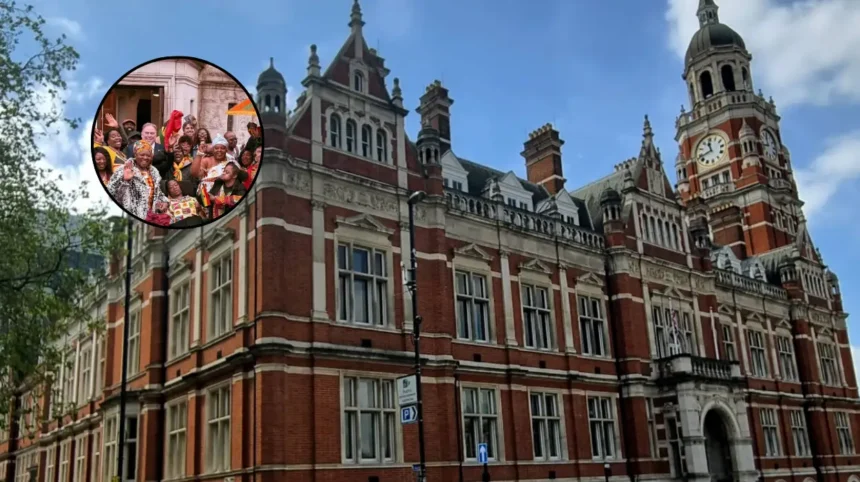
- Historic Chamber Diversity: For the first time since its formation in 1965, Croydon Council features elected representatives from five different political parties, alongside an independent councillor.
- Political Gridlock and Power Imbalance: Despite the Labour Party remaining the largest group in the chamber, the executive power resides strictly with Conservative Executive Mayor Jason Perry.
- Minority Mandate, Maximum Control: Mayor Perry secured his position with just 30.7% of the total votes cast, while the Conservative Party won 28 seats—the fewest in the 61-year history of the borough.
- Constitutional Obstacles: The existing Croydon Council constitution embeds a rigid two-party duopoly, protecting the interests of the two major parties and council bureaucrats while marginalising smaller parties.
- The Two-Thirds Threshold: Under current constitutional rules, a two-thirds majority in the chamber is required to overturn most mayoral decisions, allowing the 28 Conservative councillors to effectively block any opposition initiatives.
Croydon (South London News) May 18, 2026 — The political landscape of Croydon has entered uncharted territory following local election shifts that have fractured the traditional two-party duopoly for the first time in more than half a century. As reported by Walter Cronxite, Political Editor of Inside Croydon, the newly formed chamber comprises councillors from five distinct political parties plus one independent representative. However, this unprecedented level of democratic diversity faces an immediate structural roadblock. The core question gripping the town hall is whether these newly elected minor-party representatives will be able to exert any meaningful influence over municipal governance, or if the council’s own rigid constitutional framework will be used to systematically lock them out of the decision-making process.
- How Does the Croydon Council Constitution Block Democratic Change?
- What Impact Will the 12 Minor-Party Councillors Have on Local Governance?
- Why Does the Mayoral System Allow a Minority of Votes to Dictate Council Policy?
- Background of the Croydon Council Governance Transition
- Prediction: How the Constitutional Gridlock Will Affect Croydon Residents
The institutional gridlock stems from a fundamental mismatch between the layout of the council chamber and the distribution of executive power. While the Labour Party retains the status of the largest single political group among the councillors, the executive authority is entirely concentrated in the hands of the Conservative Executive Mayor, Jason Perry. As Cronxite highlights, this system allows Mayor Perry to wield absolute executive control despite having secured only 30.7% of the votes cast by the electorate. Furthermore, the Conservative Party’s broader representation in the borough has hit historic lows, with the party securing just 28 council seats—the lowest total since Croydon Council was established in 1965. Despite this historically weak mandate, the architecture of the council’s constitution ensures that the minor parties and the Labour opposition remain largely powerless to challenge executive decrees.
How Does the Croydon Council Constitution Block Democratic Change?
The primary barrier to political reform within the borough is not the willingness of the newly elected councillors, but the legal framework governing town hall operations.
As analysed by Walter Cronxite of Inside Croydon, the council’s constitution is deliberately engineered to sustain a Red-Blue, Labour-Tory duopoly.
This structural design routinely works in tandem with the interests of council bureaucrats who, acting to preserve administrative stability and their own institutional influence, actively resist efforts to decentralise authority.
The mechanism that cements this power dynamic is the voting threshold required to override executive mayoral decisions. Under the current rules, a full council vote requires a two-thirds absolute majority to overturn or significantly alter most decisions handed down by Executive Mayor Perry.
Because the Conservative group holds 28 seats, they possess a large enough voting bloc to comfortably prevent the opposition from ever reaching that two-thirds threshold. Consequently, even if Labour, the independent, and the twelve councillors from the three smaller parties vote in complete unison, they cannot legally compel the executive mayoral office to alter its course on key borough policies.
What Impact Will the 12 Minor-Party Councillors Have on Local Governance?
With twelve councillors now representing three alternative political parties alongside one independent, the chamber looks fundamentally different from the bipartisan bodies of the past sixty years. In his political assessment for Inside Croydon, Walter Cronxite raised the critical question of whether this influx of political diversity can translate into tangible policy shifts.
Under normal parliamentary conditions, a third-party presence can act as a kingmaker or force compromises; however, Croydon’s mayoral model significantly diminishes this leverage.
The smaller parties face a dual challenge: they must navigate an adversarial relationship with a Conservative executive that holds a constitutional veto, while simultaneously contending with a dominant Labour opposition that is hesitant to cede its traditional role as the primary alternative voice in the borough. Bureaucratic protocols within the council also dictate committee assignments, speaking time, and the ability to table motions—areas where the constitutional framework heavily favours the two main parties.
Unless the minor parties can form an unprecedented, sustained legislative coalition with Labour to challenge procedural rules, their impact may be restricted to public dissent rather than legislative transformation.
Why Does the Mayoral System Allow a Minority of Votes to Dictate Council Policy?
The current governance crisis traces back to the introduction of the directly elected mayoral system, a model that prioritises executive decisiveness over proportional representation.
As Walter Cronxite of Inside Croydon notes, Mayor Perry’s mandate rests on less than a third of the participating electorate (30.7%).
In a standard committee-led council system, such a result would necessitate the formation of a coalition government or a minority administration relying on cross-party consensus to pass budgets and policies.
In Croydon, however, the mayoral model insulates the executive from the shifting tides of the council chamber. Once elected, the Mayor holds independent executive authority that is legally distinct from the collective will of the elected councillors.
This structure was originally championed as a way to provide clear leadership and accountability for a borough plagued by financial mismanagement. Yet, the current composition of the chamber demonstrates the system’s democratic deficit:
it enables an administration with the weakest electoral showing in the council’s history to govern without the necessity of compromise, creating what critics describe as an anti-democratic bottleneck.
Background of the Croydon Council Governance Transition
To understand the severity of the current constitutional impasse, it is necessary to examine the structural evolution of Croydon Council since its inception in 1965. For nearly six decades, the London Borough of Croydon operated under a traditional leader-and-cabinet model, which predictably oscillated between control by the Labour and Conservative parties.
This stable but rigid duopoly created a deeply entrenched political culture within the town hall, where administrative processes and constitutional protocols were designed entirely around a two-party system.
This long-standing arrangement collapsed following a catastrophic financial crisis that culminated in the council issuing multiple Section 114 notices, effectively declaring effective bankruptcy. The financial collapse, driven by high-risk property investments and systemic budget overruns, led to widespread public dissatisfaction with the prevailing political leadership. In response, a grassroots campaign successfully demanded a governance referendum, leading to the adoption of a directly elected mayoral system in 2021. The system was intended to streamline accountability by placing a single individual at the helm of the executive.
However, the constitutional frameworks transferred from the old system were never fully modernised to accommodate a highly fractured, multi-party electorate, setting the stage for the current structural friction between a diverse chamber and an isolated, highly empowered executive.
Explore More Croydon Council News
Croydon Council Housing Failures Force Family Into Car: Croydon 2026
Croydon Plumber Helps Pensioner Conned by Cowboy Tradesman in Tooting 2026
Prediction: How the Constitutional Gridlock Will Affect Croydon Residents
The ongoing institutional conflict between the five-party chamber and the executive mayor is poised to directly impact the everyday lives of Croydon residents through administrative paralysis and reduced local accountability.
Because the constitution creates an environment where cross-party consensus is structurally unnecessary for the executive, the borough is highly likely to experience prolonged periods of political stagnation, particularly regarding long-term urban planning, public service distribution, and budgetary allocations.
For the local population, this gridlock means that the diverse political viewpoints they expressed at the ballot box will fail to manifest in policy changes. Residents who voted for minor parties or independent candidates in hopes of breaking the traditional political mold will find their elected representatives marginalised by committee rules and the mayoral veto.
Furthermore, as the Conservative executive relies on its 28-seat bloc to shield its decisions from opposition overrides, public dissatisfaction with municipal transparency is expected to rise. This tension could manifest in lower voter turnout in future municipal cycles, increased reliance on legal challenges to contest council decisions, and a deepening of the democratic deficit as the town hall’s bureaucratic machinery continues to prioritize institutional self-preservation over representative governance.