Key Points
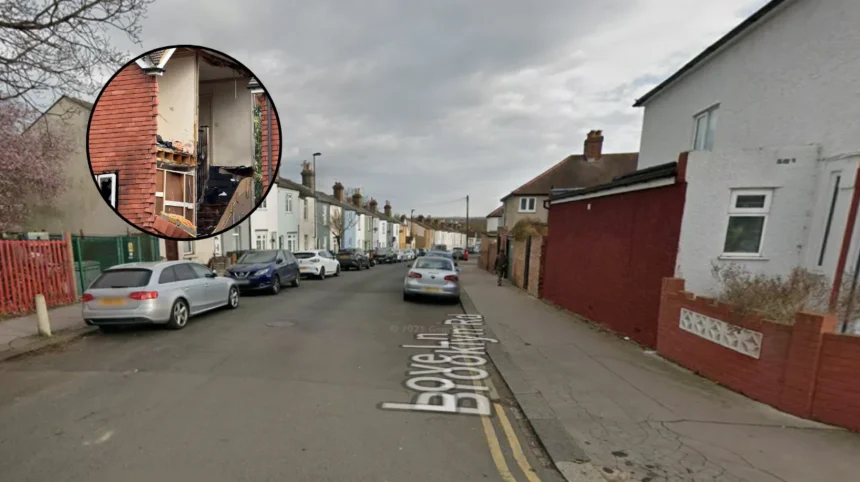
- The frontage of a vacant terraced property at 58 Love Lane in South Norwood, Croydon, suffered a partial collapse onto the public street.
- Temporary structural supports have been erected, but neighboring residents express ongoing anxiety regarding further masonry falls and long-term instability.
- Local residents Mitch and Vicky Gibbons, who live adjacent to the site with their young child, report that their calls to Croydon Council have gone without an adequate response.
- The property has reportedly sat empty and unmaintained for several years, deteriorating continuously prior to the physical masonry failure.
- Croydon Council maintains that the responsibility for structural repair lies with the private owner, though local authorities state they will explore available statutory powers to seek a long-term resolution.
South Norwood (South London News) August 18, 2026 – As reported by Harrison Galliven of MyLondon, local residents residing on Love Lane in South Norwood are raising urgent safety concerns following the structural failure and partial collapse of an adjacent, long-abandoned terraced property.
As detailed by Harrison Galliven of MyLondon, the brick frontage of 58 Love Lane collapsed directly onto the pavement below, prompting emergency interventions to install wooden structural props. Despite the arrival of temporary shoring devices, neighbours residing in the connected terraced houses state that the building remains a severe hazard and an eyesore that impacts the surrounding community.
What Triggered The Safety Concerns On Love Lane?
As reported by Harrison Galliven of MyLondon, local residents Vicky and Mitch Gibbons discovered that a major portion of the adjacent property’s exterior masonry had given way during the morning hours, spilling brickwork across the public footway.
As reported by Harrison Galliven of MyLondon, Vicky Gibbons stated that
“we came out in the morning and most of the front had collapsed.”
As quoted by Harrison Galliven of MyLondon, Vicky Gibbons further explained that
“I spent two hours trying to get the council’s dangerous structures team to come out.”
As noted by Harrison Galliven of MyLondon, Vicky and Mitch Gibbons moved into their neighbouring home in April 2024. At the time of their purchase, no exterior structural distress was immediately visible on the adjacent frontage of number 58. However, ongoing lack of maintenance on the long-empty building eventually resulted in visible cracking and the eventual collapse of the upper wall sections.
As stated by Harrison Galliven of MyLondon, Vicky Gibbons expressed frustration over the preventable nature of the incident, noting that “now the place is actually a danger,” and adding that
“it is annoying because this is exactly what I thought would happen.”
As described by Harrison Galliven of MyLondon, the couple, who live with their young child, share a continuous party wall with the damaged property. Their primary concern focuses on the structural integrity of the remaining wall sections, potential water ingress through the exposed areas, and the ongoing physical threat posed to pedestrians passing beneath the weakened timber props.
How Has Croydon Council Responded To The Structural Emergency?
As reported by Harrison Galliven of MyLondon, Croydon Council dispatched structural specialists following notification of the collapse, resulting in the immediate installation of heavy-duty timber supports against the building facade to prevent immediate collapse onto the street.
As stated by Harrison Galliven of MyLondon, a spokesperson for Croydon Council clarified that primary legal liability for maintaining, repairing, and securing private real estate rests directly with the registered owner of the property.
As quoted by Harrison Galliven of MyLondon, a council spokesperson stated that the local authority will “use every power available to us” to find a long-term solution for the site and force the owner to meet their statutory obligations.
As highlighted by Harrison Galliven of MyLondon, local authority procedures regarding vacant private properties typically involve issuing formal legal notices under the Building Act 1984 to compel private landowners to execute mandatory repairs. If owners fail to comply within specified timeframes, councils retain discretionary powers to carry out emergency works in default and seek full cost recovery through land charges placed against the property title.
Explore More Croydon News
Urban Nest Launches Supported Housing Venture in Croydon 2026
London Open House Festival 2026 Unveils Free Venue Tours In Croydon 2026
Background Of Private Property Neglect And Local Enforcement
The issue of long-term vacant and derelict residential buildings poses persistent administrative and safety challenges for local authorities across Greater London. Under UK property law, municipal councils do not hold immediate ownership or automatic repair obligations for privately owned housing stock, even when properties show visible signs of external decay.
Municipal enforcement teams generally rely on powers under Section 77 and Section 78 of the Building Act 1984 when dealing with unsafe structures. Section 77 allows a local authority to apply to a Magistrates’ Court for an order requiring the property owner to execute works to remove the danger or demolish the structure. Section 78 enables local authorities to take immediate, unannounced action to secure a building if the danger is deemed imminent, subsequently billing the private proprietor for all incurred costs.
In urban areas like Croydon, empty properties often become subject to long legal delays due to complex ownership structures, probate disputes, or financial insolvency on the part of registered titleholders. While councils possess legal mechanisms such as Compulsory Purchase Orders (CPOs) or Empty Dwelling Management Orders (EDMOs), these processes are frequently lengthy, resource-intensive, and subject to prolonged judicial oversight.
Prediction: How This Development Can Affect Local Residents And Property Owners
The partial collapse of 58 Love Lane and the subsequent legal and structural remedies will directly impact multiple local stakeholders across South Norwood:
- Immediate Neighbours: Residents sharing party walls or living adjacent to the affected structure face elevated risks of secondary damage, including damp transference, timber rot, and potential structural settlement caused by movement in the compromised masonry. Prolonged structural instability can also hinder neighbours’ ability to secure standard home insurance policies or obtain favorable terms.
- Local Pedestrians and Families: The presence of heavy timber propping on narrow residential footways creates temporary obstructions for pedestrians, pushchairs, and wheelchair users. Until permanent masonry restoration takes place, the risk of falling debris remains a ongoing public safety consideration for individuals utilizing the street.
- Area Property Values: Sustained structural blight on a residential street can negatively affect neighbourhood perception, potentially depressing local market valuations and prolonging the time properties remain listed for sale on the open market.
- Croydon Council Resources: Should the private property owner fail to fund permanent remediation, Croydon Council will need to allocate administrative and legal resources to pursue enforcement actions, direct repair orders, or eventual compulsory acquisition proceedings to safeguard the public realm.