Key Points
- A major burst water main on Coombe Lane has caused widespread water outages and low pressure across multiple postcodes in Croydon.
- The affected areas span the CR0 and CR2 postcode districts, impacting Croydon town centre, West Croydon, Addiscombe, Shirley, Addington, New Addington, Forestdale, South Croydon, Sanderstead, Selsdon, and parts of Waddon.
- Thames Water engineers have confirmed that the damage and required repairs are significantly more extensive than initially estimated.
- Temporary traffic management measures have been implemented along Coombe Lane while emergency repair works are underway.
- Local residents and businesses are experiencing ongoing disruptions, with supply restoration efforts continuing.
Croydon (South London News) November 3, 2026 — Residents and businesses across vast swathes of Croydon continue to face severe water disruptions following a major pipe burst that occurred on Monday, November 2. Water services across the borough have been either entirely cut off or reduced to low pressure after a critical water main failed on Coombe Lane.
Engineering teams deployed to the scene by Thames Water revealed that the damage to the infrastructure is considerably more extensive than initially assessed during early inspections. As a result, technical crews have been forced to expand the scope of emergency repair works, extending the timeframe required to restore normal service.
Traffic management protocols, including lane closures and temporary signals, have been put in place along Coombe Lane to allow heavy equipment and engineering personnel to safely access the underground network.
Which Postcode Areas and Neighbourhoods Are Currently Affected?
The service disruption has impacted two major postcode sectors within the borough, leaving thousands of properties without reliable access to mains water.
In the CR0 postcode region, supply issues have been documented across:
- Croydon town centre
- West Croydon
- Addiscombe
- Shirley
- Addington
- New Addington
- Forestdale
- Parts of Waddon
Simultaneously, the outage has extended deep into the neighboring CR2 postcode district. Disruption in this area has affected households and commercial properties throughout:
- South Croydon
- Sanderstead
- Selsdon
- Forestdale
- Portions of Addington
The dual-postcode impact highlights the strategic significance of the Coombe Lane main within the local distribution network, as the pressure drop has resonated across adjacent distribution zones.
What Actions Are Thames Water Engineers Taking to Resolve the Failure?
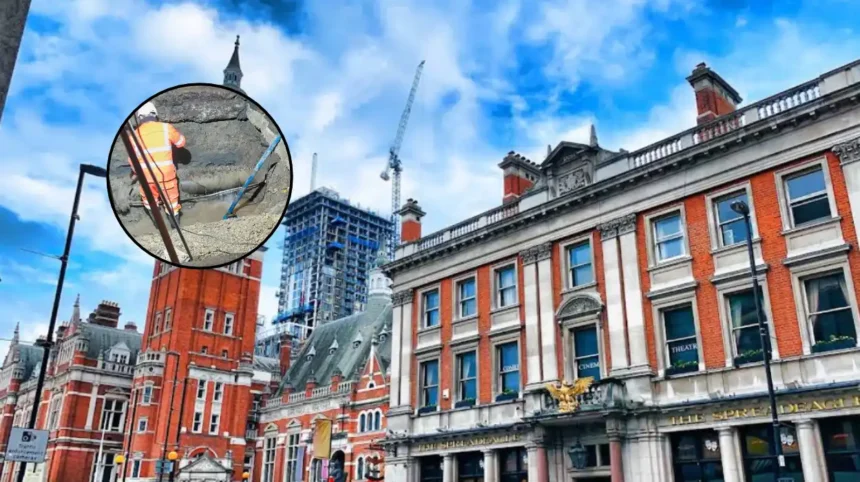
Thames Water response teams have been working continuously at the Coombe Lane site to isolate the damaged section of the main and divert network flow where feasible. Repair operations involve excavating the roadway to reach the subterranean pipe, assessing the structural integrity of the surrounding conduit, and replacing the fractured section of the main line.
Due to the scale of the subterranean break, engineers must carry out complex pressure control procedures before full flow can be safely restored to the network. Prematurely re-pressurising the system risks causing secondary ruptures in interconnected pipes.
Traffic controls on Coombe Lane are expected to remain in position until both the hydraulic repairs and the subsequent highway resurfacing works are fully completed.
Background to Croydon’s Water Infrastructure Challenges
The disruption on Coombe Lane is the latest in a series of municipal infrastructure challenges affecting South London’s water distribution system. The underground network serving the London Borough of Croydon relies on a complex matrix of trunk mains and local distribution pipes, portions of which date back several decades.
Trunk mains operating under high pressure are particularly susceptible to ground movement, seasonal temperature fluctuations, and material degradation over time. When a primary main fails, the resulting pressure drop frequently cascades across multiple pressure zones, causing widespread outages even in neighbourhoods located kilometres away from the physical site of the breach. Utilities operating across Greater London face continuous operational hurdles in balancing network maintenance against the demands of a growing urban population.
Predictions: How Will This Infrastructure Failure Affect Local Residents and Businesses?
The ongoing water supply failure carries immediate and medium-term consequences for the affected Croydon communities, impacting domestic routines, public services, and commercial operations across the CR0 and CR2 regions.
Impact on Households and Vulnerable Residents
For domestic consumers, prolonged periods of low pressure or complete loss of supply create significant logistical difficulties regarding sanitation, cooking, and basic hygiene. Vulnerable individuals, including the elderly and those with mobility limitations, face heightened risks during extended outages, often requiring targeted distribution of bottled water. Furthermore, once mains pressure returns, households may experience temporary water discoloration or trapped air within private plumbing systems, necessitating prolonged flushing of domestic taps before water is suitable for routine consumption.
Disruption to Local Businesses and Public Facilities
Commercial operations within Croydon town centre and surrounding suburban High Streets face immediate economic disruption. Food service establishments, cafes, and healthcare providers such as dental practices rely heavily on a continuous supply of clean running water to comply with statutory health and safety standards. Businesses operating without adequate water pressure may be forced to temporarily curtail services or close entirely, incurring direct revenue losses. Educational facilities and community hubs across the impacted postcodes also risk emergency closures if sanitation facilities cannot be maintained.
Transport and Highway Congestion
The implementation of traffic control measures on Coombe Lane will continue to affect local road transport networks. As a key transit link, restrictions along Coombe Lane inevitably cause traffic queuing, delays to local bus services, and congestion along alternative arterial routes throughout South Croydon. Motorists and public transport commuters should anticipate extended journey times until the repair footprint is cleared and full road capacity is restored.