Key Points
- Tyburn RWC Limited has submitted an early-stage proposal for a 100,000 square metre (sq m) data centre development located at Charlton Riverside in south-east London.
- The Luxembourg-based real estate firm has formally initiated the local planning process by requesting an Environmental Impact Assessment (EIA) Scoping Opinion.
- The proposed facility itself would occupy 75,000 sq m, with the broader 100,000 sq m site footprint incorporating ancillary infrastructure such as generator yards, a sub-station, and an office.
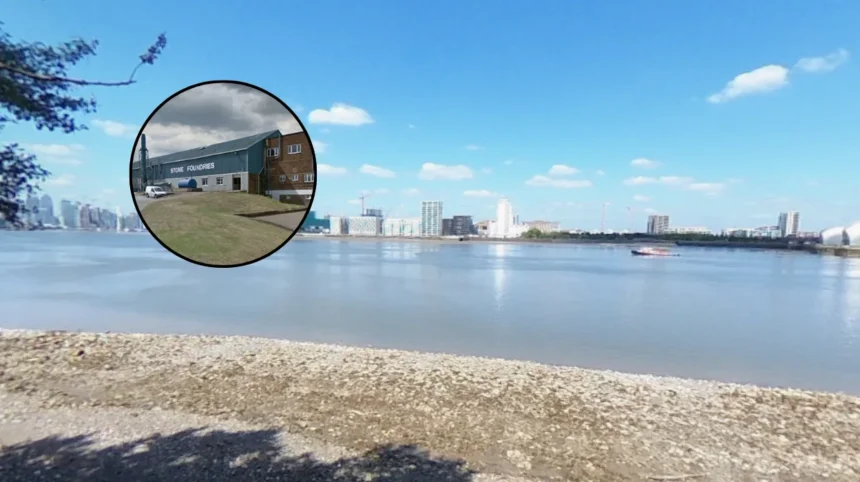
- The designated site comprises industrial plots positioned strategically between the River Thames and Woolwich Road.
- The scheme underscores the ongoing site development complexities, space constraints, and planning hurdles associated with delivering large-scale digital infrastructure within urban metropolitan zones.
Charlton Riverside (South London News) August 24, 2026 –Real estate firm Tyburn RWC Limited has formally submitted early-stage proposals to develop a major 100,000 square metre (sq m) data centre on industrial land situated at Charlton Riverside in south-east London. The Luxembourg-based property developer initiated the statutory planning procedure by filing a request for an Environmental Impact Assessment (EIA) Scoping Opinion with the local planning authority.
The comprehensive scheme contemplates a overall footprint of 100,000 sq m, within which the dedicated data centre facility itself will span approximately 75,000 sq m. To support the primary digital processing architecture, the proposed floorplan incorporates vital ancillary infrastructure, including dedicated generator yards, an on-site sub-station, and accompanying office accommodations.
The selected site consists of established industrial plots positioned between the south bank of the River Thames and Woolwich Road.
The submission of an EIA Scoping Opinion represents the baseline phase of large-scale urban development, designed to identify potential environmental effects—such as energy grid impact, noise emissions, visual impact, and local transport adjustments—before full architectural plans and formal planning applications are finalised for public consultation and council evaluation.
Explore More Charlton News
Tyburn RWC Unveils Huge Data Centre Scheme in Charlton Riverside 2026
GLI Proposes Massive Charlton Data Centre Development in Greenwich 2026
Background of the Particular Development
Charlton Riverside has long been designated as a key industrial and regeneration zone within the Royal Borough of Greenwich.
Historically dominated by heavy industry, manufacturing, and transport infrastructure along the River Thames, the corridor has increasingly become the focus of urban planning strategies aimed at balancing industrial retention with commercial modernization.
The push for data centre construction across Greater London reflects a broader national demand for digital infrastructure, driven by high-volume cloud computing, artificial intelligence workloads, and enterprise data storage requirements. However, securing viable parcels of land inside urban boundaries presents distinct challenges.
Developers must secure access to high-voltage power networks, adequate cooling resources, and resilient telecommunications connectivity while navigating strict local planning frameworks and environmental constraints.
Tyburn RWC Limited’s proposal highlights how industrial riverside plots—traditionally utilized for logistics or manufacturing—are increasingly being targeted for high-density digital infrastructure projects.
Prediction: How Will This Development Affect Local Stakeholders and the Digital Infrastructure Sector?
For residents in Charlton and the broader Royal Borough of Greenwich, the transition of industrial land into a major data centre will likely raise specific environmental and logistical considerations.
While data centres typically generate lower ongoing traffic volumes compared to distribution warehouses, the operational phase presents potential concerns regarding continuous ambient noise from cooling towers, local air quality considerations tied to backup diesel generators, and the visual integration of large-scale industrial structures near residential communities. Conversely, during construction, local trade supply chains may experience short-term economic activity.
For commercial real estate markets and industrial landowners, this proposal signifies continued demand for urban brownfield sites capable of supporting high-capacity data architecture.
If approved, the scheme may elevate land values for industrial plots along the Woolwich Road corridor and encourage similar technical redevelopments along the Thames estuary. It also places pressure on local utility providers to ensure the surrounding electrical grid can support heavy digital infrastructure demands without compromising local residential service stability.