Key Points
- Real estate firm Tyburn RWC Limited has submitted proposals for a massive 100,000-square-metre data centre in southeast London.
- The proposed development at Charlton Riverside spans a site equivalent in size to 14 football pitches.
- Located on industrial land between the River Thames and Woolwich Road, the site lies in close proximity to the Thames Barrier.
- The announcement arrives just weeks after separate plans were revealed to construct thousands of new homes in the same regeneration area.
- Local infrastructure demands, energy supply allocation, and environmental impacts remain primary focal points for community stakeholders.
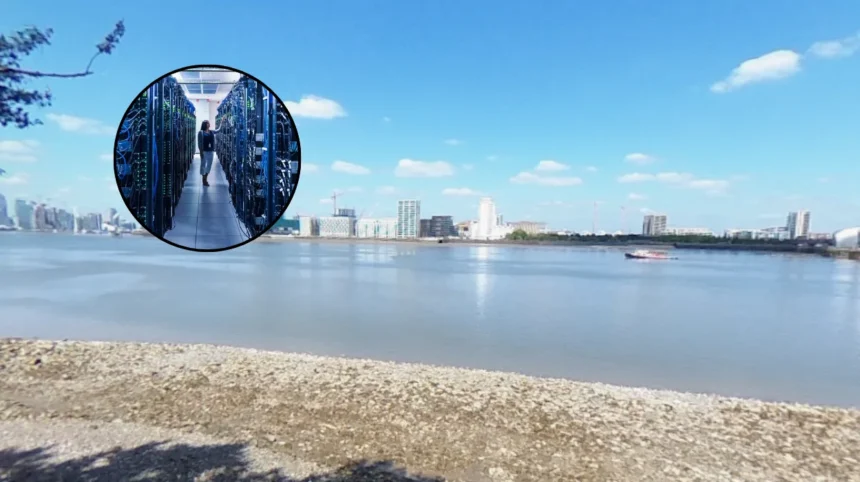
Charlton (South London News) August 22, 2026 – Proposals have been formally unveiled for a vast data centre development situated alongside the River Thames in southeast London. Luxembourg-based real estate business Tyburn RWC Limited has submitted plans to build a 100,000-square-metre facility on industrial land positioned between the River Thames and Woolwich Road, situated near the Thames Barrier. The scheme, spanning an footprint equivalent to 14 football pitches, represents a major commercial proposal for the Charlton Riverside sector, coming only weeks after separate major proposals were introduced to deliver thousands of new residential homes in the immediate vicinity.
What Are the Details of the Charlton Riverside Data Centre Proposal?
The scheme submitted by Tyburn RWC Limited focuses on transforming a key swath of industrial land within Greenwich borough. The 100,000-square-metre proposal aims to construct high-capacity digital infrastructure designed to meet the expanding processing and storage demands of the UK technology sector.
Positioned along the south bank of the Thames near Woolwich Road, the development occupies a strategic stretch of land near the Thames Barrier. The scale of the proposal, matching the area of 14 standard football pitches, makes it one of the largest single industrial data infrastructure applications put forward in inner London in recent years.
The development plan incorporates dedicated power supply structures, specialized cooling systems, and security perimeters required for commercial data warehousing. As reported by local planning correspondents covering London property developments, the submission outlines intentions to utilize the existing industrial zoning of the site while altering the physical footprint from traditional storage yards to high-density technological warehousing.
How Does This Proposal Fit Beside Planned Housing Schemes?
The unveil comes shortly after distinct outline planning notices were submitted for the broader Charlton Riverside masterplan area, which outline the construction of thousands of new homes. Local authority strategies for the Charlton Riverside Masterplan have long earmarked the riverfront for mixed-use regeneration, intending to balance commercial enterprise with high-density residential developments.
The arrival of a massive data centre proposal adjacent to designated residential parcels presents a direct interaction between industrial infrastructure and urban regeneration. Planning documents show that while the residential projects focus on public realm improvements, riverfront walkways, and high-density housing units, the Tyburn RWC Limited proposal retains an heavy industrial infrastructure purpose for the specified waterfront plot.
Local authority planners from the Royal Borough of Greenwich are set to review how the dual objectives of expanding digital infrastructure and delivering residential volume align within the designated masterplan boundaries.
Background of the Development
The Charlton Riverside area has historically operated as a primary industrial hub along the Thames in southeast London, dominated by heavy manufacturing, aggregate distribution, and logistics facilities. Over the past decade, the Royal Borough of Greenwich established overarching guidance to guide the transition of these industrial brownfield sites into a modernized, mixed-use urban district.
Data centre developments across the United Kingdom have experienced rapid growth driven by increased cloud computing usage, artificial intelligence model training, and national digital storage mandates. Greater London, particularly regions adjacent to subsea cable connectivity and power transmission networks along the Thames corridor, has become a core market for hyperscale and enterprise facility developers.
The submission by Luxembourg-registered Tyburn RWC Limited reflects wider international investment interest in London’s digital backbone infrastructure. However, high-density data centres require significant grid connections and continuous cooling resources, placing unique demands on localized utility infrastructure compared to standard industrial warehousing or residential blocks.
Prediction: How Will This Development Affect Local Residents and Businesses?
The proposed data centre will directly impact several key demographic groups across southeast London, particularly local residents, surrounding business operators, and local authority planning bodies.
For local residents in Charlton and Woolwich, the project presents a distinct contrast to the housing developments proposed nearby. Unlike residential or traditional commercial projects, data centres typically generate low level direct employment once construction concludes, operating with minimal permanent site staff. Residents may observe minimal ongoing traffic compared to traditional logistics distribution yards; however, construction phases will involve increased heavy vehicle movements along Woolwich Road and nearby arterial routes. Additionally, local communities are likely to scrutinize potential noise output from continuous cooling plant operations and ambient architectural impacts along the Thames waterfront.
For nearby commercial businesses and the broader London economy, the facility represents an expansion of core digital capacity. Local service contractors and specialized tech infrastructure providers may gain commercial opportunities during both construction and operational maintenance phases. Conversely, the high power consumption typical of a 100,000-square-metre data facility will require substantial regional energy grid capacity, focusing local business attention on how regional power networks manage supply distribution between heavy industrial installations and new housing developments across Charlton Riverside.