Key Points
- Lift Repair Work Begins: Work has officially commenced on repairing the broken north lift at the Woolwich Foot Tunnel after four years of operational downtime.
- Funding Allocation: The total cost for the lift and associated structural repair programme is £217,000, split equally as a £108,500 contribution from the Royal Borough of Greenwich and Newham Council.
- Protracted Inter-Council Delays: Negotiations between Greenwich and Newham councils were stalled for years over cost-sharing disputes, complex manufacturing requirements for bespoke parts, and sourcing constraints for a structure over a century old.
- Impact on Local Commuters: The broken lift forced cyclists, disabled residents, elderly citizens, and parents with pushchairs to carry heavy loads up and down stairs or take prolonged detours.
- High Housing Development Demand: The prolonged outage occurred despite significant housing growth and ongoing property development projects immediately adjacent to both the northern and southern entrances of the tunnel.
Woolwich (South London News) September 17, 2026 — Greenwich Council, Murky Depths, September 17, 2026 — Repair work has finally commenced on the Woolwich Foot Tunnel’s long-disrupted lift infrastructure following four years of complete inactivity. While major river crossings in the west of London have captured public attention and significant media coverage during their respective structural crises, the essential pedestrian link beneath the Thames in East London suffered years of neglect despite requiring a modest fraction of the capital expenditure needed for larger bridge projects.
- Key Points
- Why did it take four years to commence repair work on the Woolwich Foot Tunnel lifts?
- How have community campaign groups responded to the delays?
- What is the background of the Woolwich Foot Tunnel development?
- What is the prediction for how this development will affect local residents and businesses?
As reported by local media analyst Murky Depths, the total price tag attached to the repairs stands at £217,000—a figure requiring just £108,500 from each of the two local authorities responsible for the infrastructure. The four-year delay over a sum that is comparatively small in public infrastructure terms has drawn sharp criticism from local residents, accessibility advocates, and community campaign groups who kept sustained pressure on municipal leaders throughout the outage.
Why did it take four years to commence repair work on the Woolwich Foot Tunnel lifts?
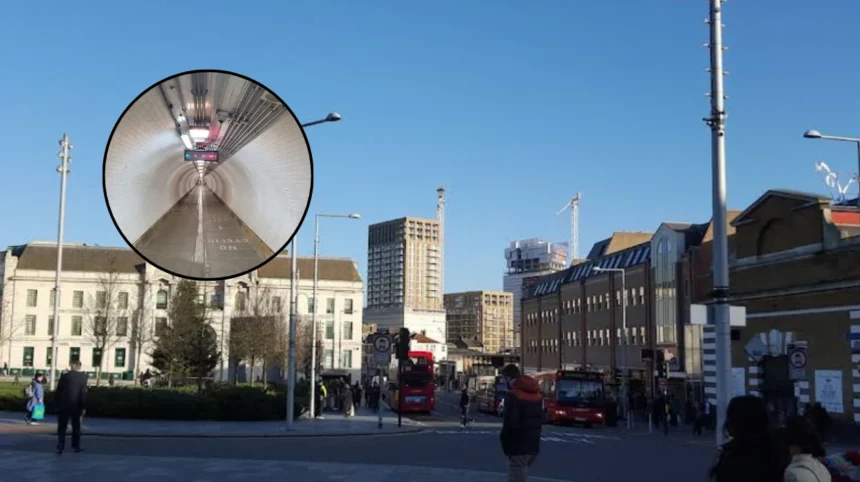
The northern lift of the Woolwich Foot Tunnel, which connects Old Woolwich in the Royal Borough of Greenwich on the south bank of the River Thames to North Woolwich in the London Borough of Newham on the north side, has been out of service since August 2022. The disruption initially stemmed from acts of vandalism, which were further compounded by systemic mechanical failures within the century-old lift mechanism.
The delay in securing repairs was driven by prolonged inter-council negotiations regarding cost allocations and complex procurement requirements. As reported by Nick Clark of Newham Voices, Labour Councillor Calum O’Byrne Mulligan, the cabinet member responsible for transport at Greenwich Council, stated that
“The structure is well over 100 years old, so it requires bespoke parts which have taken some time to manufacture.”
O’Byrne Mulligan noted that sourcing these custom components meant
“it has taken longer for the works to start than we, Newham, and our residents had hoped would be the case.”
Disagreements over funding responsibilities between the two local authorities also slowed progress significantly. As documented by Joe Coughlan of MyLondon, historic disputes over financial contributions created friction between Greenwich Council—which is directly responsible for managing the tunnel—and Newham Council. Former Greenwich Cabinet Member for Transport, Labour Councillor Averil Lekau, previously indicated that repairs were put on hold due to delays in reaching a cost-sharing consensus. Newham Council countered these assertions, stating that it had consistently honoured its contractual commitment to pay its yearly maintenance contribution towards the running, cleaning, and upkeep of the tunnel.
A formal funding model was eventually finalized, dividing the £217,000 structural repair cost equally between the two boroughs. As reported by Nick Clark of Newham Voices, Labour Councillor Zulfiqar Ali, Newham Council’s cabinet member for finance, confirmed that Newham was advised of additional part replacement necessities late in 2024 and subsequently “secured funding for improvements to get the lifts, fire systems, CCTV and lighting upgrades completed,” allocating £120,000 toward part replacements on top of its annual £125,000 operational contribution.
How have community campaign groups responded to the delays?
Grassroots organizations and civic action groups have relentlessly pressed both local councils to resolve the impasse. Groups such as Escalate London and the Greenwich-based campaign group Lifts Now maintained public scrutiny on council leadership, pointing out the disproportionate burden the out-of-service lift placed on vulnerable road users, active travel commuters, and local workers.
As reported by Local Democracy Reporting Service journalist Nick Clark, Nathan Budden of the Lifts Now campaign highlighted the direct personal and practical impact of the four-year delay. Budden stated that the non-functioning lift “stops me from cycling a lot of places because I’ve got a longstanding shoulder injury so I can’t carry my bike up the stairs on the other side.” He further noted that alternative options were often unviable:
“I can’t always rely on the boat either because of the time of day or the weather, and it more than triples the amount of time,”
while peak-time restrictions prevent cyclists from bringing bicycles onto the Docklands Light Railway (DLR).
Budden also revealed that campaign outreach at the nearby Tate & Lyle factory in Silvertown showed that “half of the people we spoke to were all commuting to work via the tunnel,” adding that those workers had “all been frustrated by the lack of action on it.” Community campaigners have consistently questioned why a vital piece of transport infrastructure serving hundreds of thousands of annual journeys was left in disrepair over a sum as small as £217,000, particularly given the extensive residential redevelopment taking place around both tunnel entrances.
What is the background of the Woolwich Foot Tunnel development?
The Woolwich Foot Tunnel was formally opened in 1912 to provide thousands of industrial and dock workers with a reliable, all-weather walking route between residential areas on the south bank of the Thames and the expanding docks and factories on the north bank in Newham. Designed by Sir Maurice Fitzmaurice, the tunnel extends 504 metres across the river bed and sits approximately 3 metres below the river surface.
Under historic administrative arrangements, management and operational maintenance of the foot tunnel fall to Greenwich Council, while Newham Council shares 50 per cent of the financial burden for capital works and routine maintenance. An estimated 300,000 pedestrians and cyclists use the crossing every year.
In addition to structural aging, the tunnel’s lifts have experienced recurring operational breakdowns due to passenger overload, vandalism, and door sensors being tripped by debris or forced entry. Similar lift reliability issues have plagued the sister crossing, the Greenwich Foot Tunnel, which connects Cutty Sark to Island Gardens and is jointly managed by Greenwich and Tower Hamlets councils. Requests by local campaigners for Transport for London (TfL) to adopt control of both foot tunnels to ensure centralized, professional oversight have so far been declined by the regional transport authority, though a joint tri-borough working group comprising Greenwich, Newham, and Tower Hamlets councils was subsequently established to explore long-term regeneration options for both historical river crossings.
What is the prediction for how this development will affect local residents and businesses?
The commencement of repair works and the eventual restoration of step-free access across the Woolwich Foot Tunnel is projected to yield immediate positive benefits for a wide demographic of East and South East London users, while directly addressing accessibility inequalities that have persisted since 2022.
- Mobility-Impaired and Elderly Residents: Wheelchair users, individuals with reduced mobility, and parents with prams or pushchairs who were effectively cut off from using the tunnel will regain direct, step-free access across the River Thames. This eliminates the need for costly, time-consuming detours via public transport or the Woolwich Ferry.
- Active Commuters and Cyclists: Pedestrians and bicycle commuters travelling between Woolwich, Silvertown, and North Woolwich will experience significantly shorter travel times. The restoration of lift functionality allows shift workers—such as those employed at industrial hubs like the Tate & Lyle refinery—to commute safely and efficiently without having to manually carry heavy bicycles up and down hundreds of stairs.
- Local Property Developments and Businesses: Both Woolwich and North Woolwich have seen substantial high-density housing developments constructed in close proximity to the tunnel portals. The return of fully functional infrastructure will enhance property connectivity, boost footfall for local retail and food businesses surrounding the tunnel entrances, and support the integration of newly built residential communities on both banks of the river.