Key Points
- Location & Event: Kingston University in south London is hosting the Archive of Retro Computing (ARC), an exhibition open to the public showcasing over 35 years of video game and computing history.
- Exhibition Scale: The exhibit features more than 65 retro personal computers and video game consoles spanning from the mid-1970s cartridge era to early-2000s systems like the original Xbox and PlayStation.
- Key Figure: The archive was created and curated by Paul Neve, the course leader for undergraduate computer science at Kingston University.
- Curator’s Background: Neve’s personal journey in technology began with the Atari 2600 and expanded through 8-bit home computers like the Sinclair ZX81, ZX Spectrum, and Commodore 64, which ultimately influenced his academic career.
- Memorable Highlights: Personal memories connected to the exhibition include Neve’s early purchase of a ZX Spectrum at WHSmith and his fondness for Matthew Smith’s 1983 classic platforming title, Manic Miner.
- Educational Purpose: ARC serves as a hands-on learning resource for a new generation of students, preserving foundational computing hardware and software that paved the way for modern digital technology.
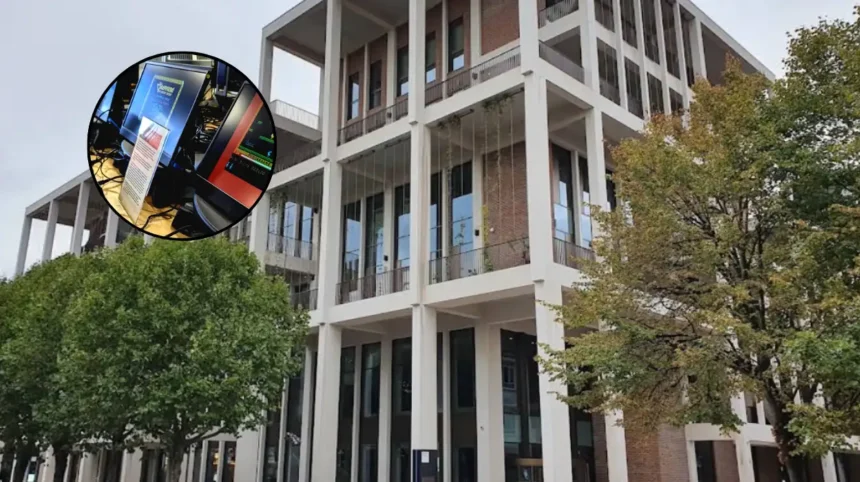
Kingston (South London News) August 7, 2026 — Wander the winding track to Kingston University in south London over the next week and you will find a little pocket of gaming history awaiting there. The Archive of Retro Computing (ARC) is free to explore and features over 65 retro personal computers and gaming consoles, some familiar and others considerably less so. It is an exhibit stretching from the mid-1970s and the advent of video game cartridges to significantly more modern gaming consoles, charting the history of personal computing across an incredibly rich three decades.
- Key Points
- What Is the Archive of Retro Computing and How Is It Set Up at Kingston University?
- Who Is Paul Neve and What Inspired Him to Preserve Early Computer Systems?
- Background of the Archive of Retro Computing Development
- Prediction: How Will This Development Affect Computer Science Students and the Local Community?
Paul Neve, the man behind ARC, is the course leader for undergraduate computer science at London’s Kingston University. Ahead of this year’s showcase, Neve sat against a corkboard backdrop festooned with nostalgic magazine advertisements. “The heart of a system that grows with you!”, exclaimed one spread for the ZX81; “Why do girls like Atari Computer Camps?”, pondered another.
Neve and many of the visitors attending the exhibition are children of what Neve calls the “glory days” of computing. His own journey began with the Atari 2600, and he would later graduate to the 8-bit era of personal computers — the Sinclair Spectrums and Commodore 64s — charting a path through the likes of the ZX81, the Spectrum 128, the Spectrum +2, the Atari ST, and eventually towards more recent consoles like the PlayStation 1 and original Xbox. “I suppose growing up in that era,” Neve stated, “it’s why I do what I do”.
As Neve reminisced, he pinpointed the Sinclair Spectrum as his “first true love”, vividly recalling having “a face like a smacked backside” after taking his Christmas and birthday savings to WHSmith in his youth, only to discover he was £17.29 short of the £49.99 asking price — at which point his father took pity on him and covered the difference. As for his favourite game, that remains designer Matthew Smith’s legendary platformer Manic Miner, even all these years on. “Maybe I’m just a dinosaur, but I find it very difficult to put in the investment of time for modern titles”, Neve noted. Yet despite Neve’s obvious passion for the computer industry’s pioneering years, the Archive of Retro Computing remains a relatively new collection established to serve both the public and Kingston’s academic community.
What Is the Archive of Retro Computing and How Is It Set Up at Kingston University?
The Archive of Retro Computing was established at Kingston University as a physical repository for early microcomputers, video game consoles, and historic computing peripheral hardware. Designed to showcase the rapid trajectory of consumer technology, the exhibition brings together over 65 working pieces of hardware representing every major era of early home computing.
Exhibits range from early dedicated pong-style units and second-generation cartridge machines like the Atari 2600 to the home computer revolution of the late 1970s and 1980s. Systems such as the Sinclair ZX81, Sinclair ZX Spectrum series (including the 128 and +2 variants), Commodore 64, and Atari ST are placed alongside later optical disc-based units including the Sony PlayStation and Microsoft Xbox.
Unlike standard museum displays behind glass cases, the ARC setup emphasizes hands-on interaction, allowing students and visitors to experience the tactile feel of physical keyboards, joysticks, cassette decks, and cathode-ray tube (CRT) displays that defined early interactive software.
Who Is Paul Neve and What Inspired Him to Preserve Early Computer Systems?
Paul Neve serves as the course leader for undergraduate computer science at Kingston University in south London. His career in computer science education was largely shaped by his early exposure to microcomputing during the late 1970s and 1980s.
Growing up during the rapid expansion of the personal computer market, Neve’s engagement with technology started on early domestic consoles before transitioning to programmable 8-bit home systems. His personal affection for hardware like the Sinclair Spectrum and early gaming titles like Manic Miner fostered a lifelong commitment to software development and computer engineering education.
Recognizing that younger generations of computer science students often lack direct exposure to the fundamental architecture and constraints of early microprocessors, Neve established ARC to bridge the gap between historical computing engineering and contemporary software development practice.
Background of the Archive of Retro Computing Development
The emergence of retro computing archives like the one at Kingston University reflects a broader movement within higher education and cultural preservation to safeguard early digital heritage. During the late 1970s and early 1980s, the home computing explosion transformed the United Kingdom into a global hub for software micro-development. The affordable availability of microcomputers such as the Sinclair ZX81, ZX Spectrum, and BBC Micro enabled a generation of self-taught programmers to build commercial software directly from home.
As computing technology accelerated into multi-core processing, cloud architectures, and complex graphics pipelines, the physical hardware of the 8-bit and 16-bit eras faced widespread obsolescence. Much of this historical hardware was discarded or left to deteriorate, leading to a risk of losing original code environments, physical media formats (such as tape cassettes and floppy disks), and custom microchip architecture context.
In response, academic institutions across the United Kingdom began recognizing the pedagogical value of early microcomputers. The Archive of Retro Computing was created at Kingston University to halt this loss of technical history, serving both as an archival museum and an interactive laboratory where foundational computer science principles — such as direct memory allocation, low-level assembly language programming, and hardware constraints — can be studied directly on legacy hardware.
Explore More Local South London News
Rotherhithe Street Claimed as London’s Longest Continuous Road, South London 2026
70 Firefighters Tackle Five-Hectare Woolwich Grass Fire Near Hospital, Woolwich 2026
Prediction: How Will This Development Affect Computer Science Students and the Local Community?
The ongoing operation and public showcase of the Archive of Retro Computing at Kingston University will yield significant long-term technical and educational benefits for multiple key groups:
Impact on Computer Science Students
Undergraduate students at Kingston University will gain direct pedagogical advantages from working alongside legacy hardware. Modern software engineering frequently relies on multiple layers of abstraction, masking how code directly interacts with central processing units and system memory. By interacting with 8-bit and 16-bit systems featuring limited memory footprints (such as the 1KB memory limits of early Sinclair machines), students develop a clearer understanding of processing efficiency, resource optimization, and low-level system design. This foundational knowledge strengthens their debugging, hardware interfacing, and system-level programming skills for contemporary applications.
Impact on the South London Community and Technology Historians
For the broader community, alumni, and local residents in south London, the free public archive offers an accessible cultural bridge between generations. Older demographics gain an opportunity to reconnect with the historical technology that shaped their early technological lives, while younger visitors experience the tangible roots of modern digital entertainment. Furthermore, digital preservationists and tech historians gain a dedicated local hub in south London to document, maintain, and research rare software and hardware configurations that might otherwise disappear due to media decay and component breakdown.