Key Points
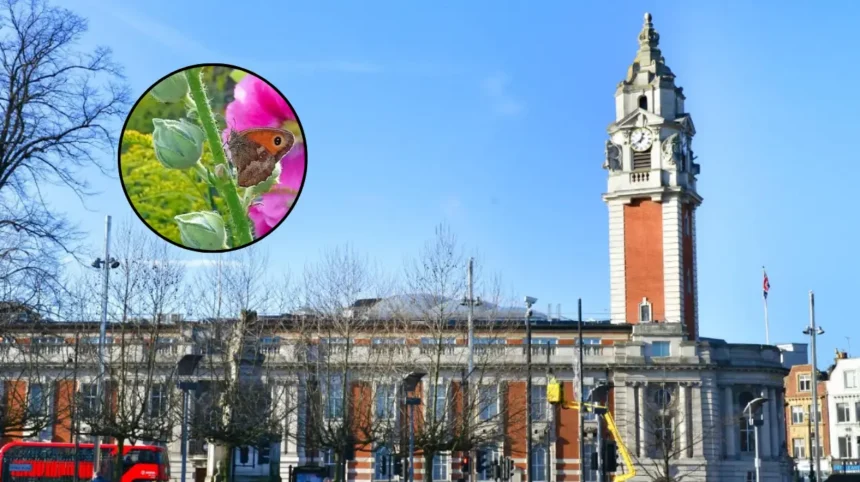
- Lambeth Town Hall has officially signed the Butterfly Conservation pledge, becoming the first London borough to attain ‘butterfly friendly council’ status.
- The triennial initiative aims to arrest severe population declines in butterflies, moths, and wider pollinator species across urban environments.
- Municipal operational changes include a total ban on pesticides in parks, the creation of wildflower habitats via ‘Lambeth Bee Roads’, and expanded long grass areas on housing estates.
- Civic leaders and conservation bodies are calling on local residents, school communities, and volunteer groups to support borough-wide habitat management over the next three years.
Lambeth (South London News) October 2, 2026 — Lambeth Council has officially become the first local authority in Greater London to sign a formal pledge committing to become a recognised ‘butterfly friendly council’. Undertaken in partnership with the national charity Butterfly Conservation, the agreement binds the Town Hall executive to a three-year strategic framework designed to safeguard declining populations of butterflies, moths, and other essential pollinating insects across the borough.
The pledge directly responds to what conservation experts have termed a national “Butterfly Emergency”, marked by dramatic contractions in insect numbers due to habitat destruction, urbanisation, and chemical management. Under the newly signed framework, the local authority will alter its grounds maintenance operational protocols across all publicly managed land, including municipal parks, highway verges, housing estate grounds, and educational sites.
Specific measures outlined within the municipal commitment focus on habitat restoration and environmental toxicity reduction. The council has pledged to eliminate pesticide usage across its public parks while accelerating habitat creation schemes. Central to this strategy is the expansion of unmown, long-grass meadow areas and the continuation of the ‘Lambeth Bee Roads’ initiative, which converts standard verges into wildflower-rich corridors.
In an official public statement regarding the signing, Councillor Ciara Alleyne, Deputy Leader and Cabinet Member for Climate Emergency and Future Generations, noted:
“Butterflies and moths are in serious decline, and in Lambeth, we’re taking practical steps to help them recover. I’m so pleased we are leading the way as the first London borough to pledge to such a worthwhile cause.”
Detailing the operational actions already underway across the municipality, Councillor Alleyne stated:
“We have already removed pesticides from use in our parks and we have a Lambeth Pollinator Action Plan. We are also changing how public green spaces are maintained, including increasing areas of long grass meadow on housing estates, highways, schools, parks and open spaces, and creating more wildflower-rich habitats through projects such as Lambeth Bee Roads.”
Acknowledging the scope of work required over the three-year timeline, Councillor Alleyne added:
“We have a few more key areas to address, but I have no doubt that with the support of our brilliant residents, volunteers, partners and community groups we will make this happen.”
Welcoming the local authority’s formal commitment, Simon Saville, Chair of Butterfly Conservation, stated:
“We are absolutely delighted that Lambeth has become the first London Borough to take our Butterfly-Friendly pledge.”
Highlighting the potential impact of local government action on national ecological trends, Mr Saville stated:
“With so many of our beautiful butterflies and moths in decline across the UK, councils have a huge opportunity to help turn the tide by managing public spaces differently and updating policies.”
Evaluating the borough’s existing green infrastructure, Mr Saville added:
“Lambeth’s parks are already good for butterflies, and taking a few simple steps – such as managing more spaces for wildlife – will make them even better. We hope that people across the borough and beyond will be inspired by the council’s Butterfly-Friendly pledge to join us on this exciting journey.”
Background of the particular development
The pledge signed by Lambeth Council is rooted in data published by Butterfly Conservation and environmental monitoring groups, which indicates that 80 per cent of UK butterfly species have declined in abundance, distribution, or both since the 1970s. Urban centres like Greater London present significant challenges for insect survival due to severe habitat fragmentation, high levels of concrete cover, and historic reliance on chemical herbicides and insecticides for vegetation control.
Prior to signing the national pledge, Lambeth Council had established initial environmental policies through its local ‘Lambeth Pollinator Action Plan’. This framework sought to address biodiversity losses within urban settings by identifying critical corridors for wildlife travel across south London. The declaration of a ‘Butterfly Emergency’ by conservation authorities in recent years highlighted the need for formalized, measurable pledges from public landholders to modify traditional groundskeeping practices. The ‘Butterfly Friendly Council’ initiative was established to provide local authorities with structured benchmarks, focusing on chemical reduction, altered mowing schedules, and active rewilding within municipal boundaries.
Prediction: How this development can affect London residents and local ecosystems
The adoption of the ‘butterfly friendly council’ framework is expected to alter both the physical environment and civic responsibilities for residents living within the London Borough of Lambeth, with potential wider implications for the capital.
- Visual and Functional Alterations to Public Spaces: Residents will observe noticeable changes in the maintenance of local parks, residential estate grounds, and roadside verges. Reduced mowing frequencies will result in higher grass and native wild flora growth, changing the standard aesthetic of urban public spaces toward rewilded natural habitats.
- Health and Environmental Quality Improvements: The formal elimination of chemical pesticides in parks and reduction on public land minimizes chemical exposures for children, pets, and local wildlife, contributing to cleaner local soil and water runoff.
- Community Engagement and Local Land Management: The council’s reliance on volunteer and community group support means local residents, tenant associations, and schools will likely be called upon to participate in citizen-science monitoring, wildflower planting, and habitat maintenance schemes.
- Precedent for Greater London Local Authorities: As the inaugural borough to sign the pledge, Lambeth’s operational framework may serve as a template for neighboring London councils, potentially leading to connected, cross-borough wildlife corridors that enhance insect biodiversity across the wider metropolitan region.